

As the legislature reviews a special drone budget this week, opposition lawmakers yesterday vowed to work out a drone development bill funded from the annual budget, amid concerns over funding delays and the constitutionality of the proposal.
The Chinese Nationalist Party (KMT) and Taiwan People’s Party (TPP) made the announcement a day after Legislative Speaker Han Kuo-yu (韓國瑜) opened interparty negotiations over funding the initiative to develop indigenous drones.
The Democratic Progressive Party’s (DPP) NT$210 billion (US$6.6 billion) drone bill is a special budget act, overseen by the Ministry of National Defense (MND), funding the acquisition of coastal surveillance drones, coastal attack drones, uncrewed one-way strike boats and more.
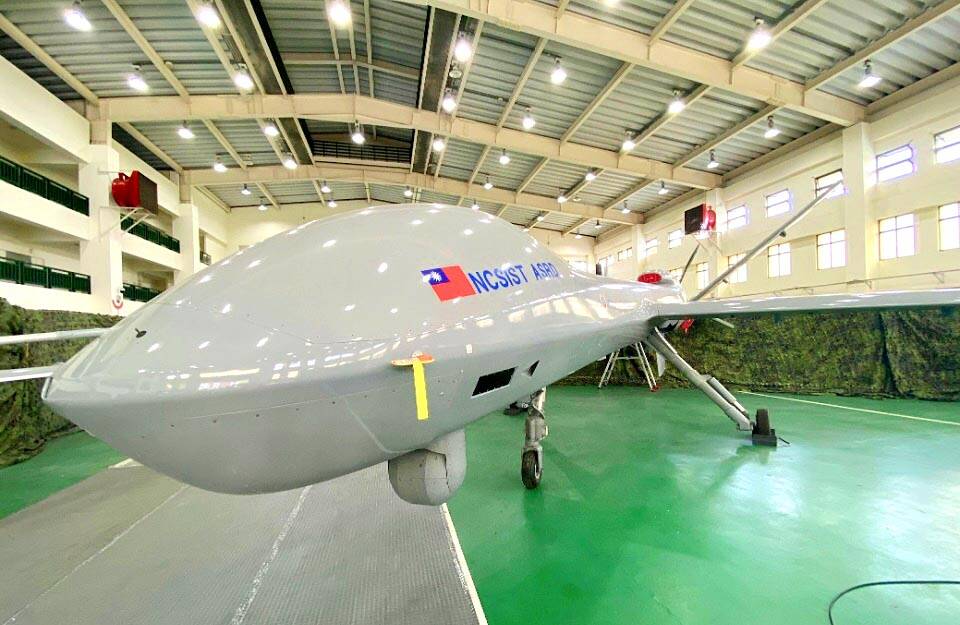
Photo: Huang Hsu-lei, Taipei Times
The government intended to implement its drone programs this year.
In contrast, the KMT and TPP proposals say that any funding for drones must draw from the annual government budget and that the Ministry of Economic Affairs must be the main agency in charge.
The KMT listed an NT$240 billion allocation for drones, to be doled out in increments of NT$40 billion a year from the annual budget over six years.
The TPP proposal included no funding sources and explicitly refused to fund uncrewed ground and surface vehicles.
Although the KMT’s version says that it should go into effect within six months of the legislation’s passage, the timetable is problematic, as the opposition could pass the budget no sooner than Friday.
This would delay the implementation of drone development by 17 months compared with the government’s version.
Moreover, it is unclear how the opposition’s drone bill could fit into the regular budget for this year or next year, as the budgets have already been proposed, meaning the government would not be able to spend money on drones until 2028.
Taiwan could seek to fund drones using supplementary budgets, but according to Article 79 of the Budget Act (預算法), only the Executive Yuan is authorized to make such proposals, casting the opposition bills’ legality into doubt.
Cabinet officials have maintained that the KMT and TPP had no authority to write a draft act for drones to begin with, as Article 70 of the Constitution forbids the legislature from adding items to the annual budget.
The opposition’s drone bills would not fund the three uncrewed systems the Taiwanese armed forces had planned to buy, MND Comptroller Bureau head Hsieh Chi-hsien (謝其賢) said on Thursday last week.
Although the opposition cited the passage on Aug. 14 of a NT$19.2 billion drone budget as evidence of their support for national defense, these funds were earmarked for government purchases of unarmed drones and industry subsidies, not uncrewed weapon systems.
A defense official commented on condition of anonymity that the acquisition of 210,000 surveillance drones, one-way strike drones and uncrewed kamikaze boats is critical to Taiwan’s defense.
The uncrewed platforms are the lynchpin of the armed forces’ asymmetric warfare concept, which envisions using drone swarms, rocket artillery and long-range precision strikes to counter the Chinese Liberation Army Navy’s (PLAN) vessels, they said.
Saturation strikes, with drones acting both as spotters and strike platforms, would be key to the defenders’ ability to overwhelm the PLAN’s air defense and hit amphibious assault ships, troop transports and supply vessels, they said.
The defense concept conforms to the “hellscape” strategy first coined by the US Indo-Pacific Command’s then-commander Admiral Samuel Paparo in 2024, the official said.
Uncrewed aerial vehicles are expected to play an important forward observer role, guiding strikes from direct and indirect fire weapons, and the Marine Corps is already trading armor and artillery battalions for drones, they added.
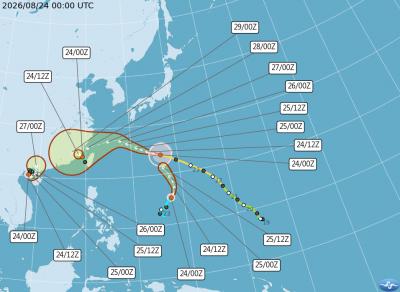
Heavy rain is expected to continue across much of Taiwan through tomorrow morning, with torrential rainfall likely in southern and southeastern areas due to strong southwesterly winds and multiple weather systems in the area, the Central Weather Administration (CWA) said today. The CWA issued a warning today for torrential or extremely torrential rain in Tainan, Kaohsiung, Pingtung County and Taitung County, and for extremely heavy to torrential rain in Chiayi County, Hualien County and on the Hengchun Peninsula (恆春半島). Heavy to extremely heavy rain is also expected through tomorrow in Changhua County, Yunlin County, Chiayi City, Yilan County, Green Island (綠島), Penghu
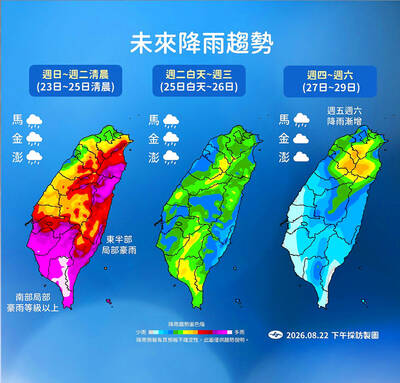
CYCLONIC SEASON: Heavy rains and strong winds are lashing southern and central Taiwan as a clutch of tropical storm events form around Taiwan and in the Pacific The Central Weather Administration (CWA) yesterday forecast heavy rain for southern Taiwan today, saying tropical depression TD22 would strengthen southwesterly winds and bring more downpours. The CWA said that in addition to torrential rain in southern Taiwan yesterday, mountainous areas in central and southeastern Taiwan also saw heavy rainfall, while northern and northeastern mountain areas were hit by short-duration downpours amid intense afternoon thunderstorms. Tainan had experienced continuous rain since Friday night, with Yongkang District (永康) recording more than 132mm of rainfall in three hours and Rende District (仁德) nearly 100mm over the same period, the CWA said. By 3:20pm yesterday, Pingtung County’s
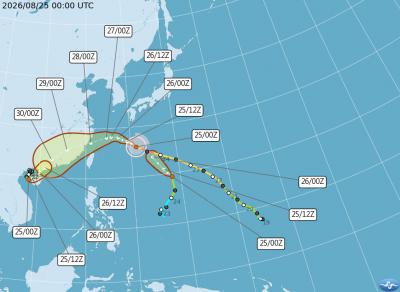
Typhoon Saudel has shown signs of weakening but is still expected to affect Taiwan when it comes closest to the nation on Friday, the Central Weather Administration (CWA) said today. The radius of Saudel shrank to about 220km as of 8am today from 250km a day earlier, and its maximum sustained winds were down to 155kph from 184kph previously, the weather agency said. As of 8am, Typhoon Saudel was 980km east of Taipei, moving west-northwest at 18kph, it said. Under the influence of a Pacific high pressure system, the storm is moving northward, meaning it is less likely to make landfall in Taiwan,
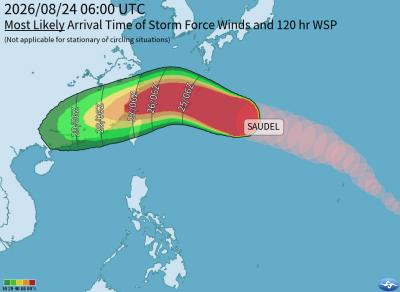
Typhoon Saudel is expected to pass closest to Taiwan on Thursday and Friday as it moves over waters to the north, having already progressed to a strong typhoon, the Central Weather Administration (CWA) said today. The typhoon is not expected to make landfall in Taiwan, but its path remains unclear, it said. Saudel strengthened into a strong moderate typhoon this afternoon with sustained winds near the center reaching 183.6kph, although it is expected to weaken somewhat by Wednesday, it added. Storm-force winds are expected to affect northern Taiwan and Lienchiang County, while northern Taiwan and mountainous areas of central Taiwan should


 RSS
RSS