

Environmental advocates on Wednesday urged the government to raise corporate carbon reduction targets and prioritize utilization of carbon revenue to support vulnerable groups rather than to subsidize businesses.
Civic groups and experts were invited to a public hearing held by the Legislative Yuan’s Social Welfare and Environmental Hygiene Committee on the Ministry of Environment’s plans to revise carbon regulations to ensure procedural fairness, facilitate industrial transformation and reduce carbon emissions.
As of May, the government had collected NT$4.97 billion (US$155.1 million) in carbon fees from the 461 factories (240 companies) since the scheme was introduced last year.
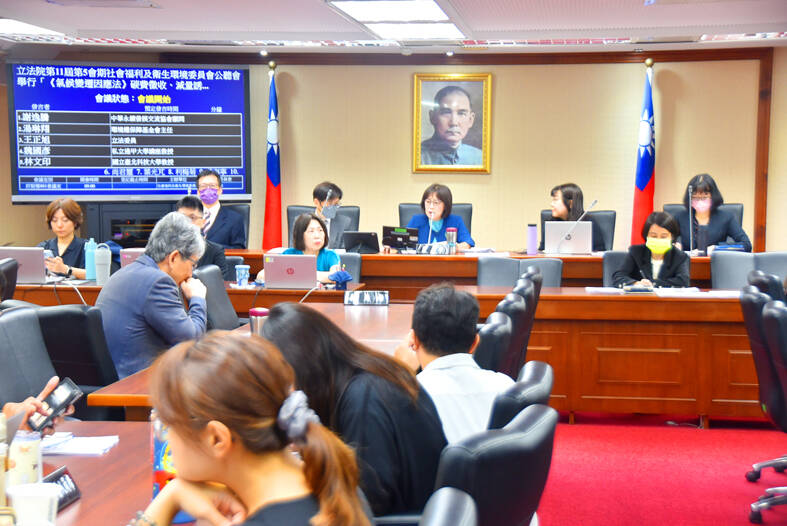
Photo: Wu Po-hsuan, Taipei Times
Democratic Progressive Party (DPP) Legislator Lin Yueh-chin (林月琴) said a system should be created to ensure the carbon proceeds would be used for groups most affected by pollution and climate change.
Newborns, pregnant women, people with chronic respiratory illnesses and elderly people should benefit from government revenue generated by the fees, she said.
DPP Legislator Wang Cheng-hsu (王正旭) urged the Ministry of Environment and the Ministry of Labor to collaborate on using the funds to help workers whose livelihoods were negatively impacted by the carbon fees.
Chinese Nationalist Party (KMT) Legislator Wang Yu-min (王育敏) said that regulators might need to strengthen the mechanisms utilized to verify commercial entities’ claimed reductions in their carbon footprint.
Businesses that did not follow through on their sustainability programs should not be allowed to benefit from carbon fee deductibles, she said.
In 2024, the Earth’s average temperature increased by more than 1.5°C compared with pre-industrial levels, crossing the projected inflection point for a global climate catastrophe, said Wei Kuo-yen (魏國彥), former minister of the Environmental Protection Administration, the predecessor of the environment ministry.
Taiwan is situated on the edge of the Western Pacific Warm Pool, the warmest oceanic body of water in the world, which would give rise to increasingly frequent super El Nino events, he said.
This means the nation would face extreme weather in its severest forms, Wei said.
The difficulties involved in achieving net zero carbon emissions by 2050 are dwarfed by the next global target of negative emissions, Academia Sinica Institute of Economics researcher Hsiao Tai-chi (蕭代基) said.
Reducing emissions and removing greenhouse gases from the atmosphere would likely require the government to impose taxes on energy use and carbon instead of the current fee scheme, he said.
The revenue collected from these policy measures should ideally be allocated to disadvantaged groups, society in general or some form of national development fund, he said.
Mom Loves Taiwan Association secretary-general Huang Pin-han (黃品涵) said the state-run Greenhouse Gas Management Fund used less than 80 percent of its operational budget.
The central government should utilize carbon fees to develop and guide local governments and the private sector in deploying technologies that mitigate green house emissions, she said.
The fund should incorporate measures that encourage local adaptability to sustainability-related challenges on a permanent institutional level, she said.
Carbon Dividend Alliance cofounder Pan Han-shen (潘翰聲) said Taiwan should embrace a true carbon tax that enables the government to fully control the tax revenues.
The current carbon fee scheme imposes significant limits on the subsidies the government could fund, he said.
Citing an example, Pan said there is a subsidy for buying new air control units, but no funds for environmentally friendly screens, eaves, softscaping or fans, he said.
Deputy Minister of Environment Hsieh Yein-rui (謝燕儒) said the government would take into consideration the opinions presented by experts and lawmakers in revising regulations governing carbon fees.
The ministry’s purpose in instituting carbon fees is to encourage compliance with sustainability goals, not increase government income, he said.

McDonald’s Taiwan today said it has halted sales of its limited edition Sea Flavor Fried Shrimp Burger and its double-patty version, after the importer notified the company last night that the shrimp patties contained nitrofurans — a group of synthetic antibiotics — and their metabolites. Sales of the shrimp burgers were suspended nationwide at 10:30am today and customers who purchased them yesterday or in the early hours of this morning would be eligible for refunds, the company said, adding that more details would be announced within a week. McDonald’s Taiwan said it was notified last night that subsequent batch testing had found

Two Chinese suspected to have illegally entered Taiwan are being held incommunicado, the Coast Guard Administration (CGA) said yesterday, after a rubber boat was found north of the Port of Taipei last month. An angler late last month discovered a rubber boat on a beach in New Taipei City’s Bali District (八里), a member of the public wrote on Threads on Monday. The next day, the angler investigated the boat and discovered that it contained Chinese-made metal oil drums, toilet paper packaging with simplified Chinese characters, an empty soda bottle sold in China and three life jackets, the post said. The fisher reported
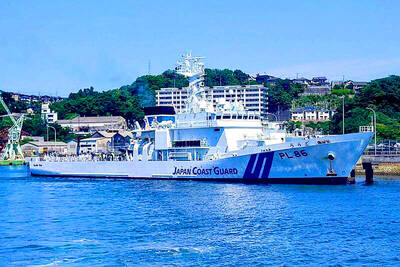
READY TO AID: The CGA has offered assistance to Chinese vessels in distress, and governments should help ships in emergencies no matter their nationality, the OAC said Taiwan yesterday condemned reported actions by the China Coast Guard against a Japanese patrol vessel attempting to shelter from Typhoon Dolphin, saying that emergency refuge should not be used to challenge Taiwan’s sovereignty or jurisdiction. Ocean Affairs Council (OAC) Deputy Minister Sung Chen-en (宋承恩) made the remarks after reports that China Coast Guard vessel No. 2304 on Friday night tailed the Japan Coast Guard’s Urado (PL-86) as it sailed from waters off Taichung toward Penghu County to evade the typhoon. Penghu fishers said they also spotted China Coast Guard vessels numbered 2504, 2102, 2301 and 1401 around the Strait’s median
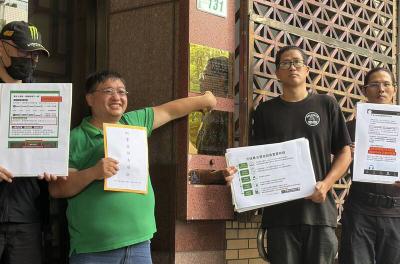
A delivery worker alliance and a labor union have filed criminal complaints against Uber Technologies Inc and Uber Eats Taiwan executives, accusing them of underpaying workers who handle multiple deliveries. The complaints, filed yesterday with the Taipei District Prosecutors’ Office, target Uber Technologies CEO Dara Khosrowshahi, Uber Eats Taiwan chairwoman Michelle Georgette Parker, the platform's Taiwan general manager and several local corporate representatives. The National Delivery Industry Union and an alliance promoting Taiwan food delivery industry rights accused Uber Eats of knowingly adopting an unlawful payment formula for so-called "stacked orders," in which a courier delivers two or more orders in a


 RSS
RSS