

The Inter-Parliamentary Alliance on China (IPAC) is not “anti-China” but instead seeks to help democratic governments develop more realistic policies toward China, group founder Luke de Pulford said.
De Pulford, who established the global network of lawmakers in 2020, said the Chinese Communist Party’s (CCP) branding of IPAC as “anti-China” was part of Beijing’s campaign to discredit its critics.
“When they see lawmakers from different traditions around the world speaking with one voice about concerns related to the behavior of the contemporary CCP, they want to shut it up,” he said in an interview with the Central News Agency on Wednesday last week.

Photo: CNA
He described IPAC as a broad coalition of legislators from different political backgrounds who often hold differing views on China and how to engage with it.
“The CCP has upset them, and they want it to be addressed,” he said. “They’re slowly coming to a realization of what the CCP is today, as opposed to what we hoped it might become or what they thought it was.”
Many IPAC members have “a deep love and respect for China, Chinese culture and the Chinese people,” De Pulford said.
“They’re people who do not like authoritarianism and don’t like the behavior of an authoritarian government. That isn’t the same as being anti-China, so we shouldn’t accept that characterization,” he said.
Beijing’s efforts to portray IPAC as anti- China had failed to curb the organization’s rapid growth, particularly in Latin America, he added.
IPAC comprises 320 lawmakers from 45 legislatures worldwide.
The alliance’s objective is not to change China’s behavior, but to encourage democracies to adopt more realistic policies toward China, De Pulford said.
“People are not prepared for escalation in cross-strait tensions, and they’re not doing nearly enough to try to deter escalation,” he said. “So we don’t have realistic policies, and we need them. IPAC is there to use the parliamentary toolbox to force that conversation. That’s its mission — to change democratic policy on China.”
Since its founding, IPAC has regularly issued statements and resolutions on Taiwan, emphasizing the importance of maintaining peace across the Taiwan Strait, supporting Taiwan’s self-determination and resisting Beijing’s diplomatic and economic coercion.
During IPAC’s summit in Taipei in 2024, Taiwan formally joined the alliance, with Democratic Progressive Party Legislator Fan Yun (范雲) and Taiwan People’s Party Legislator Chen Gau-tzu (陳昭姿) serving as IPAC cochairs.
IPAC invited Taiwan’s main opposition the Chinese Nationalist Party (KMT) to join when the alliance was founded, but the party has yet to do so, De Pulford said.
“I’ve had conversations with the KMT; some of them better than others. It’s been quite rocky over the past few years, but we’re very much open to KMT participation, and we hope that they join at some point.”
“Political parties in Taiwan that want to have fruitful relations internationally, if they overlook IPAC, they’re overlooking some of their strongest friends internationally,” he added. “It makes no sense.”
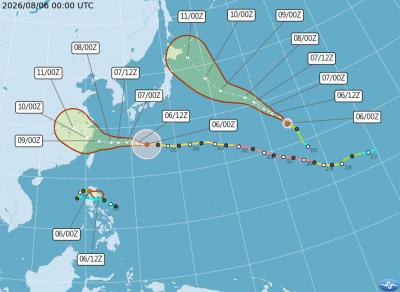
Typhoon Dolphin is expected to enter the East China Sea on Saturday and intensify rainfall in western regions over the weekend as the typhoon’s outer circulation sweeps across the sea north of Taiwan, independent meteorologist Daniel Wu (吳德榮) said today. The eastern coast should prepare for extreme heat caused by downslope winds over the weekend, while southwesterly winds from Monday would bring localized heavy rain to the southwest, he said. As Typhoon Dolphin’s outer bands move past northern Taiwan over the next couple of days, northern, central and southern areas would experience showers tomorrow, he said. Rainfall over the weekend would lead to
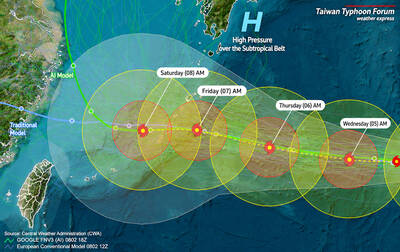
Taiwan could issue a sea warning for Typhoon Dolphin as early as Friday afternoon if the storm maintains its current westward track, the Central Weather Administration (CWA) said yesterday. As of 2pm yesterday, the center of the typhoon was about 2,590km east of Taipei and moving west at 21kph, potentially bringing hazardous conditions to waters surrounding Taiwan by Saturday. Dolphin is expected to reach waters south of the Ryukyu Islands around Saturday, but its track beyond that remains highly uncertain, CWA forecaster Lin Ping-yu (林秉煜) said. The typhoon could either continue moving westward or veer northward, Lin said. A westward track would bring
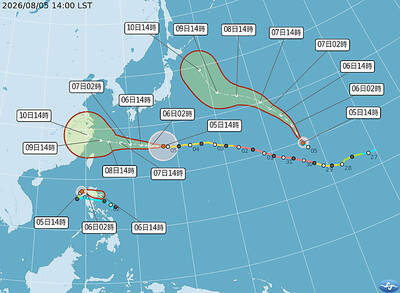
STORM SEASON: A typhoon and two tropical storms currently forming are certainly making life exciting for those living the western Pacific, the CWA said One typhoon and two tropical storms are in the west Pacific, and a sea warning for Typhoon Dolphin could be issued as early as tomorrow afternoon as the storm closes on Taiwan, the Central Weather Administration (CWA) said yesterday. As of 8am yesterday, the center of the typhoon was about 1,680km east of Taipei and moving west at 20kph, the CWA said. Meanwhile, Tropical Storm Kujia formed west of Luzon at 2am yesterday and is forecast to move east of the island before weakening and being absorbed by Typhoon Dolphin, the agency said. Steered by the Pacific high-pressure system, Dolphin is forecast to

EXPANSIONISM: Taiwan has established a cross-agency mechanism to share its experience with other nations to help build a united front against China, Joseph Wu said National Security Council Secretary-General Joseph Wu (吳釗燮) has accused China of using its coast guard and other official vessels to threaten not only Taiwan, but the broader Indo-Pacific region. “The threat posed by China is toward the whole region,” Wu said in an English-language interview with Nikkei Asia published yesterday. The entire First Island Chain, stretching from Japan southward through Taiwan to the Philippines and Malaysia, is facing increasing maritime aggression, he said. Taiwan’s intelligence, surveillance and reconnaissance systems have detected a significant increase in Chinese official vessel activity in the East China Sea, the Taiwan Strait, the western Pacific and the South


 RSS