

The Sun Moon Lake National Scenic Area Management Office yesterday apologized after hats bearing the emblem of the People’s Republic of China (PRC) were included as props at photo booth at a railway-themed music festival to celebrate the resumption of service on the Jiji Line (集集支線).
Among the activities held by the office at the railway plaza of Checheng Station (車埕) on Saturday was a stationmaster experience, where participants could wear railway uniforms and hats for photographs.
Several conductor hats featuring China’s national emblem were mixed in with Taiwan Railways Corp (TRC) hats and made available to the public, a participant said, calling it “outrageous” that the props appeared at an event organized by a public agency.
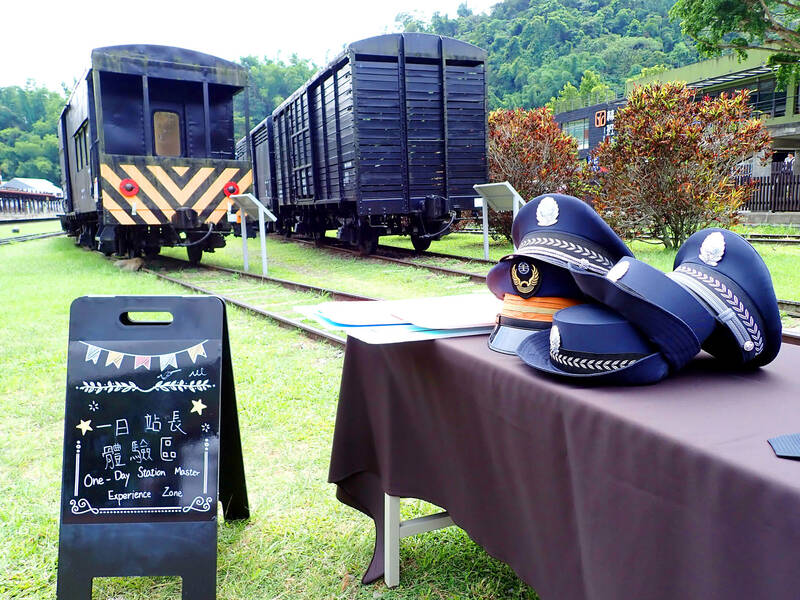
Photo courtesy of a reader
Some people unknowingly wore the hats for photos, they added.
The management office said the incident was due to a mistake by a contractor who purchased the wrong hats online and neglected to remove them before the event.
The contractor purchased “performance hats” online for the stationmaster experience, but discovered upon delivery that they bore the PRC logo, it said.
The contractor subsequently obtained authentic TRC conductor hats from a collector, it added.
A separate staging team displayed all the props without noticing the issue, while agency staff failed to conduct a final on-site inspection, the office said.
The agency apologized for the oversight, pledging to strengthen review procedures, avoid holding similar activities and conduct more thorough checks if such events are organized again.
The contractor acknowledged the “serious mistake” and pledged to carefully review all props for events and consult the authorities on their appropriateness.
The controversy followed another incident involving the use of Chinese national symbols by the Taichung City Government.
The Taichung Housing Development Department’s Civil Service Ethics Office used the PRC national emblem to represent Taiwan’s central government in a promotional poster generated by artificial intelligence (AI).
Democratic Progressive Party Legislator Wang Ting-yu (王定宇) yesterday called on government agencies at all levels to strengthen their oversight, saying that public officials must remain vigilant about matters concerning national borders.
This lack of awareness has led to similar incidents occurring at national and local levels.
Hung Pu-chao (洪浦釗), deputy head of Tunghai University’s Center for Mainland China and Regional Development Research, said that while a single incident could be dismissed as negligence, a series of similar cases raises questions about whether Taiwan’s public sector has become less attentive to Chinese political symbols.
While the two incidents are different in nature and there is no evidence of Chinese infiltration, authorities should investigate the source of the materials and the review procedures involved, he said.
In the Sun Moon Lake incident, the conductor hats passed through multiple stages, including event planning, procurement and on-site use, yet no one removed the hats featuring the five-star Chinese national emblem, Hung said.
Authorities should determine at which stage the failure occurred and clarify the responsibilities of organizers, supervisors and contractors, he said.
As government institutions represent the nation, symbols such as flags, emblems and uniforms carry clear national significance, he said, suggesting that they should be included as standard inspection items in government procurement inspections and outsourced events.
Event organizers and contractors should be responsible for inspection and review, and government agencies should not outsource content production and simultaneously outsource accountability, he said.
Chinese political symbols are entering Taiwanese society through commercial products, online materials and AI-generated content, Hung said.
The central government should establish common guidelines for central and local agencies, he said.
Additional reporting by Lin Che-yuan
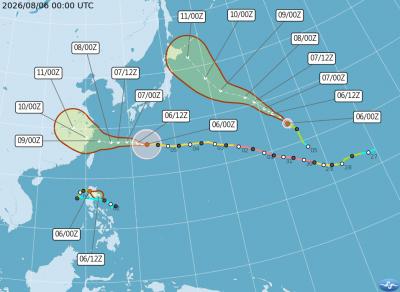
Typhoon Dolphin is expected to enter the East China Sea on Saturday and intensify rainfall in western regions over the weekend as the typhoon’s outer circulation sweeps across the sea north of Taiwan, independent meteorologist Daniel Wu (吳德榮) said today. The eastern coast should prepare for extreme heat caused by downslope winds over the weekend, while southwesterly winds from Monday would bring localized heavy rain to the southwest, he said. As Typhoon Dolphin’s outer bands move past northern Taiwan over the next couple of days, northern, central and southern areas would experience showers tomorrow, he said. Rainfall over the weekend would lead to
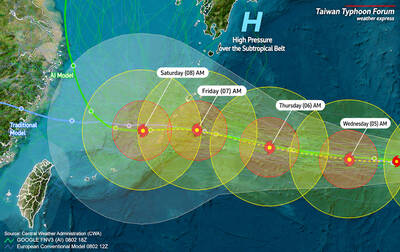
Taiwan could issue a sea warning for Typhoon Dolphin as early as Friday afternoon if the storm maintains its current westward track, the Central Weather Administration (CWA) said yesterday. As of 2pm yesterday, the center of the typhoon was about 2,590km east of Taipei and moving west at 21kph, potentially bringing hazardous conditions to waters surrounding Taiwan by Saturday. Dolphin is expected to reach waters south of the Ryukyu Islands around Saturday, but its track beyond that remains highly uncertain, CWA forecaster Lin Ping-yu (林秉煜) said. The typhoon could either continue moving westward or veer northward, Lin said. A westward track would bring
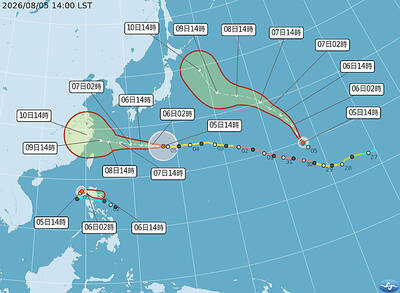
STORM SEASON: A typhoon and two tropical storms currently forming are certainly making life exciting for those living the western Pacific, the CWA said One typhoon and two tropical storms are in the west Pacific, and a sea warning for Typhoon Dolphin could be issued as early as tomorrow afternoon as the storm closes on Taiwan, the Central Weather Administration (CWA) said yesterday. As of 8am yesterday, the center of the typhoon was about 1,680km east of Taipei and moving west at 20kph, the CWA said. Meanwhile, Tropical Storm Kujia formed west of Luzon at 2am yesterday and is forecast to move east of the island before weakening and being absorbed by Typhoon Dolphin, the agency said. Steered by the Pacific high-pressure system, Dolphin is forecast to

EXPANSIONISM: Taiwan has established a cross-agency mechanism to share its experience with other nations to help build a united front against China, Joseph Wu said National Security Council Secretary-General Joseph Wu (吳釗燮) has accused China of using its coast guard and other official vessels to threaten not only Taiwan, but the broader Indo-Pacific region. “The threat posed by China is toward the whole region,” Wu said in an English-language interview with Nikkei Asia published yesterday. The entire First Island Chain, stretching from Japan southward through Taiwan to the Philippines and Malaysia, is facing increasing maritime aggression, he said. Taiwan’s intelligence, surveillance and reconnaissance systems have detected a significant increase in Chinese official vessel activity in the East China Sea, the Taiwan Strait, the western Pacific and the South


 RSS
RSS