

The Chinese People’s Liberation Army (PLA) has developed a comprehensive strategy to swiftly capture Taipei by using a combination of precision strikes, cyberattacks and cognitive warfare to paralyze the city and break the public’s will to resist without resorting to total destruction, the US-based RAND Corp said last month.
China’s “all-domain megacity incapacitation warfare” aims to break the will of Taiwanese to fight, RAND wrote in an article published on the War on the Rocks Web site.
The idea appeared in an issue of Military Art, China’s leading internal journal on military theory, in March last year, it said.
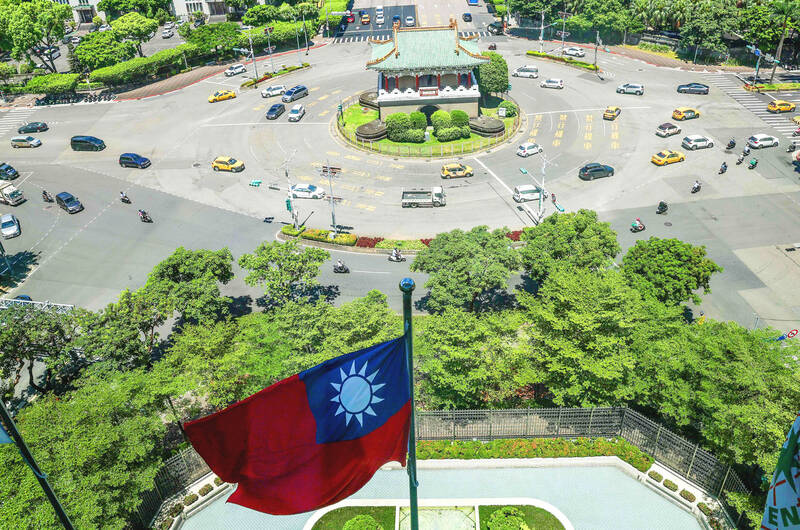
Photo: I-Hwa Cheng, AFP
“The [Chinese] Central Military Commission oversees and approves this journal, and its official circulation is limited to restricted military channels,” and because of this, “authors have liberty to speak in specifics and without varnish as they inject their concept into China’s internal debate on how to plan a war on Taiwan,” RAND said.
The Military Art article authors include China’s Academy of Military Science researchers Lt. Col. Li Hengrui (李恆銳), Senior Col. Cheng Jinming (程錦明) and Lt. Col. Wang Haiyuan (王海元), an instructor at the Chinese People’s Armed Police Command College.
The Chinese authors never specified Taipei, but the target was implicit, as the article discusses conducting operations “while simultaneously guarding against intervention by the strong enemy” — referring to potential US intervention — and claims to support China’s “facts, legal legitimacy and emotional resonance” for seizing control of the city, pointing to an attack on Taiwan, RAND said.
The concept proposed in Military Art highlights the fact that China is “framing their proposal around ‘incapacitation’” and that the authors’ objective is “submission, not destruction,” it said.
According to the concept, China would achieve its goal through military blockades, using kinetic and non-kinetic means to sever the flow of supplies and information to Taipei, and launching decapitation strikes and deploying special forces to seize — “by force or bribery” — facilities that could support Chinese forces after they land in Taiwan, RAND added.
It would also use propaganda in hopes of driving a wedge between the public and the military, and “collectively erode Taipei’s will to resist and ultimately facilitate a rapid cessation of hostilities,” making it the “optimal means for seizing Taipei,” RAND said.
China’s “information munitions” embedded in social media platforms are specifically targeting Taiwanese civilians to “manipulate perceptions, erode social cohesion, support China’s narratives and induce surrender,” it said.
Chinese threats would grow as artificial intelligence technologies create new techniques and avenues to target civilians, it added.
The RAND article urged Taiwan and the US to reimagine their countermeasures against such strategies, while calling on Taipei to “consider how to defend major media and communications facilities in addition to traditional military and government sites.”
It also urged the US to help Taiwan increase its social resilience and adopt measures to ensure a shipping lane for the delivery of goods and wartime supplies.
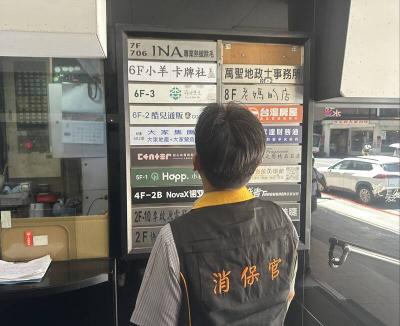
Taipei police today said they have launched an investigation into a well-known Pokemon Trading Card Game store in Taipei's Ximending (西門町) area after its sudden closure, with customers suspecting the owner absconded with up to NT$300 million (US$9.24 million). Little Sheep Card Shop (小羊卡牌社) in Wanhua District (萬華) — which specializes in card purchases and pre-orders, card grading services in Japan, submissions to the US and consignment sales — opened a physical storefront in January. Its three official Line groups, hosting up to 5,000 members each, and social media accounts on Facebook and Instagram all disappeared overnight, with the Ximending
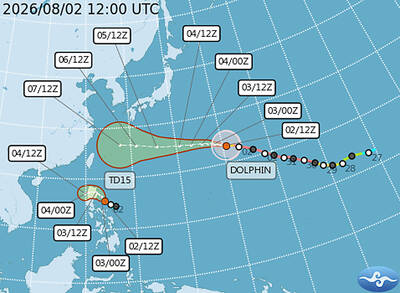
Typhoon Dolphin could bring heavy rain to northern Taiwan later this week if it tracks closer to the nation after passing the Ryukyu Islands, the Central Weather Administration (CWA) said yesterday. The CWA said forecast models agree the storm is to move toward the Ryukyu Islands through Thursday, but diverge over its path after that. One scenario has Typhoon Dolphin passing north of Taiwan, while another has it curving toward the Korean Peninsula if the Pacific high pressure system currently over the East China Sea and Taiwan weakens. Because of the uncertainty, it is still too
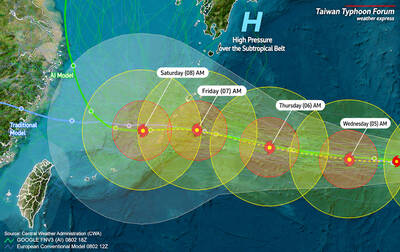
Taiwan could issue a sea warning for Typhoon Dolphin as early as Friday afternoon if the storm maintains its current westward track, the Central Weather Administration (CWA) said yesterday. As of 2pm yesterday, the center of the typhoon was about 2,590km east of Taipei and moving west at 21kph, potentially bringing hazardous conditions to waters surrounding Taiwan by Saturday. Dolphin is expected to reach waters south of the Ryukyu Islands around Saturday, but its track beyond that remains highly uncertain, CWA forecaster Lin Ping-yu (林秉煜) said. The typhoon could either continue moving westward or veer northward, Lin said. A westward track would bring
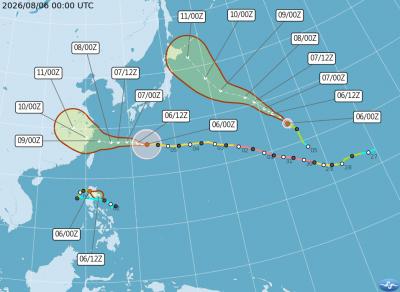
Typhoon Dolphin is expected to enter the East China Sea on Saturday and intensify rainfall in western regions over the weekend as the typhoon’s outer circulation sweeps across the sea north of Taiwan, independent meteorologist Daniel Wu (吳德榮) said today. The eastern coast should prepare for extreme heat caused by downslope winds over the weekend, while southwesterly winds from Monday would bring localized heavy rain to the southwest, he said. As Typhoon Dolphin’s outer bands move past northern Taiwan over the next couple of days, northern, central and southern areas would experience showers tomorrow, he said. Rainfall over the weekend would lead to


 RSS
RSS