

Tibetan and human rights activists yesterday protested China’s new ethnic unity law outside the Bank of China’s Taipei branch, calling on people around the world to resist China’s authoritarian rule and speak up for oppressed ethnic minorities.
Yesterday marked one month since Tibetan activist Lobga Rangzen self-immolated in protest, and his family hoped the date would act as a “global action day,” calling on Tibetan communities and human rights groups around the world to take part in coordinated actions.
The Human Rights Network for Tibet and Taiwan, Tibet Religious Foundation of His Holiness the Dalai Lama, Taiwan Tibetan Welfare Association and other human rights groups held a news conference outside the Bank of China to protest China’s Ethnic Unity and Progress Promotion Law and speak out on behalf of those living under Chinese oppression.
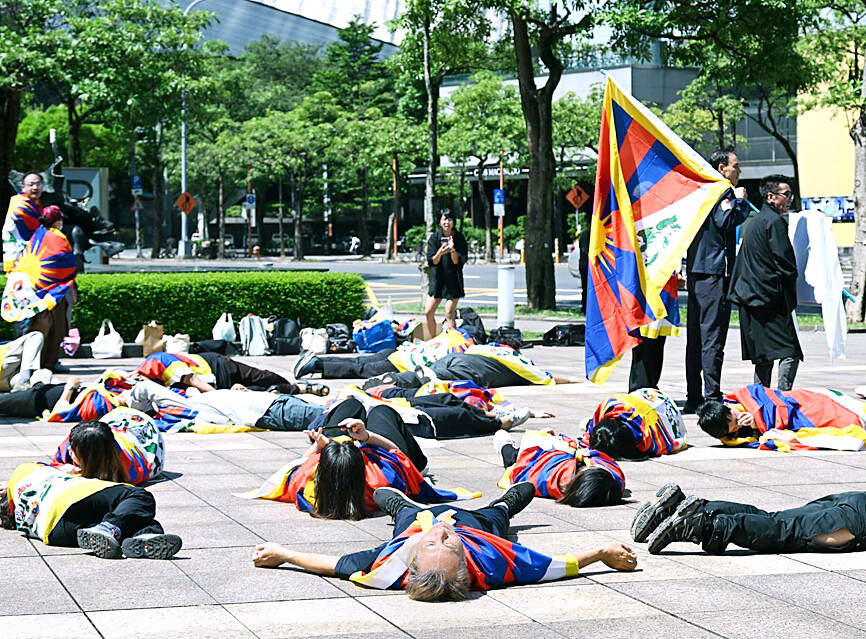
Photo: Fang Pin-chao, Taipei Times
Countless Tibetans including Rangzen have lost their lives defending their freedom, Tibet Religious Foundation of His Holiness the Dalai Lama Chairman Kelsang Gyaltsen said, calling on everyone who values human rights to denounce China’s authoritarian rule.
Gyaltsen accused the UN of being silent on the issue, saying that silence is not neutrality but complicity and asking how many more Tibetans must lose their lives before the world listens.
“Tibet belongs to the Tibetan people,” Tibetan activist Tashi Tsering said, telling Chinese troops to get out of Tibet.
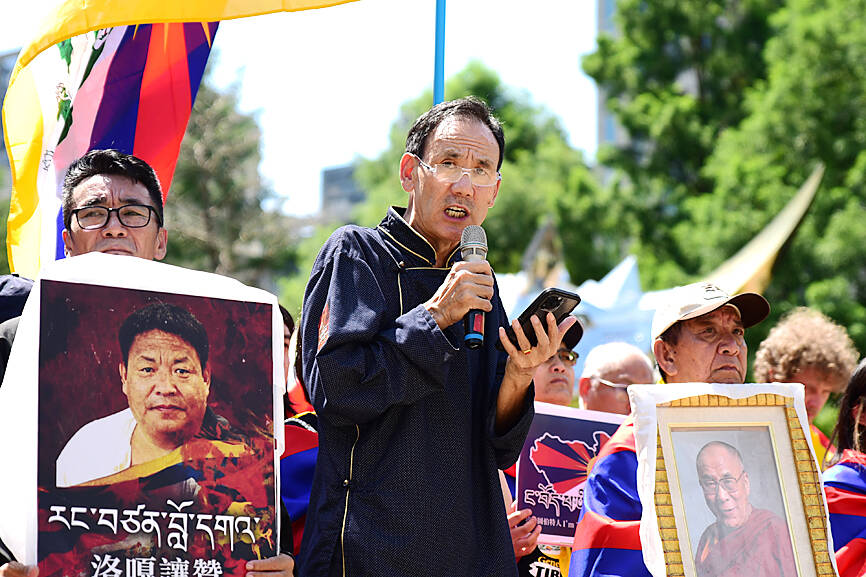
Photo couretresy of the Human Rights Network for Tibet and Taiwan via CNA
The new ethnic unity law could be used to make it illegal for Tibetans to teach their children Tibetan Buddhism or the Tibetan language, Tsering said, adding that China wants to destroy Tibetan religion and culture, “but we will not let them succeed.”
While laws in democratic countries manage people’s external actions to maintain public order, this new law attempts to regulate people’s internal thoughts, requiring people to promote “ethnic unity” in workplaces and even at home, human rights advocate Lee Ming-che (李明哲) said.
The law is similar to a criminal organization’s code of conduct because it intrudes on people’s thoughts and private family lives, which only criminal groups would do, Lee said.
In addition, adding the word “progress” to the law’s title shows that eroding minority cultures, undermining Hong Kong’s “one country, two systems” framework and seeking to annex Taiwan are what Beijing defines as “progress,” Lee said.
China considers minority groups choosing their own cultures and Taiwanese people choosing their own future as “savage,” he said.
“If China’s definition of progress means forcing us to give up the right to choose our future, we will show you the pride of being savages,” Lee said.

The first batch of individual income tax refunds for this tax season is to be deposited on Friday, covering more than 3.65 million cases and totaling NT$61.24 billion (US$1.89 billion), with an average refund of NT$16,745 per case, the National Taxation Bureau of Kaohsiung said. After the annual individual income tax filing deadline, regional tax bureaus process refunds in three batches based on the filing method used by taxpayers, the bureau said, adding that the three batches are scheduled for Friday, Oct. 30, and Jan. 20 next year. The first batch covers taxpayers who completed online filing before June 1, those who

NEW AND IMPROVED: The N700ST is based on Japan’s N700S Shinkansen, and features a lighter design, better energy efficiency and upgraded accessibility facilities The first set of N700ST high-speed rail carriages, scheduled to arrive in Taiwan next month, would begin service on July 1 next year, Taiwan High Speed Rail Corp (THSRC) said yesterday. THSRC chairman Shih Che (史哲) made the remarks during a ceremony in Hitachi Ltd’s Kasado Works in Yamaguchi Prefecture, Japan, where he and Hitachi Railway Systems Business Unit CEO Giuseppe Marino unveiled the locomotive of the first N700ST train. More than 200 guests attended the unveiling. “The first set of N700ST trains will soon be shipped to Taiwan from the prefecture’s Kasado Port. Hopefully, all the required tests will be completed successfully
Taiwan has suspended visa processing for Moroccan nationals in response to Morocco halting visa applications for Taiwanese travelers worldwide, the Ministry of Foreign Affairs said today. The Moroccan embassy in Japan on Thursday last week informed Taiwanese travel agencies that it would suspend its visa confirmation letter application service for Taiwanese seeking to travel to Morocco, the ministry said in a statement. Taiwanese are required to obtain a visa confirmation letter before traveling to Morocco, the Bureau of Consular Affairs Web site says. Applications are submitted through the Moroccan Embassy in Japan, which forwards them to authorities in Morocco for review. Once approved,

RELIGIOUS GROUNDS: Followers of the I-Kuan Tao are especially advised not to travel to China, following a 50 percent surge in religious detentions in three months Nineteen people have been detained in China in the past three months because of their religious beliefs, representing a 50 percent surge from the previous three months, Straits Exchange Foundation Secretary-General Lo Wen-chia (羅文嘉) said yesterday. The Legislative Yuan’s Internal Administration Committee invited the foundation, Mainland Affairs Council (MAC) and other agencies to deliver a report on the government’s response to the growing number of missing Taiwanese citizens in China. From Jan. 1, 2024, to Wednesday last week, 402 people have gone missing, been detained for questioning or imprisoned in China, MAC data showed. Of the total cases, 154 are missing, 32 have


 RSS
RSS