

If one person in a married couple has dementia, their spouse is at significantly higher risk of developing the disease themselves, Taiwanese researchers said in a study published on Monday.
A nationwide study of nearly 1 million married people from 1998 to 2022 showed that women were 74 percent more likely to develop dementia if their spouse had it, compared with 69 percent for men.
The study, titled “Spousal Dementia Exposure and Risk of Dementia” was published in the international journal JAMA Network Open.
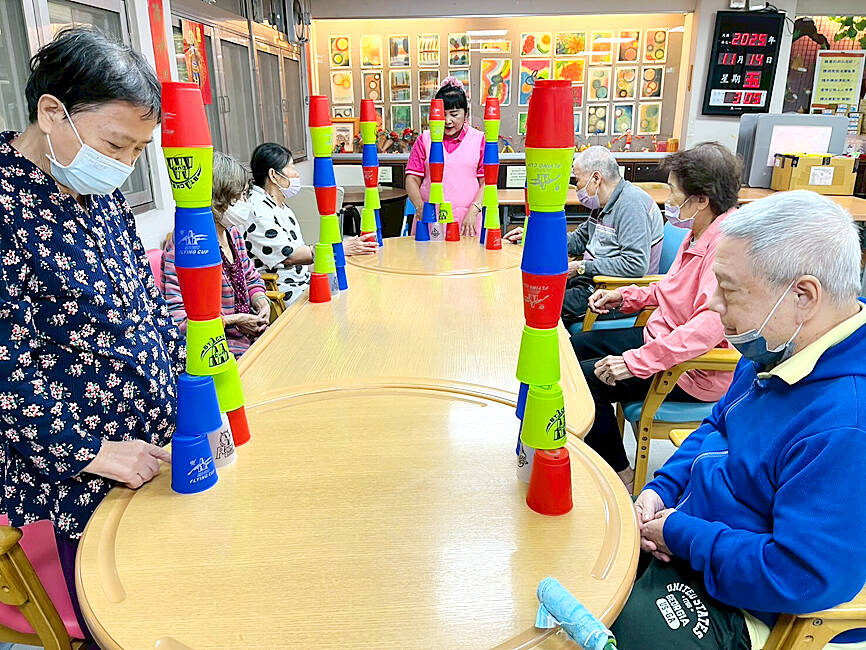
Photo courtesy of the Taiwan Catholic Foundation of Alzheimer’s Disease and Related Dementia
The researchers, including Wang Shi-heng (王世亨), an associate researcher at the National Health Research Institutes’ National Center for Geriatrics and Welfare Research, analyzed data from the National Health Insurance Research Database of 955,000 married people.
Among spouses whose partners did not have dementia, about six out of every 100 men and three out of every 100 women were diagnosed with dementia, the data showed.
However, if a spouse developed dementia, those figures rose to nine out of 100 for men and six out of 100 for women over a five-year period, the researchers said.
Similar associations were also found for Alzheimer’s disease and vascular dementia, they said.
Relative risks were more prevalent among younger spouses, while the absolute increase in dementia cases was greater among older spouses, they said.
Among the possible explanations for the correlation was assortative mating — in which people tend to select a spouse with a similar educational background, socioeconomic status and health behaviors — alongside shared environmental and lifestyle exposures accumulated over their lives, the researcher said.
The link might also be due to caregiver distress, depression, sleep disturbance, social isolation, metabolic dysregulation, inflammation and adverse health behaviors from living with a spouse with cognitive decline, they said.
Lower-income households and those with fewer children had larger absolute risk differences, they said.
The study does not suggest that caring for a spouse with dementia causes dementia, but rather that people in that situation are in a statistically high-risk group that requires more attention, Wang said.
The link likely reflects shared lifestyle factors, overall health status and the long-term stresses associated with dementia caregiving, said Wu Chi-shin (吳其炘), a senior attending physician and researcher at the institutes, and a corresponding author of the paper.
Once a person is diagnosed with dementia, healthcare support should extend to include their spouse, including assessments of cognitive function, depression, sleep quality and chronic disease management, the researchers said.
Priority should be given to low-income families, households with few children and families lacking alternative caregivers, they added.

SOUTHBOUND POLICY: Agencies said Thailand, Brunei and the Philippines would benefit from continuation of the program, but Cambodia was rebuffed over rhetoric Conditional visa waiver programs for holders of Thai, Bruneian and Philippine passports are to be extended to July 31 next year to help implement Taiwan’s New Southbound Policy, the Bureau of Consular Affairs said on Friday. The decision was a result of cross-ministry meetings chaired by the Ministry of Foreign Affairs since April 21 for a comprehensive review of the ministry’s visa waiver program for Thai, Brunei and Philippine nationals, the Ministry of the Interior’s Travel Authorization Certificate (TAC), and the Ministry of Transportation and Communication’s Guanhong Project (觀宏專案), also known as the Project for Simplifying Visa Regulations for High-end Group

Taiwan will remove Cambodia from two visa facilitation programs on Aug. 1, while extending eased entry arrangements for Thailand, India and several other Southeast and South Asian countries, the Ministry of Foreign Affairs said Friday. Cambodian nationals will no longer be eligible for the Guanhong Project, which eases visa requirements for certain tour groups, or the Travel Authorization Certificate program, which offers conditional visa-free entry, MOFA said. In a news release, the ministry said Cambodia had failed to reciprocate Taiwan’s goodwill and had instead echoed China in statements undermining Taiwan’s sovereignty. MOFA also accused Cambodia of appearing to support Beijing’s possible use of

Travel agencies and hotels offering airport pickup services face fines beginning next month if they continue to hold space in arrival halls with placards, luggage or other personal items, Taoyuan International Airport Corp (TIAC) said in a letter to operators. As the number of visitors to Taiwan continues to grow, many travel agencies and hotels provide meet-and-greet services that allow arriving travelers to head directly to their hotels or begin their itineraries upon landing. However, some pickup personnel have been occupying the wall near the exit of the arrival hall with signs, luggage and personal items, obstructing passenger flow, disrupting terminal

The Food and Drug Administration (FDA) yesterday said that two additional batches of cooking oil produced by Central Union Oil Corp had been found to contain excessive levels of the carcinogen benzopyrene. The contamination was traced to two tainted downstream products, bringing the total number of affected soybean-based cooking oil batches to seven of the 30 batches produced by the company from April to June, the agency said. The tainted oil has affected a total of 1,322 businesses, it added. As of 11am yesterday, 2,584.4 tonnes of contaminated oil products had been removed from shelves, while another 5,126.7 tonnes had been preemptively withdrawn


 RSS