

Taiwan is eager to deepen cooperation with democratic partners such as Poland to address authoritarian expansion and hopes to deepen collaboration on research and build a safer, more resilient democratic supply chain, President William Lai (賴清德) said yesterday.
Lai made the comments while receiving a delegation of Polish members of the European Parliament led by former Polish prime minister Beata Szydlo, who is a member of the European Parliament’s Special Committee on the European Democracy Shield, at the Presidential Office.
Szydlo called Taiwan one of the EU’s most important and reliable partners, adding that the bloc should continue enhancing cooperation with trusted democratic partners, the Presidential Office said in a statement.
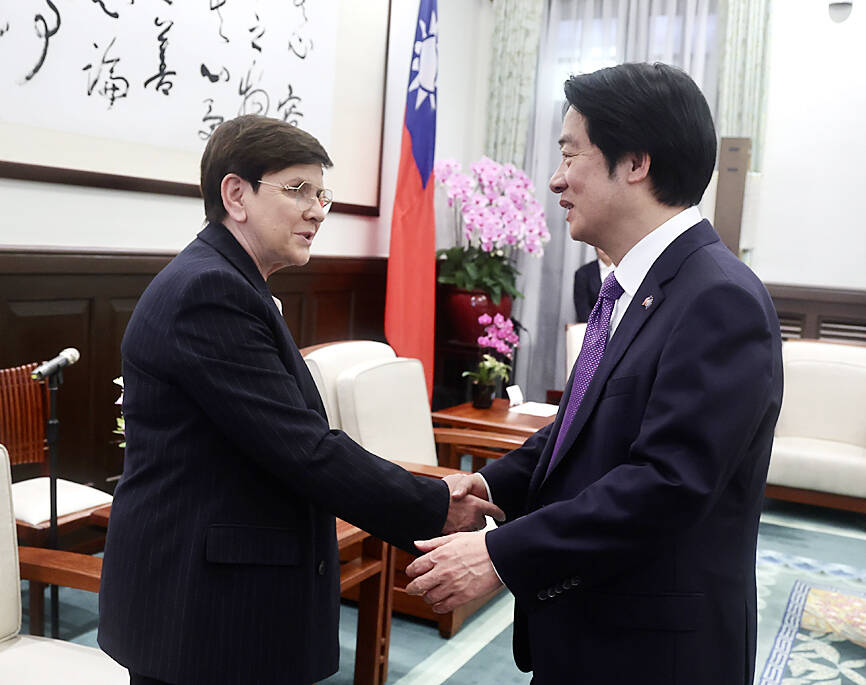
Photo: CNA
The delegation was the third from the European Parliament to visit Taiwan this year, and the first delegation in nearly two parliamentary terms to consist entirely of members from the same political group and country, demonstrating that Taiwan-Poland ties were reaching a new level, the statement cited Lai as saying.
Since the beginning of this year, the European Parliament has adopted Taiwan-friendly resolutions, such as supporting drone development between Taiwan and the EU, supporting Taiwan’s meaningful participation in international bodies, calling for deeper collaboration among democratic partners and stressing the importance of maintaining peace and stability across the Taiwan Strait, he said.
Lai lauded the European Parliament’s condemnation of the China’s Ethnic Unity and Progress Promotion Law for restricting cultural, religious and linguistic freedoms abroad and their call for the law’s abolition in April.
It also adopted a resolution to counter Chinese transnational repression, he said, adding that these actions highlight how Europe is upholding the values of democracy and human rights.
Only by working together and bolstering democratic resilience can like-minded partners protect their democratic and free way of life, and protect regional and global peace and stability, he said.
Taiwan and Poland have thriving innovation ecosystems and robust technological foundations that are complementary to each other, and by deepening research and development cooperation and expanding markets, the nations can create safer and more resilient democratic supply chains, Lai said.
Although geographically far apart, Taiwan and Poland share common values, including strong work ethics, solidarity and a commitment to safeguarding security, Szydlo said, adding that Taiwan is a trustworthy partner.
Taiwan’s accomplishments in emerging technology, artificial intelligence and semiconductors are crucial to the restructuring of global supply chains, she said.
Amid heightened political tensions, supply chain restructuring is directly connected to national security, making Taiwan and Poland great partners to cooperate in investment, economic security, artificial intelligence, Internet security and high-tech sectors, she said.
Peace and stability across the Taiwan Strait is not only important to Taiwan, but to peace and stability in Europe, Szydlo said, adding that all conflicts should be resolved peacefully and in line with international law, without the use of force.
The EU should continue to enhance collaborations with trustworthy democratic partners such as Taiwan, she said.
SOUTHBOUND POLICY: Agencies said Thailand, Brunei and the Philippines would benefit from continuation of the program, but Cambodia was rebuffed over rhetoric Conditional visa waiver programs for holders of Thai, Bruneian and Philippine passports are to be extended to July 31 next year to help implement Taiwan’s New Southbound Policy, the Bureau of Consular Affairs said on Friday. The decision was a result of cross-ministry meetings chaired by the Ministry of Foreign Affairs since April 21 for a comprehensive review of the ministry’s visa waiver program for Thai, Brunei and Philippine nationals, the Ministry of the Interior’s Travel Authorization Certificate (TAC), and the Ministry of Transportation and Communication’s Guanhong Project (觀宏專案), also known as the Project for Simplifying Visa Regulations for High-end Group
Taiwan will remove Cambodia from two visa facilitation programs on Aug. 1, while extending eased entry arrangements for Thailand, India and several other Southeast and South Asian countries, the Ministry of Foreign Affairs said Friday. Cambodian nationals will no longer be eligible for the Guanhong Project, which eases visa requirements for certain tour groups, or the Travel Authorization Certificate program, which offers conditional visa-free entry, MOFA said. In a news release, the ministry said Cambodia had failed to reciprocate Taiwan’s goodwill and had instead echoed China in statements undermining Taiwan’s sovereignty. MOFA also accused Cambodia of appearing to support Beijing’s possible use of
Travel agencies and hotels offering airport pickup services face fines beginning next month if they continue to hold space in arrival halls with placards, luggage or other personal items, Taoyuan International Airport Corp (TIAC) said in a letter to operators. As the number of visitors to Taiwan continues to grow, many travel agencies and hotels provide meet-and-greet services that allow arriving travelers to head directly to their hotels or begin their itineraries upon landing. However, some pickup personnel have been occupying the wall near the exit of the arrival hall with signs, luggage and personal items, obstructing passenger flow, disrupting terminal
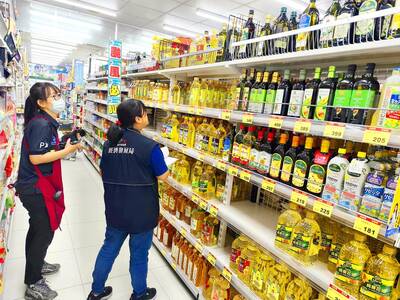
The Food and Drug Administration (FDA) yesterday said that two additional batches of cooking oil produced by Central Union Oil Corp had been found to contain excessive levels of the carcinogen benzopyrene. The contamination was traced to two tainted downstream products, bringing the total number of affected soybean-based cooking oil batches to seven of the 30 batches produced by the company from April to June, the agency said. The tainted oil has affected a total of 1,322 businesses, it added. As of 11am yesterday, 2,584.4 tonnes of contaminated oil products had been removed from shelves, while another 5,126.7 tonnes had been preemptively withdrawn


 RSS
RSS