

This year’s urban resilience exercises are to fully integrate with the annual Han Kuang military drills for the first time, expanding from a single day to two days to test civil-military coordination across county lines, a national security source said today.
The exercises would include underground medical operations, civilian evacuations, medical evacuations, joint transportation logistics and drone-based supply deliveries as part of efforts to strengthen whole-of-society defense resilience, the source said.
The Han Kuang 42 military exercises, scheduled to take place from Aug. 5 to 14, are to be concurrently held with urban resilience exercises in two phases: Aug. 6 to 7 in Kaohsiung and Pingtung County, and Aug. 12 to 13 in New Taipei City and Yilan County.
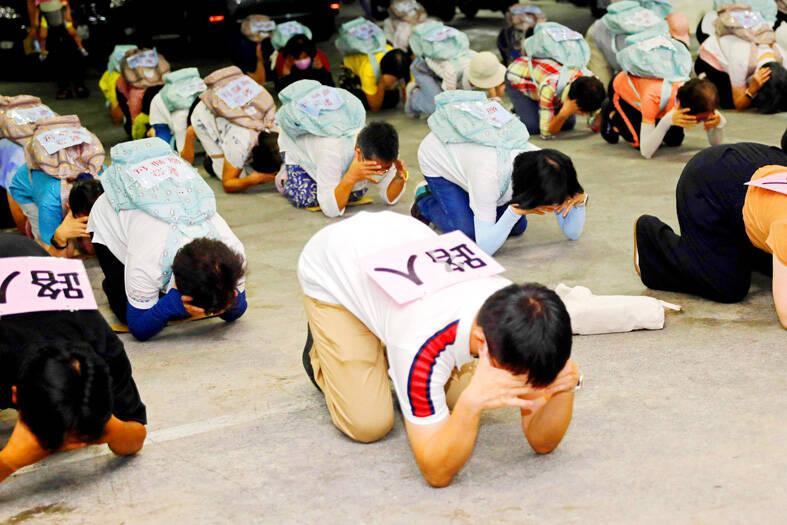
Photo: Jameson Wu, AFP
Unlike previous drills that held a tabletop exercise in the morning followed by field drills in the afternoon, this year’s resilience exercise would feature one full day dedicated to tabletop wargames and a second full day for practical execution, the source said.
Local governments would be required not only to activate emergency operations centers, but also to conduct drills at physical sites such as medical stations, relief centers and supply distribution hubs, they said.
The biggest change compared with previous years is the focus on military-civilian integration, they said.
While last year's urban resilience exercises were held alongside the Han Kuang exercises, the military and local governments conducted separate drills, they said.
This year, both sides would operate under the same scenario, requiring local governments to respond simultaneously to military and civilian needs, while military personnel would be stationed at local emergency operations centers to improve information sharing and coordination, they said.
Three major military-civilian integration mechanisms would be tested: preventive and emergency evacuations, medical evacuation and healthcare capacity, and transportation coordination, they said.
The exercises would also feature cross-county support drills for the first time to test how neighboring jurisdictions could support evacuations, allocate resources, operate shelters and provide transportation during emergencies, they said.
"Underground medical operations" would be introduced for the first time to test how hospitals could reduce patient loads in advance by transferring non-critical patients elsewhere and relocating surgeries, emergency treatment and patient care to basement levels or other protected spaces, they said.
Medical facilities in high-risk areas would also practice relocating patients and operations to hospitals in safer areas to preserve healthcare capacity, they added.
In addition, the exercises would test the logistical capabilities of large multirotor drones, with a drill in Pingtung County simulating the delivery of medical and relief supplies, they said.
Military-civilian integration exercises are not unique to Taiwan, they said, adding that Israel, Singapore, Finland and NATO member states have all incorporated similar elements into their annual exercises.
Facing compound disasters and evolving regional security challenges, the government aims to establish a unified response capability across the military, local governments and the general public to bolster whole-of-society resilience through routine exercises, they said.
Taiwan would not ignore threats posed by China's expanding military activities around the Taiwan Strait, East China Sea and South China Sea, they said, adding that exercises would continue to align with real-world scenarios.
SOUTHBOUND POLICY: Agencies said Thailand, Brunei and the Philippines would benefit from continuation of the program, but Cambodia was rebuffed over rhetoric Conditional visa waiver programs for holders of Thai, Bruneian and Philippine passports are to be extended to July 31 next year to help implement Taiwan’s New Southbound Policy, the Bureau of Consular Affairs said on Friday. The decision was a result of cross-ministry meetings chaired by the Ministry of Foreign Affairs since April 21 for a comprehensive review of the ministry’s visa waiver program for Thai, Brunei and Philippine nationals, the Ministry of the Interior’s Travel Authorization Certificate (TAC), and the Ministry of Transportation and Communication’s Guanhong Project (觀宏專案), also known as the Project for Simplifying Visa Regulations for High-end Group
Taiwan will remove Cambodia from two visa facilitation programs on Aug. 1, while extending eased entry arrangements for Thailand, India and several other Southeast and South Asian countries, the Ministry of Foreign Affairs said Friday. Cambodian nationals will no longer be eligible for the Guanhong Project, which eases visa requirements for certain tour groups, or the Travel Authorization Certificate program, which offers conditional visa-free entry, MOFA said. In a news release, the ministry said Cambodia had failed to reciprocate Taiwan’s goodwill and had instead echoed China in statements undermining Taiwan’s sovereignty. MOFA also accused Cambodia of appearing to support Beijing’s possible use of
Travel agencies and hotels offering airport pickup services face fines beginning next month if they continue to hold space in arrival halls with placards, luggage or other personal items, Taoyuan International Airport Corp (TIAC) said in a letter to operators. As the number of visitors to Taiwan continues to grow, many travel agencies and hotels provide meet-and-greet services that allow arriving travelers to head directly to their hotels or begin their itineraries upon landing. However, some pickup personnel have been occupying the wall near the exit of the arrival hall with signs, luggage and personal items, obstructing passenger flow, disrupting terminal
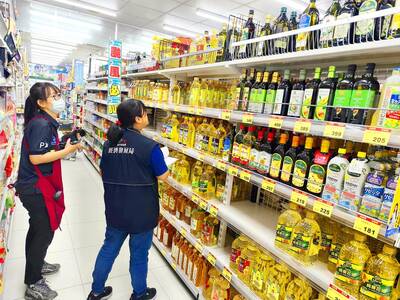
The Food and Drug Administration (FDA) yesterday said that two additional batches of cooking oil produced by Central Union Oil Corp had been found to contain excessive levels of the carcinogen benzopyrene. The contamination was traced to two tainted downstream products, bringing the total number of affected soybean-based cooking oil batches to seven of the 30 batches produced by the company from April to June, the agency said. The tainted oil has affected a total of 1,322 businesses, it added. As of 11am yesterday, 2,584.4 tonnes of contaminated oil products had been removed from shelves, while another 5,126.7 tonnes had been preemptively withdrawn


 RSS
RSS