

If one partner in a married couple has dementia, their spouse is at significantly higher risk of developing dementia themself, Taiwanese researchers found in a study published yesterday.
A nationwide cohort study of nearly 1 million married people in Taiwan from 1998 to 2022 showed that women were 74 percent more likely to develop dementia if their spouse has dementia, compared to 69 percent for men.
The study titled "Spousal Dementia Exposure and Risk of Dementia" was published in the international journal JAMA Network Open yesterday.
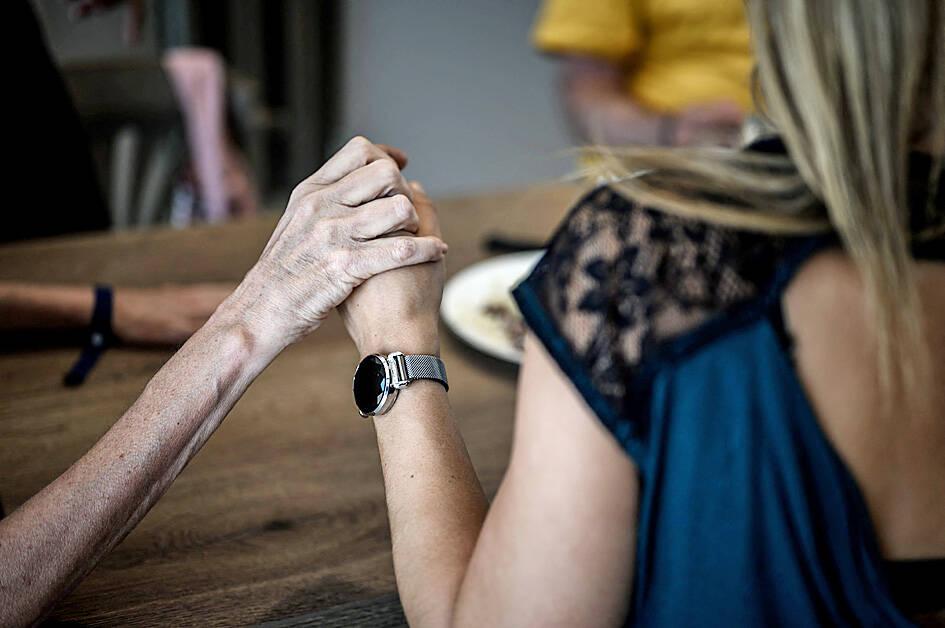
Photo: AFP
Researchers including Wang Shi-heng (王世亨), an associate researcher at the National Center for Geriatrics and Welfare Research under the National Health Research Institutes, analyzed data from the National Health Insurance Research Database of 955,000 married people.
Among spouses whose partners did not have dementia, about six out of every 100 men and three out of every 100 women were diagnosed with dementia.
However, if a spouse developed dementia, those figures rose to nine out of 100 for men and six out of 100 for women over a five-year period.
Similar associations were also found for Alzheimer's disease and vascular dementia, the researchers found.
Relative risks were more prevalent among younger spouses, while the absolute increase in dementia cases was greater among older spouses, they said.
The researchers suggested possible explanations, including assortive mating — in which people tend to select spouses with similar educational background, socioeconomic status and health behaviors — alongside shared environmental and lifestyle exposures accumulated over the course of their lives.
Moreover, the link may be due to caregiver distress, depression, sleep disturbance, social isolation, metabolic dysregulation, inflammation and adverse health behaviors from living with a spouse suffering from cognitive decline, they said.
Lower-income households and those with fewer children had larger absolute risk differences, they said.
The study does not suggest that caring for a spouse with dementia causes dementia, but rather that these people are in a statistically high-risk group that requires more attention, Wang said.
The link likely reflects shared lifestyle factors, overall health status and the long-term stresses associated with dementia caregiving, said National Health Research Institutes senior attending physician and researcher Wu Chi-shin (吳其炘), a corresponding author of the paper.
Once a person is diagnosed with dementia, healthcare support should extend to include their spouse, including assessments of cognitive function, depression, sleep quality and chronic disease management, the researchers said.
Priority should be given to low-income families, households with fewer children and families lacking alternative caregivers, they added.

‘FRIENDSHIP FLEET’: A CGA official is scheduled to meet with the president of the Pacific nation, while one of the ships is to host a banquet and National Day event Two Coast Guard Administration (CGA) patrol vessels have docked at Malakal Harbor in Palau as part of an expedition exercise and diplomatic visit, during which a senior official is expected to meet with Palauan President Surangel Whipps Jr, the agency said yesterday. The two vessels, the 4,000-tonne-class Chiayi and the 1,000-tonne-class Penghu, set sail for Palau from Taiwan last week and arrived on Tuesday at Malakal Harbor, the CGA’s Fleet Branch said in a statement. The journey marks the second time the CGA has dispatched a “friendship fleet” to another country, after it sent its first-ever goodwill fleet, comprising the Hualien and

Two executives of drone supplier Jiin Ming Industry Co (錦明實業) have been detained and held incommunicado over the company's alleged use of prohibited China-made chips and camera lenses in drones supplied under recent military contracts, the Taoyuan District Prosecutors' Office said today. In a statement, prosecutors said they raided the offices of Jiin Ming — headquartered in Taoyuan — as well as those of its subsidiaries and its suppliers on Thursday last week. The raids followed a report that the company had breached its procurement contracts by putting the prohibited components into drones delivered to the military. During the raids, prosecutors summoned

South Korean boy band BigBang drew 120,000 fans to three concerts at Taipei Dome from Friday through yesterday, as the band thanked them for their support over their 20-year career. The Taipei Dome concerts were part of BigBang's "2026-2027 World Tour XX: Cosmos." Friday's concert was BigBang's first performance in Taiwan in 11 years. During the encore, group leader G-Dragon (GD) shouted "I love you" in Chinese and said he was especially happy to perform in Taiwan with bandmates Taeyang and Daesung. "Taipei, I'm very grateful to you all," GD said in Chinese, asking fans to wait for the band's return. Daesung thanked
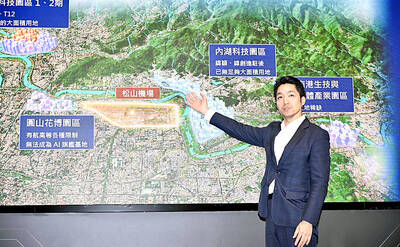
DETAILED PLAN NEEDED: Relocating the airport would affect not just travelers, but also undermine national defense and emergency medical services, a legislator said Taipei Mayor Chiang Wan-an (蔣萬安) yesterday proposed relocating Taipei International Airport (Songshan airport) and turning the site into an artificial intelligence (AI) park, drawing opposition from politicians across party lines. Chiang’s plan would turn the 300 hectares into an AI park featuring tech clusters, residential communities and green space. The industrial cluster would host 200 domestic enterprises, generate NT$12 trillion (US$376.47 billion) in output, and accommodate 65,000 jobs and 35,000 residents, he said. Cabinet spokeswoman Michelle Lee (李慧芝) said the Executive Yuan was surprised by the announcement, as the Taipei City Government did not discuss the proposal with the central government before making


 RSS