

Taiwan detected a sharp rise in Chinese coast guard and research vessel activity around the nation last month, prompting Taipei to plan drills simulating Chinese escalations off its Pacific coast, Coast Guard Administration data and officials said.
Taiwan reported 55 Chinese government vessel sightings, including coast guard and research boats, around the nation last month, up from 30 in May, the data showed.
The sightings marked an 83 percent increase from May and a 120 percent rise from 25 sightings in June last year.
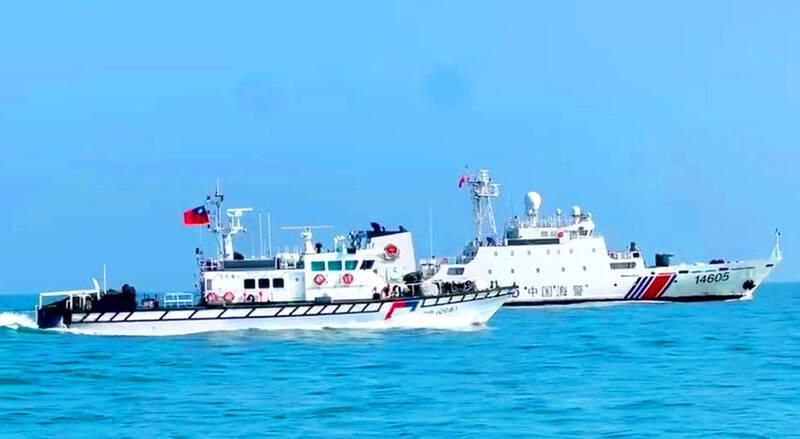
Photo courtesy of the CGA
The tally excluded sightings around Taiwan-controlled islands near the Chinese coast.
The figures underscore the growing role of China's coast guard in Beijing's latest pressure campaign against Taiwan.
China's military operates almost daily around Taiwan, but Beijing has increasingly used its coast guard to assert its territorial claims in what Taipei calls "lawfare" — efforts to create a legal basis for Chinese actions around the nation.
Taiwan officials said the activity points to a critical wartime risk: that Beijing may be rehearsing how to sever Taiwan's Pacific supply lines from allies.
"If the situation escalates to a blockade — or what would already amount to a quasi-war — we have plans to work with the navy to jointly protect Taiwan's lifeline sea routes," a senior Taiwan coast guard official said at a briefing on condition of anonymity.
"We have anticipated this scenario not only through tabletop exercises, but also through live drills," the official said.
China's Ministry of National Defense and Taiwan Affairs Office did not immediately respond to requests for comment.
A senior Taiwan coast guard official said some Chinese coast guard ships had been converted from former naval destroyers and repainted for coast guard use, posing a heightened threat to Taiwan's coast guard due to their size, endurance and military-grade capabilities.
Chinese coast guard vessels now often operate in pairs just outside Taiwan's economic waters in the Pacific, an expansive area that places a major strain on Taiwan's limited coast guard fleet, the official added.
"This places a major strain on the capacity of Taiwan's coast guard vessels," the official said.
A second senior official described the Chinese activity as "expansion" and an attempt to change the "status quo."
China's coast guard had broadcast questions to merchant vessels about port entry and exit information, putting pressure on commercial shipping, even though no vessel had so far changed course, officials said.
Taiwan had broadcast back to the ships, telling them to maintain normal navigation and ignore Chinese interference.
"It knows it has no jurisdiction now, so it is trying to create something out of nothing," said the second official, who also spoke on condition of anonymity.

Beijing has been offering subsidized trips to China’s Xinjiang region for Taiwanese teachers as part of efforts to influence teachers and, indirectly, students, a government official said yesterday. With China subsidizing the trips, the teachers only need to pay a NT$4,000 registration fee for an eight-day, seven-night tour that includes accommodation and meals, the official said, speaking on condition of anonymity. Participants risk having their personal information collected and their social networks monitored by Chinese authorities, the official said. Chinese authorities are offering separate summer exchange programs targeting Taiwanese teachers and students, with the student program including study-related activities, they
SOUTHBOUND POLICY: Agencies said Thailand, Brunei and the Philippines would benefit from continuation of the program, but Cambodia was rebuffed over rhetoric Conditional visa waiver programs for holders of Thai, Bruneian and Philippine passports are to be extended to July 31 next year to help implement Taiwan’s New Southbound Policy, the Bureau of Consular Affairs said on Friday. The decision was a result of cross-ministry meetings chaired by the Ministry of Foreign Affairs since April 21 for a comprehensive review of the ministry’s visa waiver program for Thai, Brunei and Philippine nationals, the Ministry of the Interior’s Travel Authorization Certificate (TAC), and the Ministry of Transportation and Communication’s Guanhong Project (觀宏專案), also known as the Project for Simplifying Visa Regulations for High-end Group
Taiwan will remove Cambodia from two visa facilitation programs on Aug. 1, while extending eased entry arrangements for Thailand, India and several other Southeast and South Asian countries, the Ministry of Foreign Affairs said Friday. Cambodian nationals will no longer be eligible for the Guanhong Project, which eases visa requirements for certain tour groups, or the Travel Authorization Certificate program, which offers conditional visa-free entry, MOFA said. In a news release, the ministry said Cambodia had failed to reciprocate Taiwan’s goodwill and had instead echoed China in statements undermining Taiwan’s sovereignty. MOFA also accused Cambodia of appearing to support Beijing’s possible use of
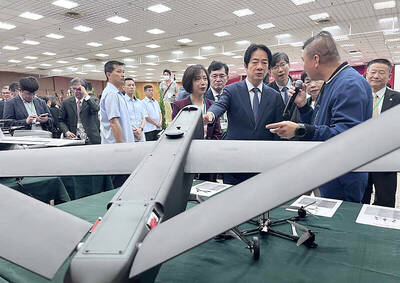
Saudi Arabia bought a record US$47.2 million of drones from Taiwan last month — a sign that the nation’s nascent uncrewed aerial vehicle (UAV) industry is becoming more attractive to buyers. The figure, released by the Ministry of Finance in Taipei last week, was the most in a month for any nation in data going back to June 2023. The Czech Republic has previously been a major buyer. It was unclear how Saudi Arabia intended to use the drones, which weighed an average of 7kg to 15kg. UAVs in that weight category can be used for a range of industrial and military purposes. Su


 RSS
RSS