

Taiwan’s military conducted several cross-regional reinforcement drills over the past week that defense experts said focused on locations most vulnerable to a Chinese attack and critical for testing Taiwan’s wartime operational plans.
In one exercise, the army took an alternative route along the Suhua Highway to move battle tanks, armored vehicles and artillery from further down the east coast in Hualien County to Suao Township (蘇澳) in Yilan County.
In separate exercises, an army command based in eastern Taiwan deployed troops to Orchid Island (Lanyu, 蘭嶼) and Green Island (綠島) to simulate the expulsion of enemy forces, while another command based in Yilan County sent armored vehicles and artillery through the Hsuehshan Tunnel for the first time to reinforce an undisclosed location in western Taiwan.

Photo: CNA
Chieh Chung (揭仲), a researcher at the government-funded Institute for National Defense and Security Research (INDSR), said the locations chosen for the reinforcement drills were areas Taiwan’s military has identified as likely targets of the Chinese People’s Liberation Army’s (PLA) main assault.
As an example, Chieh said that Orchid Island, located about 65km off Taiwan’s southeastern coast, was once considered to have little strategic value.
However, in recent years, Taiwan has been forced to reassess that view after China deployed Type 075 landing helicopter docks to waters off its southeastern coast.
“Now, there is the possibility that if Orchid Island is captured, [the PLA] could use it as a staging area for its helicopter units to reinforce combat troops on Taiwan’s main island,” Chieh said. “That would be much more convenient and efficient than flying helicopters across the Taiwan Strait from Fujian Province.”
Su Tzu-yun (蘇紫雲), another INDSR researcher, said the Orchid Island and Green Island drills involved transporting troops and equipment by land and sea before moving them inland again, complex operations that require regular practice.
Asked about the significance of the other two reinforcement drills on Taiwan proper, Chieh said they should not be dismissed as simple troop movements, adding that they were intended to validate wartime operational plans.
Taiwan’s armed forces have developed operational plans for a wide range of scenarios, and the reinforcement drills conducted over the past week were designed to test those plans, Chieh added.
“Without live troop exercises, there would be no way of determining whether troops are familiar with the plans or whether they have made adequate preparations,” he said.
More importantly, Chieh said, only by driving military vehicles along planned routes in wartime formations can the armed forces determine whether their mobilization plans would work in practice.
As an example, he cited an incident during last year's Han Kuang military exercises in which a Patriot missile launcher became stuck in New Taipei City’s Sindian District (新店) after catching on a rain awning while making a turn, leaving it stranded for more than two hours.
The incident highlighted a “mismatch” between the military’s road movement plan and actual conditions on the ground, preventing what should have been a smooth deployment, he said.
“Terrain and urban environments may have changed between the formulation of an operational plan and a contingency, making it necessary to deploy troops in advance to validate the plan,” Chieh noted.
Mving military equipment and personnel is already a challenging task, made even more demanding when vehicles must travel in formation, Su said.
The reinforcement mission from Yilan to western Taiwan, for example, involved CM33 armored vehicles, CM23 mortar carriers and 105mm howitzers, the Fourth Theater Command said.
“Such drills are absolutely necessary, just as enterprises regularly conduct fire drills,” Su said.
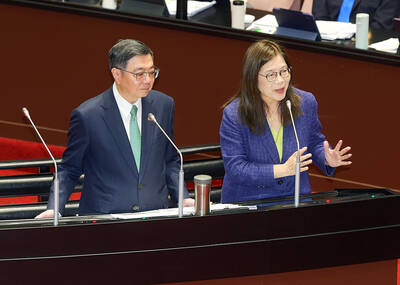
The donation of offshore patrol vessel Kinmen to the Philippines includes provisions that protect Taiwanese fishers and facilitate security cooperation across the First Island Chain, officials said yesterday. The comment was made during the Cabinet’s comprehensive administrative report at the legislature after Chinese Nationalist Party (KMT) Legislator Hsu Yu-chen (許宇甄) expressed concerns about the decision to give a ship to a country whose coast guard had in 2013 fired on a Taiwanese trawler and killed its captain without provocation. The Cabinet should lay out the safeguards that have been established to prevent the Philippine government from using the Kinmen to harass, expel
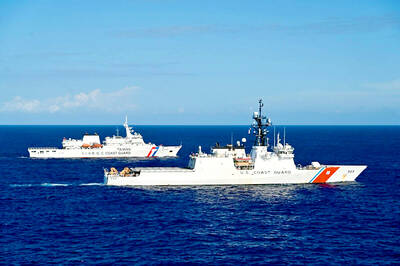
GROWING TIES: The CGA is planning a goodwill mission to the Philippines, in what would be the first time since 1975 a Taiwanese paramilitary vessel has visited the country The Coast Guard Administration (CGA) plans to significantly expand its participation in international security cooperative frameworks and its operational capabilities, a budget proposal for next year showed. The budget indicates a transformation of the CGA from a maritime law enforcement arm into a national defense and intelligence gathering entity capable of tackling larger regional security matters. The proposal showed that personnel from the coast guard’s Intelligence Division and Special Action Support Center are to participate in high-level national security talks with the US. As the CGA has dealt with China’s rising “gray zone” threats around Taiwan, it has become a valuable asset to
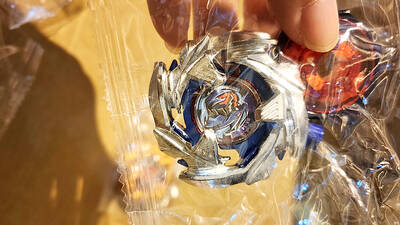
The National Police Agency’s Third Special Police Corps yesterday said that from May to July, it intercepted five smuggling operations from China, seizing more than 70,000 counterfeit Beyblades with an estimated infringement value of NT$34.45 million (US$1.08 million). It added that any bootleg unit that reached the local market could present hidden health hazards to players. Beyblades, a line of spinning toy tops used in competitive gaming and developed in Japan by toy company Takara Tomy, have become popular in Taiwan, making them a target for fraudsters. The Third Special Police Corps, dedicated to safeguarding maritime borders and trade lines,
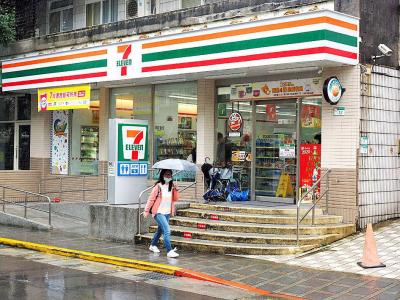
Five customers who made purchases at 7-Eleven stores across Taiwan won the top NT$10 million (US$313,716) special prize in the July-August uniform invoice lottery, including one who spent just NT$27 on photocopying, the convenience store chain said today. The five special prize winners made their purchases at stores in Taoyuan, Taipei, Taichung and Kaohsiung, 7-Eleven operator President Chain Store Corp said. The five winning purchases included NT$29 spent on snacks at a store in Taoyuan's Zhongli District (中壢), NT$27 on photocopying at a store in Taipei's Zhongzheng District (中正), NT$139 on City Cafe coffee and daily necessities at a store in Taipei's


 RSS