

President William Lai (賴清德) yesterday asked government agencies to remain vigilant and keep Taiwan free from African swine fever (ASF), after a pig carcass found on a beach in Kinmen County tested positive for the highly contagious disease.
In a social media post, Lai said he has instructed the Ministry of Agriculture and other agencies to implement quarantine, surveillance and control measures, make sure interagency reporting and response mechanisms are functioning properly, and keep the public informed to safeguard Taiwan’s pig farming industry.
The carcass was discovered on Tuesday after it had apparently drifted onto the beach.
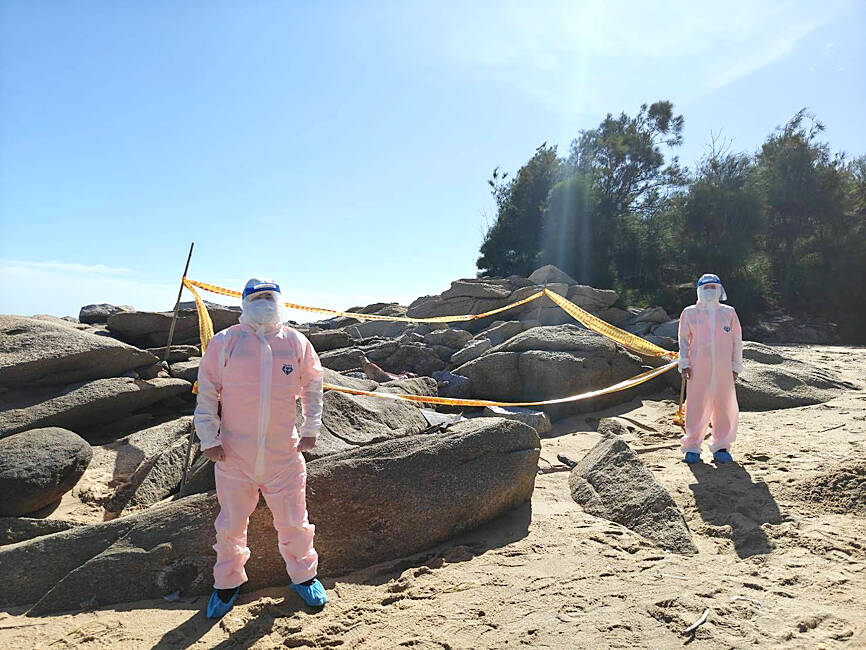
Photo courtesy of the Kinmen County Government
County authorities immediately took a sample for testing, which yielded a positive result for ASF, Lai said.
The county, located less than 10km off China’s coast, immediately incinerated and buried the carcass, disinfected the site, and suspended shipments of pork and processed pork products from Kinmen to Taiwan proper and other offshore islands, he said.
A subsequent real-time quantitative polymerase chain reaction test also confirmed that the carcass was positive for ASF, making it the 21st ASF-positive pig carcass found washed ashore since 2018, he said.
The Coast Guard Administration has also stepped up coastal patrols and anti-smuggling operations, while the Animal and Plant Health Inspection Agency has strengthened border quarantine measures, Lai said.
The Kinmen County Animal and Plant Disease Control Center has also completed health inspections of nearby pig farms and confirmed that all pigs are in good health, he said.
In April, the World Organization for Animal Health approved Taiwan’s self-declaration as an ASF-free area, which Lai said reflected the nation’s extensive disease prevention experience and expertise.
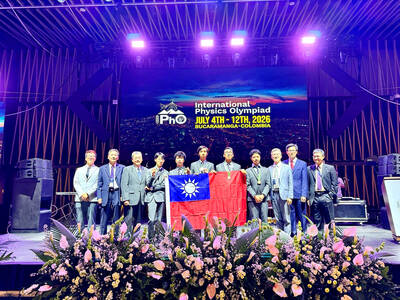
Taiwan tied for first with five golds at the 56th International Physics Olympiad (IPhO) held in Colombia this year, showcasing high school physics prowess. The team, led by National Taiwan Normal University physics professor Chen Chuan-Ren (陳傳仁), was represented by five students, who were chosen from 2,361 students nationwide via multiple selections to receive pre-competition training. Competing with 381 participants from 91 countries, all five students won a gold medal for Taiwan. Other countries earning five golds included China, India, Kazakhstan, South Korea and Russia. One of the five Taiwanese, Chien Kuo High School (CKHS) student Wu Ssu-chien (吳思謙) said he has enjoyed studying

Beijing has been offering subsidized trips to China’s Xinjiang region for Taiwanese teachers as part of efforts to influence teachers and, indirectly, students, a government official said yesterday. With China subsidizing the trips, the teachers only need to pay a NT$4,000 registration fee for an eight-day, seven-night tour that includes accommodation and meals, the official said, speaking on condition of anonymity. Participants risk having their personal information collected and their social networks monitored by Chinese authorities, the official said. Chinese authorities are offering separate summer exchange programs targeting Taiwanese teachers and students, with the student program including study-related activities, they

Saudi Arabia bought a record US$47.2 million of drones from Taiwan last month — a sign that the nation’s nascent uncrewed aerial vehicle (UAV) industry is becoming more attractive to buyers. The figure, released by the Ministry of Finance in Taipei last week, was the most in a month for any nation in data going back to June 2023. The Czech Republic has previously been a major buyer. It was unclear how Saudi Arabia intended to use the drones, which weighed an average of 7kg to 15kg. UAVs in that weight category can be used for a range of industrial and military purposes. Su

THE PLAYBOOK: Beijing starts claims in the region with reinterpretations of history by academics, followed by ‘law enforcement’ actions and missile tests, the source said China aims to control the First Island Chain through naval maneuvers and legal warfare, a national security source said yesterday, urging Taiwan, Japan and the Philippines to act early to counter the threat. In the 10 years since a tribunal administered by the Permanent Court of Arbitration on July 12, 2016, ruled that China’s claims to historic rights in the South China Sea within its “nine-dash line” had no legal basis, Beijing has not only failed to rein in its authoritarian expansion in the region, but has also displayed greater outward aggression, despite the ruling helping to ease regional tensions


 RSS
RSS