

Taiwan faces an extremely difficult diplomatic situation because China is suppressing it “everywhere,” Vice President Hsiao Bi-khim (蕭美琴) said yesterday, after Papua New Guinea (PNG) said it was closing Taipei’s representative office in the country.
The Pacific has long been an area for diplomatic competition between China and Taiwan.
PNG Minister of Foreign Affairs Justin Tkatchenko on Thursday said that Taiwan’s office would be closed, drawing praise from Beijing and condemnation from Taipei.

Photo: CNA
Papua New Guinea, like most countries, only has formal ties with China, not Taiwan.
“Our diplomatic situation is truly extremely difficult. China is suppressing us everywhere — suppressing our chances to survive and to expand our international space,” Hsiao told reporters in Taipei.
“For us, this is a setback, but we will still continue to strive — to strive for opportunities, whether for our overseas compatriots or to continue expanding our cooperation with the international community,” she said.
Only 12 countries maintain formal diplomatic ties with Taiwan, three of which are in the Pacific — Palau, Tuvalu and the Marshall Islands.
New Zealand’s Ministry of Foreign Affairs and Trade said in a statement that it was aware of PNG’s statement about the closure of Taiwan’s office.
“We will seek further information about this decision in due course,” it added, without elaborating.
Taiwan and Papua New Guinea are both members of APEC.
Port Moresby hosted the group’s annual leaders’ summit in 2018, which was attended by a Taiwanese government envoy.
PNG very briefly had diplomatic relations with Taiwan in 1999, and Taiwan also has a representative office in Fiji.
In 2020, a Taiwanese diplomat ended up in hospital in Fiji after two Chinese diplomats stormed into a reception trying to gather information on the attendees.
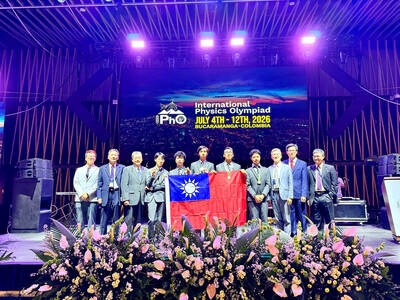
Taiwan tied for first with five golds at the 56th International Physics Olympiad (IPhO) held in Colombia this year, showcasing high school physics prowess. The team, led by National Taiwan Normal University physics professor Chen Chuan-Ren (陳傳仁), was represented by five students, who were chosen from 2,361 students nationwide via multiple selections to receive pre-competition training. Competing with 381 participants from 91 countries, all five students won a gold medal for Taiwan. Other countries earning five golds included China, India, Kazakhstan, South Korea and Russia. One of the five Taiwanese, Chien Kuo High School (CKHS) student Wu Ssu-chien (吳思謙) said he has enjoyed studying

Beijing has been offering subsidized trips to China’s Xinjiang region for Taiwanese teachers as part of efforts to influence teachers and, indirectly, students, a government official said yesterday. With China subsidizing the trips, the teachers only need to pay a NT$4,000 registration fee for an eight-day, seven-night tour that includes accommodation and meals, the official said, speaking on condition of anonymity. Participants risk having their personal information collected and their social networks monitored by Chinese authorities, the official said. Chinese authorities are offering separate summer exchange programs targeting Taiwanese teachers and students, with the student program including study-related activities, they

Saudi Arabia bought a record US$47.2 million of drones from Taiwan last month — a sign that the nation’s nascent uncrewed aerial vehicle (UAV) industry is becoming more attractive to buyers. The figure, released by the Ministry of Finance in Taipei last week, was the most in a month for any nation in data going back to June 2023. The Czech Republic has previously been a major buyer. It was unclear how Saudi Arabia intended to use the drones, which weighed an average of 7kg to 15kg. UAVs in that weight category can be used for a range of industrial and military purposes. Su

THE PLAYBOOK: Beijing starts claims in the region with reinterpretations of history by academics, followed by ‘law enforcement’ actions and missile tests, the source said China aims to control the First Island Chain through naval maneuvers and legal warfare, a national security source said yesterday, urging Taiwan, Japan and the Philippines to act early to counter the threat. In the 10 years since a tribunal administered by the Permanent Court of Arbitration on July 12, 2016, ruled that China’s claims to historic rights in the South China Sea within its “nine-dash line” had no legal basis, Beijing has not only failed to rein in its authoritarian expansion in the region, but has also displayed greater outward aggression, despite the ruling helping to ease regional tensions


 RSS