

The Executive Yuan on Thursday said it would work to ensure that Taiwan Semiconductor Manufacturing Co’s (TSMC) most advanced technology remains in Taiwan after the chipmaker announced plans to invest an additional US$100 billion in the US.
TSMC chairman C.C. Wei (魏哲家) announced earlier on Thursday that the company would invest an additional US$100 billion in Arizona to build four more advanced wafer and packaging facilities, on top of a previous US$165 billion investment commitment in the state.
The pledge compounded concerns in Taiwan that its edge in advanced semiconductors would be eroded as it invested more abroad, especially as Washington insists that more of the world’s semiconductors be manufactured in the US.
Photo: I-Hwa Cheng, AFP
In a statement issued on Thursday, Cabinet spokesperson Michelle Lee (李慧芝) said the government has respected TSMC’s gradual expansion of its global footprint in the past few years in response to market demand, especially given the rapid growth in artificial intelligence (AI).
Lee also highlighted Wei’s announcement that TSMC planned to build 13 leading-edge and advanced packaging fabs in Taiwan over the next several years, saying it would help ensure Taiwan remains home to most of TSMC’s manufacturing capacity and most advanced technology.
The government is helping facilitate TSMC’s domestic expansion by securing land for future investments and supporting infrastructure such as water, electricity and energy supplies, as it prioritizes keeping a complete semiconductor ecosystem in Taiwan, she said.
Foreign companies, including Nvidia, Advanced Micro Devices and Micron, were continuing to expand their operations in Taiwan, reflecting confidence in the country’s semiconductor industry and supply chain, she added.
The Ministry of Economic Affairs said the global AI boom is continuing to drive growth in Taiwan’s semiconductor industry, with local companies expanding overseas while also increasing investment at home to strengthen their roots in Taiwan.
TSMC, which operates 19 advanced process and packaging facilities in Taiwan, is planning to expand its investment in the country, which would help it maintain a much larger advanced process capacity at home than overseas, it said.
The government will continue to improve Taiwan’s investment environment and support companies’ global expansion while strengthening the resilience and competitiveness of the semiconductor supply chain, the ministry said, without elaborating.
Separately, American Institute in Taiwan (AIT) Director Raymond Greene on Thursday welcomed TSMC’s plan to increase its investment in the US, describing it as a sign of confidence in bilateral ties.
“This investment is a powerful signal of the trust and confidence that defines the US-Taiwan partnership,” Greene said in a post on the AIT’s Facebook page.
The investment would allow TSMC to operate closer to its largest US customers, respond more quickly to growing global demand for advanced chips and contribute to more resilient supply chains, he said.
“Being closer to the customer matters,” Greene said, adding that proximity to end users would enable TSMC to “move at market speed,” as artificial intelligence and high-performance computing transform industries.
Regarding concerns that TSMC’s overseas investment plans might erode Taiwan’s leading position in advanced semiconductors, thus depriving it of a “silicon shield” that makes foreign powers more likely to defend Taiwan if attacked by China, Greene said that Taiwan would remain the anchor of the semiconductor industry even as TSMC expands internationally.
He cited growth in Taiwan’s semiconductor output from about NT$4.3 trillion (US$133.2 billion) in 2023 to a projected NT$8.4 trillion this year.
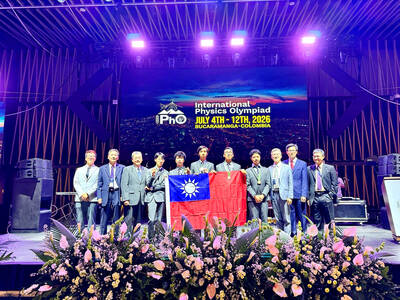
Taiwan tied for first with five golds at the 56th International Physics Olympiad (IPhO) held in Colombia this year, showcasing high school physics prowess. The team, led by National Taiwan Normal University physics professor Chen Chuan-Ren (陳傳仁), was represented by five students, who were chosen from 2,361 students nationwide via multiple selections to receive pre-competition training. Competing with 381 participants from 91 countries, all five students won a gold medal for Taiwan. Other countries earning five golds included China, India, Kazakhstan, South Korea and Russia. One of the five Taiwanese, Chien Kuo High School (CKHS) student Wu Ssu-chien (吳思謙) said he has enjoyed studying

Beijing has been offering subsidized trips to China’s Xinjiang region for Taiwanese teachers as part of efforts to influence teachers and, indirectly, students, a government official said yesterday. With China subsidizing the trips, the teachers only need to pay a NT$4,000 registration fee for an eight-day, seven-night tour that includes accommodation and meals, the official said, speaking on condition of anonymity. Participants risk having their personal information collected and their social networks monitored by Chinese authorities, the official said. Chinese authorities are offering separate summer exchange programs targeting Taiwanese teachers and students, with the student program including study-related activities, they
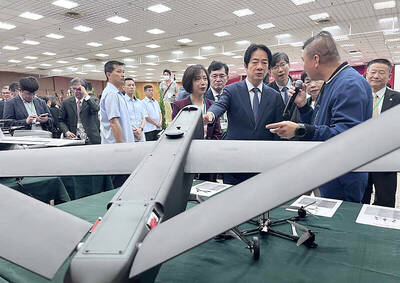
Saudi Arabia bought a record US$47.2 million of drones from Taiwan last month — a sign that the nation’s nascent uncrewed aerial vehicle (UAV) industry is becoming more attractive to buyers. The figure, released by the Ministry of Finance in Taipei last week, was the most in a month for any nation in data going back to June 2023. The Czech Republic has previously been a major buyer. It was unclear how Saudi Arabia intended to use the drones, which weighed an average of 7kg to 15kg. UAVs in that weight category can be used for a range of industrial and military purposes. Su

THE PLAYBOOK: Beijing starts claims in the region with reinterpretations of history by academics, followed by ‘law enforcement’ actions and missile tests, the source said China aims to control the First Island Chain through naval maneuvers and legal warfare, a national security source said yesterday, urging Taiwan, Japan and the Philippines to act early to counter the threat. In the 10 years since a tribunal administered by the Permanent Court of Arbitration on July 12, 2016, ruled that China’s claims to historic rights in the South China Sea within its “nine-dash line” had no legal basis, Beijing has not only failed to rein in its authoritarian expansion in the region, but has also displayed greater outward aggression, despite the ruling helping to ease regional tensions


 RSS
RSS