


China's deployment of scientific research and survey vessels in waters east of Taiwan and beyond carries a military motive — to prepare to deny foreign naval vessels access to strategically important waters, a coast guard captain said yesterday.
Speaking at the Taiwan International Ocean Forum, Arthur Yang (楊献璋), captain of the Coast Guard Administration's (CGA) Sixth Offshore Flotilla, said that research vessels are one of China's tools for harassing Taiwan, along with coast guard and flag-of-convenience ships.
China has increased research vessel activity in the waters east of Taiwan since Tokyo and Manila in May announced that they would begin talks on an area — also claimed by China — where the exclusive economic zones of Taiwan, Japan and the Philippines overlap.
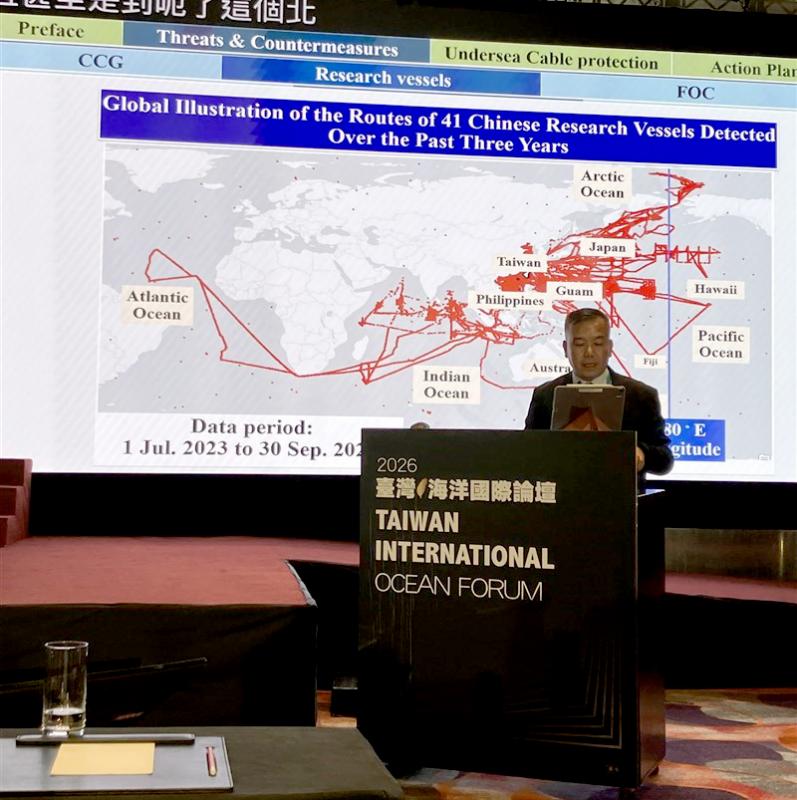
Photo: CNA
China extensively mapped the waters east of Taiwan and the Bashi Channel between 2023 and last year, said Yang, citing a report by the Institute for the Study of War, a US think tank.
Yang is stationed in Hualien County on Taiwan’s east coast.
From July 2023 to September last year, 41 Chinese research vessels monitored by the CGA were deployed to the second and third island chains and the Arctic and Atlantic oceans, he said, citing CGA data.
"We must be clear. This is not scientific research. This bathymetric and hydrographic data serves Beijing's anti-access / area denial strategy," Yang said.
"This global expansion confirms these missions are dual-use operations designed to support China's military strategic objectives," he said.
Asked to elaborate, Yang said that scientific research is normally conducted within a defined area, but Chinese research vessels have operated across the first island chain, which extends from Japan to Borneo, and into the Atlantic and Indian oceans, suggesting their activities have "gone beyond the scope of research."
Those "research projects" extended far beyond China's exclusive economic zone, and it is unlikely Beijing obtained consent from coastal states before operating in those waters, he said.
"It is very likely that China was covertly conducting [anti-access / area denial preparations]," Yang said.
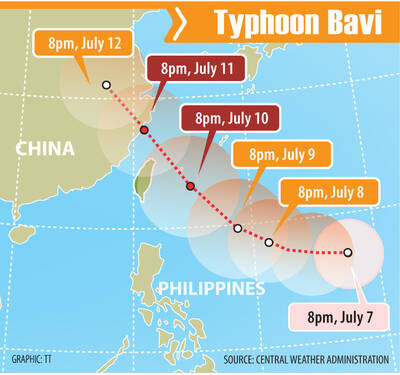
TORRENTIAL: People should be on alert for heavy rain, the CWA said, as Typhoon Bavi is forecast to bring more than 1m of rain to Taiwan Torrential rain brought by Typhoon Bavi is forecast to affect Taiwan most severely on Friday and Saturday, prompting authorities to urge local governments to clear drainage ditches, while nearly 29,000 troops were placed on disaster-prevention standby. As of 2pm yesterday, the typhoon’s center was approximately 1,930km east-southeast of Oluanpi (鵝鑾鼻), Taiwan proper’s southernmost tip, moving west-northwest at 25kph, the Central Weather Administration (CWA) said. Bavi is showing signs of weakening as it approaches Taiwan, although it is still expected to have the intensity of a typhoon, CWA forecaster Lee Meng-hsuan (李孟軒) said. The typhoon has a 350km storm radius, Lee said,
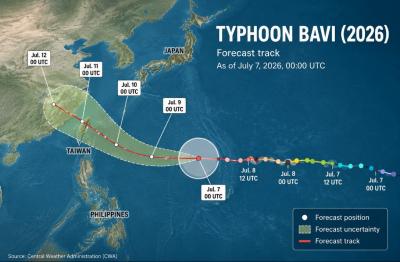
As Typhoon Bavi approaches Taiwan from the southeast, a sea warning is expected to be issued on Thursday, followed by a land warning on either Thursday evening or Friday morning, the Central Weather Administration (CWA) said today. With a relatively wide radius of 350km, the typhoon is expected to affect a wide swathe of the country as it passes by to the north, bringing the heaviest rain on Friday and Saturday, when its path tracks closest to Taiwan, the weather agency said. Torrential rain is forecast in mountainous regions north of Taichung on Friday and Saturday, while heavy rain is also
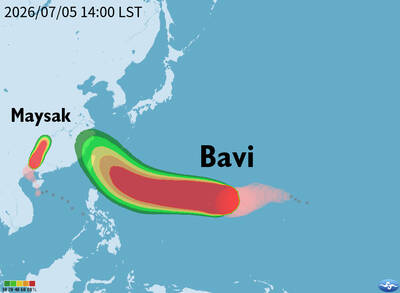
Typhoon Bavi is expected to make its closest approach to Taiwan on Friday and Saturday, with a sea warning likely to be issued as the storm approaches, the Central Weather Administration (CWA) said yesterday. As of 2pm, the eye of the typhoon was about 3,030km east-southeast of Oluanpi (鵝鑾鼻), Taiwan’s southernmost tip, and moving west-northwest at 17kph, the CWA said. The storm, which has a radius of 320km, had maximum sustained winds of 198kph near its center, it said. CWA forecaster Lai Hsin-kuo (賴欣國) said Bavi is expected to strengthen further today, with maximum sustained winds reaching 227kph and its
Taiwan yesterday stepped up preparations for Typhoon Bavi, suspending ferry services to outlying islands, closing tourist attractions, preparing traffic restrictions and offering flexible airline ticket changes. As of 2pm yesterday, Bavi was about 1,380km east-southeast of Oluanpi (鵝鑾鼻), Taiwan’s southernmost point, moving west-northwest at 17kph to 21kph, the Central Weather Administration (CWA) said. All ferry services in eastern Taiwan were suspended yesterday afternoon, the Maritime and Port Bureau said. Services could resume on Sunday, if the weather permits, it added. The Keelung-Matsu route is also to be suspended from today through Saturday, while routes linking Kaohsiung and Budai (布袋) with Penghu, as well as


 RSS
RSS