


The National Park Service and the chip industry association SEMI Taiwan signed a memorandum of understanding (MOU) yesterday to strengthen public-private cooperation and advance Taiwan’s sustainability goals.
Minister of the Interior Liu Shyh-fang (劉世芳), who witnessed the signing ceremony, said the partnership would help protect two of Taiwan’s most valuable assets: its technology industry and rich biodiversity.
The National Park Service oversees all designated national parks, wetlands and coastal conservation areas in Taiwan and plays a key role in implementing the UN’s 30x30 initiative, which aims to protect 30 percent of the world’s land, oceans and inland waters by 2030, Liu said.

Photo: CNA
Under the MOU, SEMI Taiwan’s hundreds of member companies would provide technological support to help the government improve environmental monitoring, develop natural carbon sinks and restore damaged ecosystems, she said.
The Ministry of the Interior said Taiwan has designated 25.4 percent of its land and territorial waters as environmentally important areas, including national parks, wetlands and coastal zones.
The National Park Service has already led 106 public-private conservation initiatives in these areas, which collectively absorb about 2.28 million tonnes of carbon emissions annually, the ministry said.
The agreement marks a new phase in collaboration between the government and private sector, aligning Taiwan’s sustainable development policies with companies’ environmental, social and governance (ESG) objectives, it said.
The partnership will allow the government to tap into private-sector resources for conservation projects aimed at protecting black-faced spoonbills, coral reefs and other critical habitats, it said.
The industry association’s members will also establish employee volunteer programs for conservation efforts and support the purchase of environmentally friendly products from Indigenous communities, according to the ministry.
SEMI will promote the conservation efforts of its Taiwan branch and the government, helping raise Taiwan’s international visibility and influence, it added.
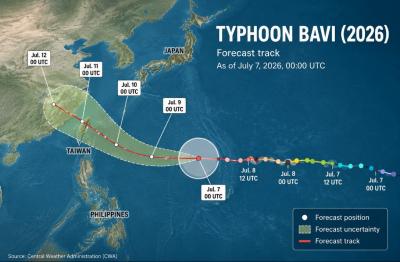
As Typhoon Bavi approaches Taiwan from the southeast, a sea warning is expected to be issued on Thursday, followed by a land warning on either Thursday evening or Friday morning, the Central Weather Administration (CWA) said today. With a relatively wide radius of 350km, the typhoon is expected to affect a wide swathe of the country as it passes by to the north, bringing the heaviest rain on Friday and Saturday, when its path tracks closest to Taiwan, the weather agency said. Torrential rain is forecast in mountainous regions north of Taichung on Friday and Saturday, while heavy rain is also
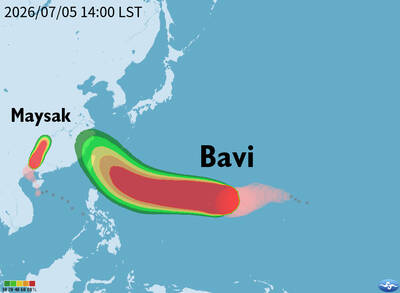
Typhoon Bavi is expected to make its closest approach to Taiwan on Friday and Saturday, with a sea warning likely to be issued as the storm approaches, the Central Weather Administration (CWA) said yesterday. As of 2pm, the eye of the typhoon was about 3,030km east-southeast of Oluanpi (鵝鑾鼻), Taiwan’s southernmost tip, and moving west-northwest at 17kph, the CWA said. The storm, which has a radius of 320km, had maximum sustained winds of 198kph near its center, it said. CWA forecaster Lai Hsin-kuo (賴欣國) said Bavi is expected to strengthen further today, with maximum sustained winds reaching 227kph and its
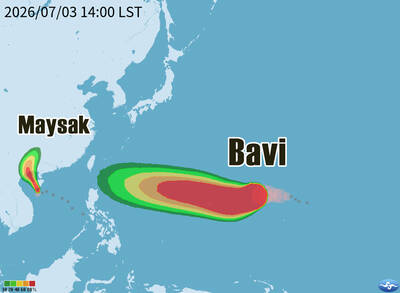
TWO STORMS: Typhoon Bavi was 3,670km from Taiwan, with models showing diverging tracks for it, while a second storm was expected to not affect Taiwan at all Typhoon Bavi, which was moving westward over waters east of the Philippines, was showing signs of strengthening, although its potential impact on Taiwan was uncertain, the Central Weather Administration (CWA) said yesterday. As of 2pm, the center of the storm was 3,670km east of Oluanpi (鵝鑾鼻), Taiwan proper’s southernmost tip, moving westward and slowing to 11kph from about 15kph, CWA data showed. It had maximum sustained winds of up to 155kph near its center, with gusts of up to 191kph, the data showed. Due to environmental conditions, the CWA said that Bavi was expected to continue to strengthen in the next few days. Forecasts
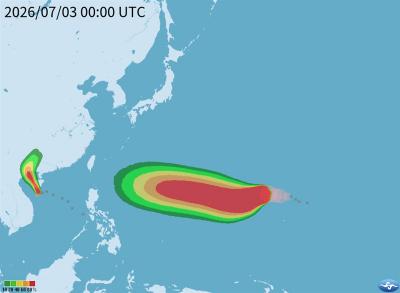
Typhoon Bavi, which is moving westward over waters east of the Philippines, is showing signs of intensifying, though its potential impact on Taiwan remains uncertain, the Central Weather Administration (CWA) said today. As of 8am, the center of the storm was 3,800km east-southeast of Oluanpi (鵝鑾鼻), on the southernmost tip of Taiwan, moving westward but slowing from 16kph to 13kph, CWA data showed. It was packing maximum sustained winds of up to 137kph near its center, with gusts of up to 173kph, the weather agency said. Due to environmental conditions, Bavi is expected to continue strengthening in the coming days, the CWA said. The


 RSS
RSS