

The Ministry of Health and Welfare (MOHW) is today to convene a meeting with the nation’s four major cooking oil producers to establish a new oil management system, Minister of Health and Welfare Shih Chung-liang (石崇良) said yesterday, following criticism of the cooking oil recall issue.
The Food and Drug Administration (FDA) on Tuesday last week was notified by Central Union Oil Corp that batch No. 315-1150404, manufactured in April, contained excessive levels of the carcinogen benzopyrene during internal testing, and that the batch had been distributed to three companies — Taisun Enterprise Co, Fwusow Industry Co and Formosa Oilseed Processing Co.
The three companies on Tuesday last week began removing products that used the contaminated oil from shelves and launched recalls after receiving the notification, the FDA said.

Photo: Taipei Times
However, the FDA initially only ordered the recall of the raw oil and did not require the removal of blended oils or downstream food products, raising public concern.
Food safety authorities on Saturday expanded the product recall to processed foods made with more than 20 percent of the contaminated oil.
The FDA said it has notified 257 affected businesses, and required them to remove affected products from shelves and publicly disclose product information by 11:59pm today.
Shih said the Food Safety and Sanitation Act (食品安全衛生管理法) is guided by two core principles.
First, in cases involving illegal additives or substances exceeding toxic limits, first and second-tier products must be fully removed and recalled, he said.
Second, for legally permitted additives or substances formed naturally during production, a “safety threshold” approach is used — only products exceeding the standard are pulled from shelves. Second-tier products are generally not considered a risk, he added.
The current case was handled under the second framework, Shih said.
He said he initially found it was “strange” not to call for a second-tier recall, but added that the FDA followed the law and acted in line with regulations.
The agency later added blended oils to the recall list after assessing that the case was far more widespread than previous cases, Shih said.
The regulations would need to be revisited through a new expert meeting, he added.
FDA Director-General Chiang Chih-kang (姜至剛) cited experts as saying that the incident might be linked to heat damage from post-harvest drying and fumigation of some Brazilian soybeans.
Benzopyrene levels in crude soybean oil vary significantly and can typically only be reduced by up to about 80 percent even after refining, he said.
If the raw material already contains high levels of benzopyrene, the refined oil might still exceed legal limits, he added.
While soybeans imported from the US have showed no detectable benzopyrene and past tests of Brazilian soybeans have all complied with regulations, in April, a batch of Brazilian soybeans was found to contain 1.6 ppb, within the legal limit of 2 ppb, Chiang said.
Benzopyrene levels could also vary between batches of raw materials in continuous production, so some oil that originally passed testing might later exceed limits downstream, he cited experts as saying.
That is why the problem was first picked up in checks by downstream companies, Chiang said.
Experts have recommended tightening controls at the raw material stage, including lowering the acceptable moisture level for Brazilian soybeans from 13 percent to 12.5 percent to reduce heat damage risk from drying and fumigation, he added.
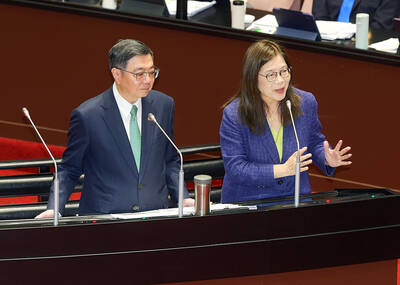
The donation of offshore patrol vessel Kinmen to the Philippines includes provisions that protect Taiwanese fishers and facilitate security cooperation across the First Island Chain, officials said yesterday. The comment was made during the Cabinet’s comprehensive administrative report at the legislature after Chinese Nationalist Party (KMT) Legislator Hsu Yu-chen (許宇甄) expressed concerns about the decision to give a ship to a country whose coast guard had in 2013 fired on a Taiwanese trawler and killed its captain without provocation. The Cabinet should lay out the safeguards that have been established to prevent the Philippine government from using the Kinmen to harass, expel
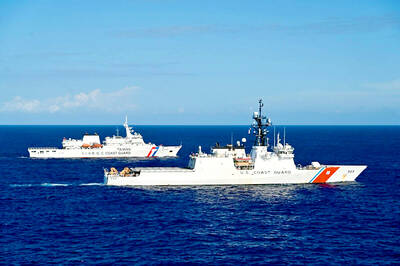
GROWING TIES: The CGA is planning a goodwill mission to the Philippines, in what would be the first time since 1975 a Taiwanese paramilitary vessel has visited the country The Coast Guard Administration (CGA) plans to significantly expand its participation in international security cooperative frameworks and its operational capabilities, a budget proposal for next year showed. The budget indicates a transformation of the CGA from a maritime law enforcement arm into a national defense and intelligence gathering entity capable of tackling larger regional security matters. The proposal showed that personnel from the coast guard’s Intelligence Division and Special Action Support Center are to participate in high-level national security talks with the US. As the CGA has dealt with China’s rising “gray zone” threats around Taiwan, it has become a valuable asset to
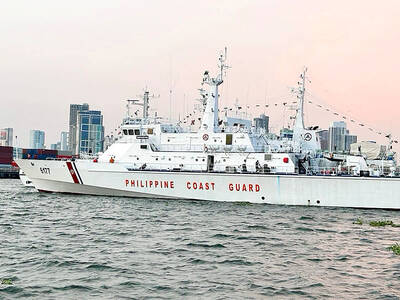
A patrol vessel donated by the Coast Guard Administration (CGA) to the Philippines was commissioned into the Philippine Coast Guard (PCG) on Friday, a Philippine non-governmental organization said. The CGA on Sept. 16 confirmed media reports that Taiwan had donated a retired 500-tonne patrol vessel to the Philippines. The Manila-based We Protect Our Seas (WPS) foundation, which served as an intermediary in the transfer, said that the vessel was formerly the CGA’s 500-tonne petrol vessel Kinmen (CG123). The WPS, in a statement issued on Friday, said the vessel, renamed as the BRP Sarangani, had been commissioned into the PCG the
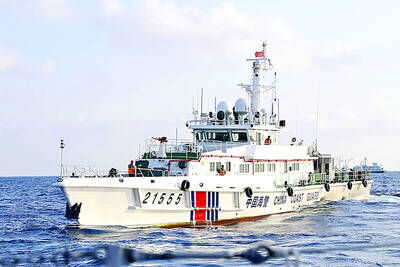
‘GRAY ZONE’ TACTICS: Beijing sent two China Coast Guard vessels to escort a ‘supposedly private research ship,’ a Philippine Coast Guard spokesman said The Coast Guard Administration (CGA) yesterday confirmed that it had recently deployed three patrol vessels to waters in Taiwan’s overlapping exclusive economic zone with the Philippines to monitor three Chinese vessels. CGA Deputy Director-General Hsieh Ching-chin (謝慶欽) said the agency regularly monitors Chinese vessels around Taiwan, and that the deployment south of Oluanpi (鵝鑾鼻), Taiwan proper’s southernmost point, was carried out in accordance with standard procedures. He added that the waters fall within the overlapping exclusive economic zones of Taiwan and the Philippines, which extend 200 nautical miles (370km) from their coastlines. Hsieh made the comments when asked about a


 RSS