


Animal rights advocates yesterday rallied on Ketagalan Boulevard in Taipei to urge the government to fulfill its commitment to ban snare traps.
The Ministry of Agriculture had promised to announce a snare trap ban within a year back in 2024, but failed to follow through, they said.
They called on President William Lai (賴清德) to urge the ministry to introduce the ban, with a collection of letters and postcards written by more than 10,000 people presented to the Presidential Office.

Photo: CNA
Chao Ping-chu (趙炳筑), who traveled with her husband from Nantou County to join the rally, said she was there to speak for animals harmed by traps near where she lives.
Chao said she never saw a snare trap while living in downtown Kaohsiung and did not know what one was until her family moved to Nantou’s Puli Township (埔里) two years ago.
The township is surrounded by mountains, she said, adding that it was hard to find a dog with all four legs there.
“I was shocked when I once saw more than 10 dogs that all had lost at least a limb,” Chao said.
Snare traps injure or kill many animals, including wildlife such as muntjacs or civets and stray dogs and cats, but such scenes remained unseen and unimaginable for most urban residents, Chao said.
“That is why we felt it necessary to travel all the way to express support, to advocate for banning snare traps,” she said.
Taiwan One Ecology Coalition spokesman Pan Han-chiang (潘翰疆) said legislators across party lines proposed a draft bill to ban snare traps, but the bills were still on hold at the legislature’s Economics Committee.
Snare traps are accessible to anyone and its use is not limited to indigenous people, he said, adding that indigenous people should not be stigmatized for using it.
Pan called on the ministry to announce an administrative order banning snare traps.
Special clauses can be included in the ban, allowing indigenous people to use improved snare traps if they have registered with the local authority and would periodically check their traps, he said.
Animals caught by a snare trap would experience necrosis near the wound within three hours and would die of thirst and hunger within three days, Pan said.
Many hunters that place traps regularly patrol the mountains, he said, which can substantially reduce the risk of animals dying from the traps.
There are records of a wide range of wildlife in Taiwan, including crab-eating mongoose, Formosan macaques and leopard cats being injured or killed by snare traps, Pan said.
Data from the coalition showed that at least 31 Formosan black bears were caught in snare traps over the past five years, killing at least nine.
At least nine leopards were trapped, in the past three years, killing eight, the data showed.
In response, the ministry’s Forestry and Nature Conservation Agency yesterday said the pledge to ban snaring was made with the premise that a consensus is reached with local indigenous communities.
A survey carried out by the Council of Indigenous Peoples in January showed that only 41 percent of indigenous people approved of the design of improved snare traps, while up to 60 percent of indigenous people opposed completely banning snare traps, the forestry agency said.
Regarding advocates’ concern that improved snare traps might not be less harmful, as small animals’ limbs would still be trapped in the 12cm snare loop, the agency said anti-slip designs were incorporated to limit the snare loop diameter to no less than 7cm.
Banning snare traps might drive the use underground and deter users from reporting trapped endangered wildlife, such as black bears, to authorities, adding it would continue to promote replacing snare traps with improved traps.
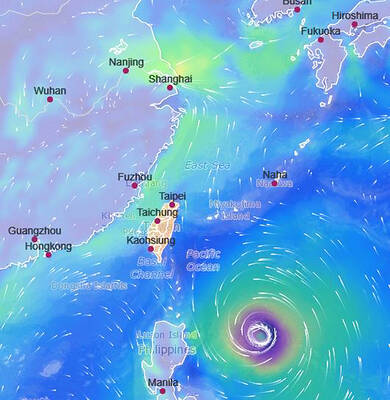
Typhoon Mekkhala is likely to come closest to Taiwan on Thursday, according to the Central Weather Administration (CWA), which forecast localized rain or thundershowers in western and northeastern parts of the country for that day. As of 2pm yesterday, the eye of the storm was 770km southeast of Oluanpi (鵝鑾鼻), the southernmost point of Taiwan, as it continued to move toward waters east of the Philippines, the agency said. Mekkhala was expected to become a severe typhoon last night, CWA forecaster Lai Hsin-kuo (賴欣國) said. A severe typhoon has maximum wind speeds of more than 184kph, compared with 118kph to 183kph for a
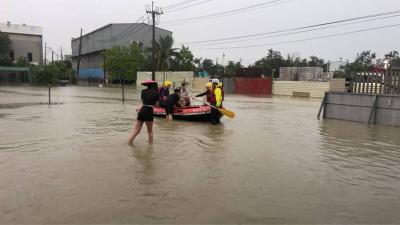
Torrential rains from a passing tropical storm shut down a swathe of southern Taiwan today, forcing more than 5 million people to stay home from work or school. Typhoon Mekkhala, now a tropical storm and nearing southern Japan's Ryukyu Islands, did not make direct landfall in Taiwan, but its outer bands brought heavy rain to parts of the nation, especially Kaohsiung, Tainan and Pingtung in the south. The governments of all three regions, where more than 5 million people live, ordered offices and schools closed today. Severe flooding in Tainan shut down a section of the main north-south railway line. No casualties have been
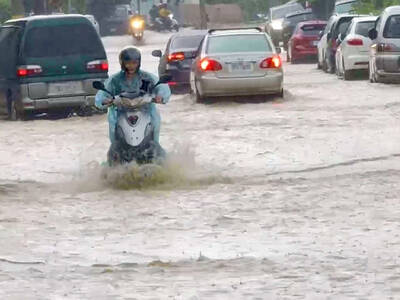
YELLOW ALERT: Work and classes are to be suspended in 10 districts in Kaohsiung, and residents in areas in Hualien County have been evacuated over flood risk, officials said The combined influence of Tropical Storm Mekkhala and the southwest jetstream brought torrential rainfall to Taiwan, with severe flooding reported in Taipei and multiple other regions. Today, work and classes are to be suspended in 10 districts of Kaohsiung — Namasiya (那瑪夏), Taoyuan (桃源), Jiaxian (甲仙), Liugui (六龜), Maolin (茂林), Meinong (美濃), Qishan (旗山), Neimen (內門), Shanlin (杉林) and Tianliao (田寮) — while Pingtung County would suspend work and classes across the entire county. Meanwhile, residents of seven areas in Hualien County’s Fonglin (鳳林) and Wanrong (萬榮) townships were to be evacuated yesterday, after a flood alert was issued for a

The new MRT Sanying Line in New Taipei City is scheduled to open on Tuesday next week, with rides free through Aug. 31 as part of a two-month trial period, New Taipei City Mayor Hou You-yi (侯友宜) said today. The New Taipei City Government’s Department of Rapid Transit Systems and New Taipei Metro Corp are to operate a new 14.29km-long metro line connecting 12 stations across the city’s Tucheng (土城), Sansia (三峽) and Yingge (鶯歌) districts. The commute time from the Sanying area into Taipei and New Taipei City is expected to be cut by up to 20 minutes, Hou


 RSS
RSS