


Taiwan is working to align its labor policies with evolving international standards, particularly in the areas of gig worker protections and labor rights in global supply chains, Minister of Labor Hung Sun- han (洪申翰) said during a visit to Brussels this week.
Speaking on the sidelines of the 7th EU-Taiwan Labor Consultation Meeting on Wednesday, Hung said Taiwan’s recently enacted law governing food delivery platforms reflects many of the principles currently being promoted internationally to safeguard the rights of platform workers.
The law, which is scheduled to take effect in July, includes measures aimed at strengthening protections for delivery workers, including fair treatment, workplace safety and access to social insurance, he said.
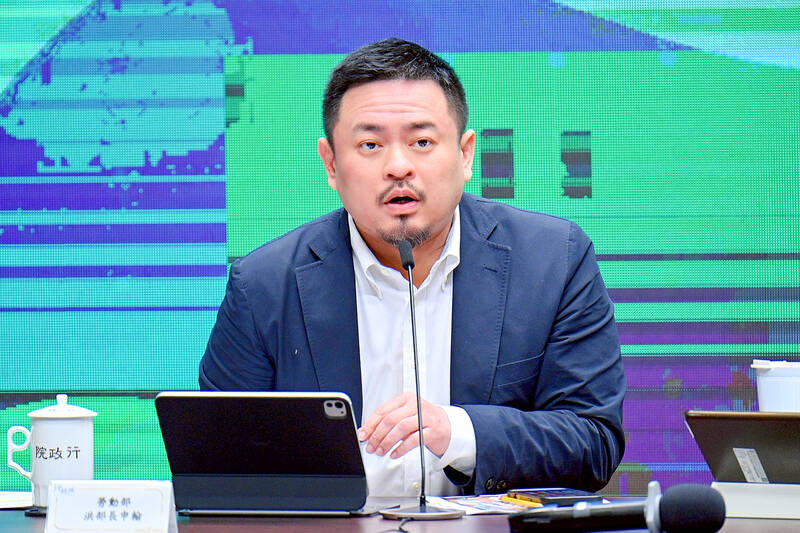
Photo courtesy of the Executive Yuan
Hung said labor challenges associated with the platform economy are a global issue rather than unique to Taiwan, adding that the country’s legislative approach shares many of the same objectives as emerging international standards on platform work.
According to Hung, officials and experts attending the consultation meeting expressed interest in Taiwan’s efforts to establish a legal framework for platform workers and exchanged views on how to balance worker protections with industry flexibility and innovation.
He emphasized that meaningful dialogue among governments, businesses, workers and consumers is essential to building consensus on increasingly complex labor issues.
Beyond the platform economy, labor rights in global supply chains were another key focus of the meeting, Hung said.
Concerns over forced labor and labor rights are no longer solely human rights issues, but have also become important considerations in international trade and supply chain management, he added.
As Taiwan assumes a larger role in global supply chains, the government is working to strengthen labor protections while helping businesses adapt to international expectations, Hung said.
The government’s objectives are to help companies reduce trade-related risks associated with labor compliance and to support industries in meeting international standards while keeping additional costs manageable, he noted.
Taiwan has introduced guidance and support measures to promote fair recruitment practices and strengthen labor rights protections, he said, adding that the efforts require close coordination across multiple government agencies.
In Taipei, the Ministry of Labor said in a statement released yesterday that the consultations also covered the impact of artificial intelligence on employment and labor shortages linked to demographic changes.
Both sides agreed to deepen exchanges, with the next EU-Taiwan Labor Consultation Meeting scheduled to be held in Taipei in 2027, it said.
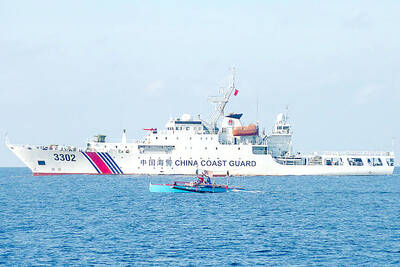
EXPANSIONIST: China deploys an average of 40 to 50 warships and coast guard vessels daily in the South China Sea, despite pledges not to militarize the region, an official said China is attempting to expand its influence across the First Island Chain and increase pressure on Japan by sending coast guard vessels into waters off of Taiwan under the pretext of maritime negotiations with Japan and the Philippines, a national security official said yesterday. China’s recent actions in the waters east of Taiwan and Japan and the Philippines’ exclusive economic zones (EEZ) are attempts to establish dominance in First Island Chain waters, said the official who declined to be named, adding that this is “expansion disguised as law enforcement.” Framing China’s actions solely as a cross-strait issue is a serious misjudgment that
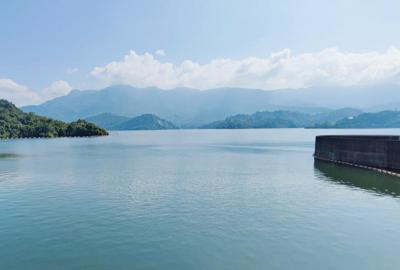
Several major reservoirs are estimated to have received 590 million tonnes of water inflow from June 4 to this morning, with storage levels at Wushantou Reservoir exceeding 50 percent and Zengwen Reservoir approaching 30 percent as of 9am today, data from the Water Resources Agency showed. Of the estimated 590 million tonnes, 450 million have already been stored in reservoirs, the data showed. As of 9am today, Baoshan Reservoir storage levels reached 100 percent, while Baoshan Second Reservoir, Yongheshan Reservoir and Techi Reservoir all exceeded 90 percent, data on the Water Resources Agency’s Web site showed. In addition, the Shimen Reservoir is at
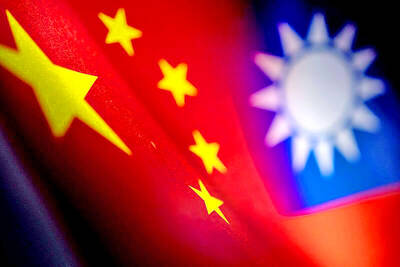
BAIT AND SWITCH: Allowing KMT-run counties to sell to China while the threat of abrupt cancelations hangs overhead is another form of coercion, officials said Beijing is using agricultural purchase offers announced during the Straits Forum to deepen Taiwan’s dependence on the Chinese market, a Taiwanese official said yesterday as they criticized the Taitung County commissioner’s participation in the initiative. During the Straits Forum held in Xiamen on Saturday, Chinese officials announced a sales and purchase agreement for agricultural products from some counties led by the Chinese Nationalist Party (KMT). Taitung County Commissioner Yao Ching-ling (饒慶鈴), who was barred from attending the event in person by the Mainland Affairs Council, participated via video. Under the agreement, China would purchase atemoyas, pomeloes, tea and grouper harvested in Taitung,

SHIFTING FIRE: While the tempo of purely military exercises around Taiwan has gone down somewhat, Beijing is working to isolate Lai diplomatically from support abroad Chinese President Xi Jinping (習近平) is shifting tactics in his campaign to pressure Taiwan, ramping up diplomatic isolation of the nation while dialing down provocative displays of military aggression. Taiwan recorded a daily average of five Chinese military aircraft crossing the Taiwan Strait’s buffer line with China through May this year — half the number logged in the same period last year. In March, Beijing did not send a single fighter jet near Taiwan for seven days, the longest absence on record outside of typhoon season. In comparison, China sent 153 planes near Taiwan during one day at its peak in


 RSS
RSS