


Taiwan needs to purchase US weapons to ensure its self-defense in the face of a growing threat from Beijing, Representative to the US Alexander Yui said.
A US$14 billion arms sale package to Taiwan is still in limbo after US President Donald Trump returned from Beijing last month and said he had discussed the proposal “in great detail” with Chinese President Xi Jinping (習近平), heightening anxieties in Taiwan and raising concerns among lawmakers on Capitol Hill.
“We need those arms for defensive purposes,” Yui, who heads the Taipei Economic and Cultural Representative Office in the US, told the Associated Press in an interview on Wednesday in Washington. “We’re trying to increase our defense expenditure. We try to increase our ability to defend ourselves better and survive times of crisis.”
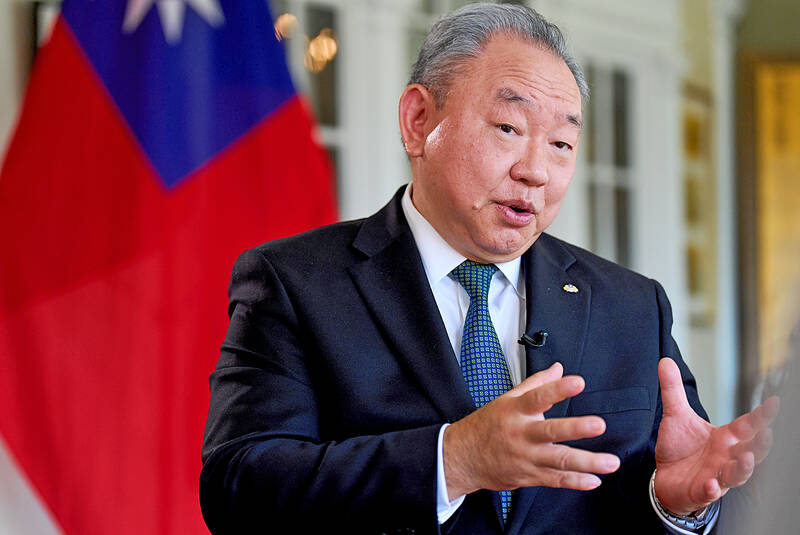
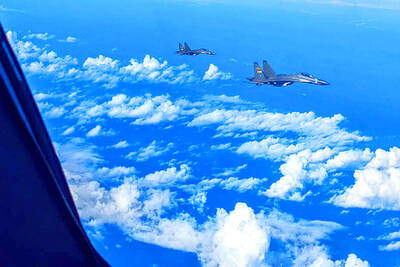
Photo: AP
The Trump administration has not moved forward with the US$14 billion weapons sale proposal approved by senior lawmakers earlier this year. Trump has described the sale as a “very good negotiating chip” with China.
Washington is obligated by domestic law to provide Taiwan with sufficient hardware to deter aggression from China.
Taiwan is aware that it must defend its territory, Yui said.
“This is our responsibility, so we will not wait and depend for the US cavalry to come and save us,” he said. “That’s why we’re willing to acquire, to buy US equipment and arms to make ourselves stronger.”
The weapons sales need to be “commensurate” to the threat level, which is “actually pretty high” from China, Yui said.
“First and foremost, we’re not the aggressors. It is the People’s Republic of China who is sending all the planes and ships,” he said. “They’re the ones huffing and puffing. They are the ones who’s trying to annihilate our freedom and democracy in Taiwan.”
China sends warships and military aircraft near Taiwan almost daily and has conducted major military exercises around the nation over the past few years.
There had been no changes to the US’ position on Taiwan and the Taiwanese government will respect the Trump administration’s “tempo” in making announcements, Yui said.
The arms sale has broad support in the US Congress, with lawmakers raising concerns to US Secretary of State Marco Rubio at a hearing this month.
Rubio affirmed that US policy on Taiwan has not changed and that Washington does not “consult with the Chinese on these arms deals.”
The proposal was not held up, but under review, he said, adding that the administration had other factors to weigh.
“It includes the availability of the stocks in the short term,” Rubio said of US weapons stockpiles, which have been drawn down during the Iran war. “We have to balance that with our own procurement process.”
The administration approved a separate US$11 billion arms sale package to Taiwan in December last year that included High Mobility Artillery Rocket Systems and howitzers.
As much as Trump has raised eyebrows by ignoring a promise from the era of former US president Ronald Reagan not to consult with Beijing on arms sales to Taipei, he also said he could call President William Lai (賴清德), which would break a decades-long practice that no sitting US president has directly spoken with the leader of the nation.
In its national defense strategy published in January, the Pentagon said it seeks to deter China through strength, not confrontation.
The US “will build, posture, and sustain a strong denial defense” along a strategic line of islands, including Taiwan, to keep China out of the wider Pacific Ocean, it said.
Yui ascribed what appears to be mixed messages to Trump’s outside-of-the-box style, but expressed confidence in Taiwan-US relations.
“It’s important to look at the actions, what is happening, not just the rhetoric,” Yui said. “The big stick is still there.”
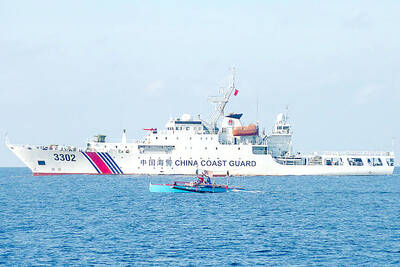
EXPANSIONIST: China deploys an average of 40 to 50 warships and coast guard vessels daily in the South China Sea, despite pledges not to militarize the region, an official said China is attempting to expand its influence across the First Island Chain and increase pressure on Japan by sending coast guard vessels into waters off of Taiwan under the pretext of maritime negotiations with Japan and the Philippines, a national security official said yesterday. China’s recent actions in the waters east of Taiwan and Japan and the Philippines’ exclusive economic zones (EEZ) are attempts to establish dominance in First Island Chain waters, said the official who declined to be named, adding that this is “expansion disguised as law enforcement.” Framing China’s actions solely as a cross-strait issue is a serious misjudgment that
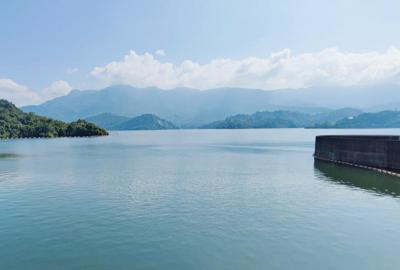
Several major reservoirs are estimated to have received 590 million tonnes of water inflow from June 4 to this morning, with storage levels at Wushantou Reservoir exceeding 50 percent and Zengwen Reservoir approaching 30 percent as of 9am today, data from the Water Resources Agency showed. Of the estimated 590 million tonnes, 450 million have already been stored in reservoirs, the data showed. As of 9am today, Baoshan Reservoir storage levels reached 100 percent, while Baoshan Second Reservoir, Yongheshan Reservoir and Techi Reservoir all exceeded 90 percent, data on the Water Resources Agency’s Web site showed. In addition, the Shimen Reservoir is at
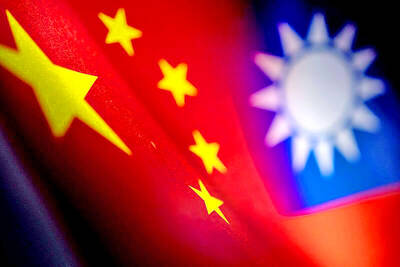
BAIT AND SWITCH: Allowing KMT-run counties to sell to China while the threat of abrupt cancelations hangs overhead is another form of coercion, officials said Beijing is using agricultural purchase offers announced during the Straits Forum to deepen Taiwan’s dependence on the Chinese market, a Taiwanese official said yesterday as they criticized the Taitung County commissioner’s participation in the initiative. During the Straits Forum held in Xiamen on Saturday, Chinese officials announced a sales and purchase agreement for agricultural products from some counties led by the Chinese Nationalist Party (KMT). Taitung County Commissioner Yao Ching-ling (饒慶鈴), who was barred from attending the event in person by the Mainland Affairs Council, participated via video. Under the agreement, China would purchase atemoyas, pomeloes, tea and grouper harvested in Taitung,
SHIFTING FIRE: While the tempo of purely military exercises around Taiwan has gone down somewhat, Beijing is working to isolate Lai diplomatically from support abroad Chinese President Xi Jinping (習近平) is shifting tactics in his campaign to pressure Taiwan, ramping up diplomatic isolation of the nation while dialing down provocative displays of military aggression. Taiwan recorded a daily average of five Chinese military aircraft crossing the Taiwan Strait’s buffer line with China through May this year — half the number logged in the same period last year. In March, Beijing did not send a single fighter jet near Taiwan for seven days, the longest absence on record outside of typhoon season. In comparison, China sent 153 planes near Taiwan during one day at its peak in


 RSS
RSS