


US President Donald Trump’s meeting with Japanese Prime Minister Sanae Takaichi this week before his planned meeting with Chinese President Xi Jinping (習近平) later signaled Washington’s priority focus on East Asian security, a Taiwanese defense analyst told an event in Tokyo on Sunday, adding that the Trump-Takaichi meeting could also deepen Washington’s security commitments along the first island chain.
Su Tzu-yun (蘇紫雲), director of the Institute for National Defense and Security Research’s Defense Strategy and Resource Research Institute, made the comment at an event hosted by the Taiwanese Association in Japan.
Taiwan should pay attention to whether Trump makes additional commitments to enhance the security of US allies in the first island chain during his meeting with Takaichi, Su said.
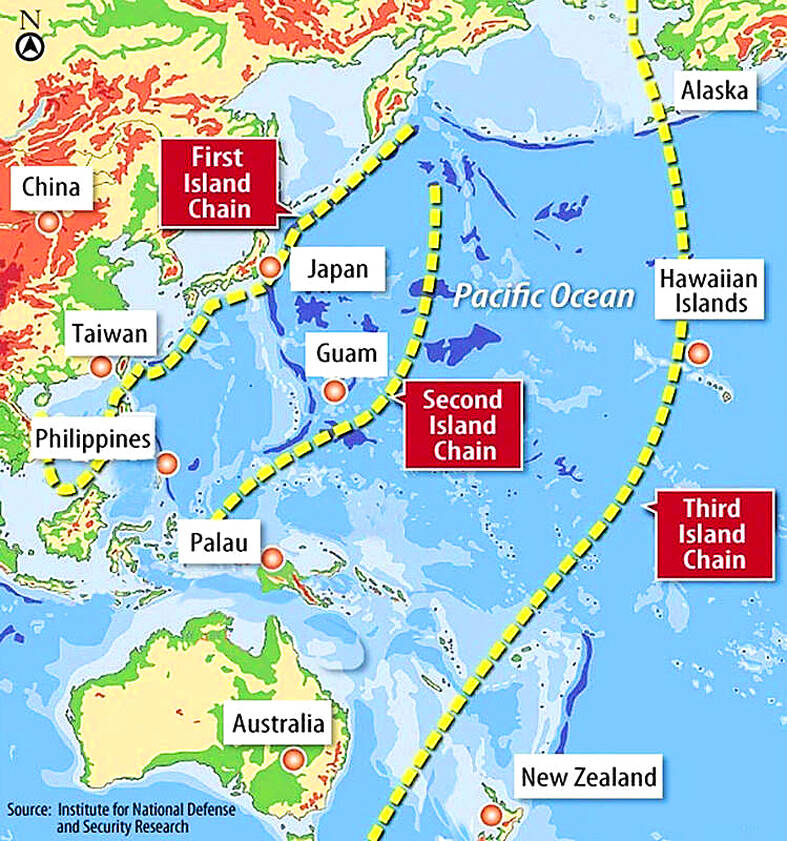
Taiwan should demonstrate the seriousness with which the nation takes the collective security of the Indo-Pacific region, as well as its own self-defense, instead of passively benefiting from US security arrangements, he said.
News that Japan is interested in collaborating with the US in Trump’s “Golden Dome” missile defense and missile production proposals is a positive development with strategic implications for Taiwan, he said.
Japan is confronting the increased threat from North Korean ballistic missiles, and its interest in intelligence and technology cooperation with the US would improve regional missile defense, Su said.
US-Japan collaboration in missile defense would indirectly benefit Taiwan, as the US has some of the most sophisticated advanced radar warning systems in the world that could share intelligence with regional allies, he said.
A joint US-Japan Patriot missile production scheme would help minimize costs and the delays associated with US arms deliveries to Taiwan, he said.
The US is capable of producing 600 Patriot missiles a year, but plans to boost that number to 2,000 a year, Su said.
If Germany and Japan open additional assembly lines, the production volume could meet global demand for inceptors, he said.
Takaichi’s efforts to link Japan’s national security with peace in the Taiwan Strait, boost Japan’s air defense capabilities and play a larger role in the regional security framework are evidence of a keen geostrategic insight, Su said.
Her move to meet with Trump before he meets with Xi also emphasizes Japan’s importance to the Indo-Pacific region, he said.
Takaichi has flexibility in implementing her policy to counter China’s ambitions, forgoing high-profile declarations in favor of demonstrating Japan’s resilience with pragmatic and meaningful action, he said.
Su disagreed with views of other commentators that the conflict in Iran would weaken the US in the Indo-Pacific region, saying that Trump likely seeks to deal with the Middle East before shifting resources to focus on East Asia.
US deployment of air defense systems and Marines from South Korea and Japan to the Middle East, and requests for the Chinese, Japanese and South Korean navies to help secure the Hormuz Strait are indicative of a well-thought-out strategy on Trump’s part, he said.
Countering China’s rise in the Indo-Pacific region remains Washington’s most important strategic objective, he said.
Trump’s request that China escort ships in the Hormuz Strait presses it to share responsibility for global security, Su added.
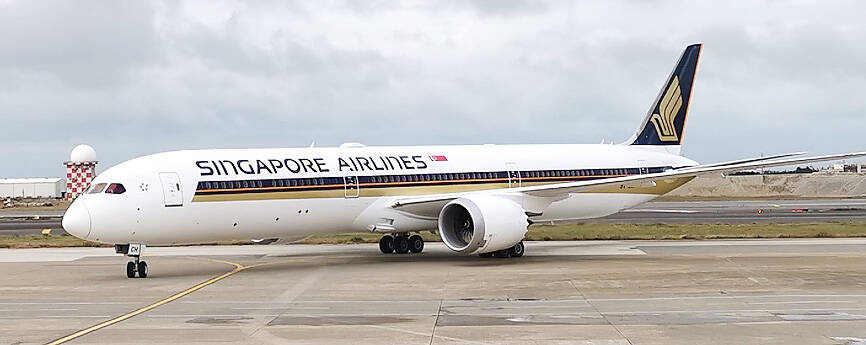
INCREASED CAPACITY: The flights on Mondays, Wednesdays, Fridays and Sundays would leave Singapore in the morning and Taipei in the afternoon Singapore Airlines is adding four supplementary flights to Taipei per week until May to meet increased tourist and business travel demand, the carrier said on Friday. The addition would raise the number of weekly flights it operates to Taipei to 18, Singapore Airlines Taiwan general manager Timothy Ouyang (歐陽漢源) said. The airline has recorded a steady rise in tourist and business travel to and from Taipei, and aims to provide more flexible travel arrangements for passengers, said Ouyang, who assumed the post in July last year. From now until Saturday next week, four additional flights would depart from Singapore on Monday, Wednesday, Friday
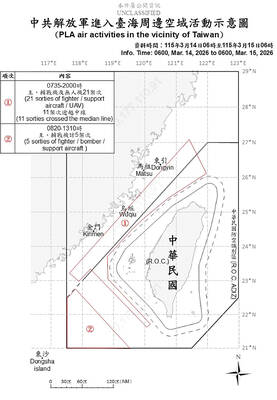
The Ministry of National Defense yesterday reported the return of large-scale Chinese air force activities after their unexplained absence for more than two weeks, which had prompted speculation regarding Beijing’s motives. China usually sends fighter jets, drones and other military aircraft around the nation on a daily basis. Interruptions to such routine are generally caused by bad weather. The Ministry of National Defense said it had detected 26 Chinese military aircraft in the Taiwan Strait over the previous 24 hours. It last reported that many aircraft on Feb. 25, when it spotted 30 aircraft, saying Beijing was carrying out another “joint combat
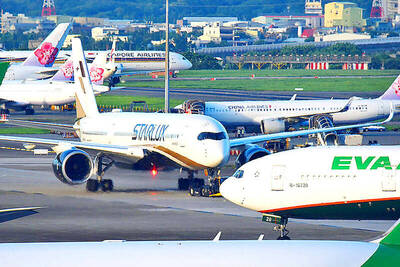
Taiwan’s three major international carriers are increasing booking fees, with EVA Airways having already increased the charge to US$28 per flight segment from US$25, while China Airlines (CAL) and Starlux Airlines are set to follow suit. Booking fees are charged by airlines through a global distribution system (GDS) and passed on to passengers. Carriers that apply the fees include CAL, EVA, Starlux and Tigerair Taiwan. A GDS is a computerized network operated by a company that connects airlines with travel agents and ticketing platforms, allowing reservations to be made and processed in real time. Major players include Amadeus, Sabre and Travelport. EVA Air began
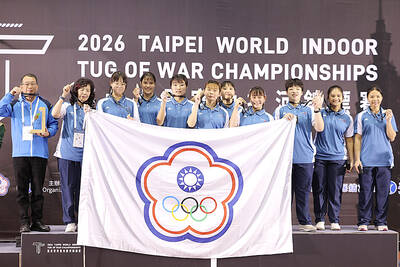
Taiwan successfully defended its women’s 540 kilogram title and won its first-ever men’s 640 kg title at the 2026 World Indoor Tug of War Championships in Taipei yesterday. In the women’s event, Taiwan’s eight-person squad reached the final following a round-robin preliminary round and semifinals featuring teams from Ukraine, Japan, Thailand, Vietnam, the Basque Country and South Korea. In the finals, they swept the Basque team 2-0, giving the team composed mainly of National Taiwan Normal University students and graduates its second championship in a row, and its fourth in five years. Team captain


 RSS
RSS