


The Ministry of Education and the Overseas Community Affairs Council should conduct a comprehensive review of the government’s New Southbound Talent Policy to improve safeguards of the rights of overseas and international students in Taiwan, the Chinese Nationalist Party (KMT) caucus told a news conference in Taipei yesterday.
The Democratic Progressive Party government implemented the policy in 2016, with a goal to attract to Taiwan 200,000 applicants of outstanding talent from Southeast Asia, the KMT said.
After 10 years, the cost to taxpayers has been NT$4.2 billion (US$131.72 million), but the retention rate is only 30 percent, it said, adding that the policy has degenerated into a “study-work profit chain” involving intermediaries, lower and mid-tier private universities, and businesses.

Photo: Lo Pei-de, Taipei Times
What was meant to be “coming to Taiwan to study” for foreign students has turned into “coming to Taiwan to work,” with many employed as substitutes at factories, and at retail stores and in the service industry, it said.
KMT caucus secretary-general Lin Pei-hsiang (林沛祥) said Taiwan is gradually shifting from an “island for study” into what critics describe as an “island of student labor.”
Many international students who arrive expecting an education find themselves unable to focus on their studies, instead working long hours in restaurants, hotels and factories, Lin said.
In some cases, they are a form of “disguised migrant labor,” filling gaps in Taiwan’s workforce, he said.
Some lower and mid-tier private universities rely on such students as a financial lifeline, while intermediaries, education providers and businesses form a tightly linked chain of shared interests, he said.
Recruitment campaigns promote the promise of “studying in Taiwan,” but for many, the reality is closer to “working in Taiwan,” he added.
The ministry and the council should undertake a sweeping review of the system — revisiting everything from recruitment practices and oversight of intermediaries to industry-academia programs, student working hours and safeguards of the right to education, the KMT said.
“Policymakers must return to the core mission of education: International students are meant to study, not to plug labor shortages in the service sector,” it said.
It also called on the government to better protect the education and human rights of foreign students, warning that if Taiwan aspires to be a truly international society, it cannot allow a “student labor” model to evolve into another form of exploitation.
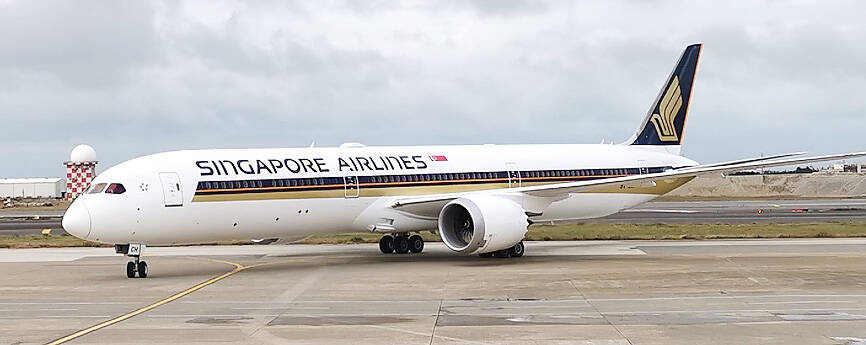
INCREASED CAPACITY: The flights on Mondays, Wednesdays, Fridays and Sundays would leave Singapore in the morning and Taipei in the afternoon Singapore Airlines is adding four supplementary flights to Taipei per week until May to meet increased tourist and business travel demand, the carrier said on Friday. The addition would raise the number of weekly flights it operates to Taipei to 18, Singapore Airlines Taiwan general manager Timothy Ouyang (歐陽漢源) said. The airline has recorded a steady rise in tourist and business travel to and from Taipei, and aims to provide more flexible travel arrangements for passengers, said Ouyang, who assumed the post in July last year. From now until Saturday next week, four additional flights would depart from Singapore on Monday, Wednesday, Friday
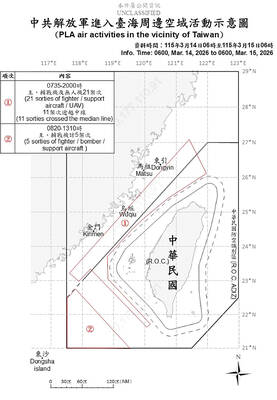
The Ministry of National Defense yesterday reported the return of large-scale Chinese air force activities after their unexplained absence for more than two weeks, which had prompted speculation regarding Beijing’s motives. China usually sends fighter jets, drones and other military aircraft around the nation on a daily basis. Interruptions to such routine are generally caused by bad weather. The Ministry of National Defense said it had detected 26 Chinese military aircraft in the Taiwan Strait over the previous 24 hours. It last reported that many aircraft on Feb. 25, when it spotted 30 aircraft, saying Beijing was carrying out another “joint combat
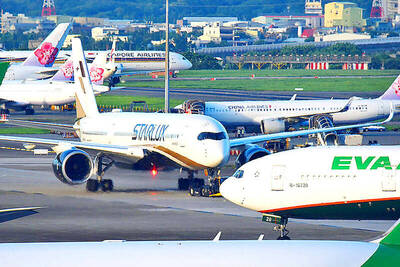
Taiwan’s three major international carriers are increasing booking fees, with EVA Airways having already increased the charge to US$28 per flight segment from US$25, while China Airlines (CAL) and Starlux Airlines are set to follow suit. Booking fees are charged by airlines through a global distribution system (GDS) and passed on to passengers. Carriers that apply the fees include CAL, EVA, Starlux and Tigerair Taiwan. A GDS is a computerized network operated by a company that connects airlines with travel agents and ticketing platforms, allowing reservations to be made and processed in real time. Major players include Amadeus, Sabre and Travelport. EVA Air began

Taiwan successfully defended its women’s 540 kilogram title and won its first-ever men’s 640 kg title at the 2026 World Indoor Tug of War Championships in Taipei yesterday. In the women’s event, Taiwan’s eight-person squad reached the final following a round-robin preliminary round and semifinals featuring teams from Ukraine, Japan, Thailand, Vietnam, the Basque Country and South Korea. In the finals, they swept the Basque team 2-0, giving the team composed mainly of National Taiwan Normal University students and graduates its second championship in a row, and its fourth in five years. Team captain


 RSS
RSS