


A ruling by the US Supreme Court declaring US President Donald Trump’s global tariffs unconstitutional should boost Taiwan’s stock market when trading resumes tomorrow after the Lunar New Year holiday ends, an analyst said yesterday, while an academic warned that the government and political parties must not misjudge the situation or abandon the negotiated terms in the Agreement on Reciprocal Trade (ART).
In a 6-3 decision issued on Friday, the court ruled that Trump’s use of the International Emergency Economic Powers Act (IEEPA) to impose the levies was unlawful.
Fan Chen-hung (范振鴻), president of Capital Investment Management Corp, said the decision should be seen as somewhat positive for the Taiwan Stock Exchange’s post-holiday reopening.
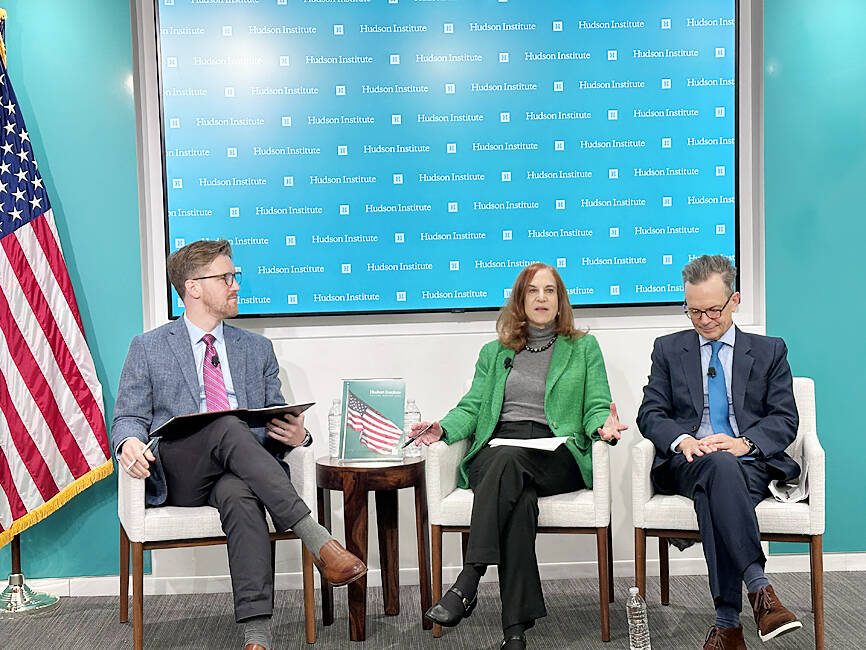
Photo: CNA
Fan said Taiwan’s major exports to the US, such as semiconductors and electronic components, were already exempt from the tariffs and would therefore see little direct impact.
The main beneficiaries, he said, were likely to be the stocks of non-tech manufacturers, including apparel and footwear producers.
Overall, Fan said the court ruling would have only a limited influence on the local stock market, with investor sentiment likely to be more affected by how the market interprets the earnings report of chip giant Nvidia Corp scheduled to be released on Wednesday.
Chiou Jiunn-rong (邱俊榮), an economics professor at National Central University, said the most critical task for the government and parties is to avoid mishandling the situation and observing the reactions of the Japanese and South Korean governments while persuading the legislature to pass the agreed-upon conditions.
Many believe that if the IEEPA becomes invalid, tariffs would return to previous levels and be lower, but the reality is not so simple, he said, adding that the impact of tariffs is not just about the surface number.
The rates applied to Taiwan’s main competitors also play a role, Chiou said. Japan and South Korea have already finalized their tariff rates.
Taiwan’s negotiated tariff agreements are one of the lowest among nations with a trade surplus with the US and it secured most favorable treatment, so the nation is already in a winning position, he said.
Trump has invested significant time and energy into investigating the trade status of various countries and adjusting tariff rates to meet his predetermined goals and to him, these rates are a “done deal,” so even if the IEEPA were to lose effect, he could invoke other mechanisms to raise tariffs back to his target levels, Chiou said.
It is not as simple as: “if the IEEPA fails, tariffs return to square one,” he said.
Separately, at a Hudson Institute seminar yesterday, Hudson Institute senior fellow Riley Walters said that the US Supreme Court ruling would affect Taiwan minimally, as tariffs on Taiwanese exports to the US, namely the 25 percent tariff rate on Taiwanese auto parts, timber, lumber and wood derivative products, were mostly governed under Section 232.
The ART has reduced IEEPA tariffs to 15 percent, while Section 232 tariffs on Taiwanese exports have been reduced to 15 percent, Walters said.
German Marshall Fund of the US’ Indo-Pacific Program managing director Bonnie Glaser yesterday said that the ART highlighted the importance of maintaining Taiwan-US relations.
Glaser said Trump must approve all trade negotiations and the signing of the ART, and his notifying Congress of the intent to sell Taiwan military packages valued at US$11 billion highlights Trump’s willingness to strengthen Taiwan-US relations.
Glaser wrote on social media that “Trump “doesn’t want to look weak, and so he wants to handle [Taiwan] in a way that he doesn’t offend [Chinese President] Xi Jinping (習近平) and undermine the prospects of having a good summit... But he also wants to be seen as tough. And he doesn’t want to be seen as abandoning Taiwan.”

FUKUOKA SITUATION: Japanese media reported that the pathogen is expected to be identified by the summer, while the CDC downplayed the idea that it was hMPV A “mysterious cold-like illness” reported in Japan’s Fukuoka Prefecture does not seem to be a new disease, but Japanese authorities have been asked about the situation, the Centers for Disease Control (CDC) said yesterday. The Fukuoka Prefectural Medical Association on Wednesday told a news conference that a “mystery cold” that has become a hot topic on social media is “highly likely to be caused by some kind of viral infection,” Japan’s KBC News reported. “Many people are experiencing symptoms starting with a sore throat, followed by a runny nose, phlegm and a severe cough,” KBC News reported, citing association officials. Health authorities are

Nvidia Corp CEO Jensen Huang (黃仁勳) arrived in Taiwan yesterday ahead of upcoming AI and technology events, saying he plans to meet with clients and Taiwan Semiconductor Manufacturing Co Chairman C.C. Wei (魏哲家) during his visit. After landing at Taipei Songshan Airport, Huang posed for photos with fans and handed out Yakult drinks to reporters and supporters waiting at the scene, saying he has “a lot to do” during the trip. Asked about reports that Nvidia’s planned headquarters site in Taipei’s Beitou Shilin Technology Park could break ground on May 27, Huang said that if the company holds an event, he would

The Ministry of Finance this afternoon announced the winning numbers for the March-April uniform invoice lottery. The winning number for the NT$10 million (US$318,060) special prize is 19531471, and the winning number for the NT$2 million grand prize is 85941329. Three numbers were drawn for the NT$200,000 first prize: 07225810, 20231230 and 83518781. Those with receipts matching the last seven digits of any of the first-prize numbers will win the NT$40,000 second prize, while those matching the last six digits will win the NT$10,000 third prize. Those whose receipts match the last five digits of the first-prize numbers can claim the NT$4,000 fourth prize,
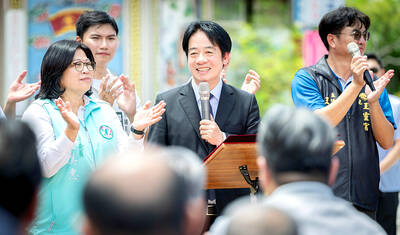
SIX SUBSIDIES: The monthly allowance for older farmers is to increase to NT$10,000, and NT$5,000 is to be given to homemakers under the national pension system, Lai said The government is to implement major welfare policies for disadvantaged groups, including raising the monthly allowance for older farmers to NT$10,000 and providing homemakers with NT$5,000 per month, President William Lai (賴清德) said yesterday. Lai made the remarks during a visit to Wangling Temple in Chiayi County, saying that the planned increases were being introduced amid economic growth and an increase in tax revenue. Touting a policy, in which the government plans to provide a monthly allowance of NT$5,000 for every child under the age of 18 in a bid to address Taiwan’s low birthrate, Lai said that if received for the


 RSS
RSS