


The military is to hold live-fire drills along the Taimali River (太麻里溪) in Taitung County’s Taimali Township (太麻里) next month for the first time in three decades, a source said yesterday.
The drills, part of the “Tianma Exercise” (天馬操演), are aimed at enhancing combat readiness in eastern Taiwan. They are to include anti-armor missile launches and heavy artillery calibration firing.
“The scenario simulates Chinese forces breaking through Taiwan’s sea and air defenses, with amphibious fleets preparing to land along the east coast,” the source said. “Ground forces would then employ heavy firepower in coastal interception operations to block an assault on eastern Taiwan.”
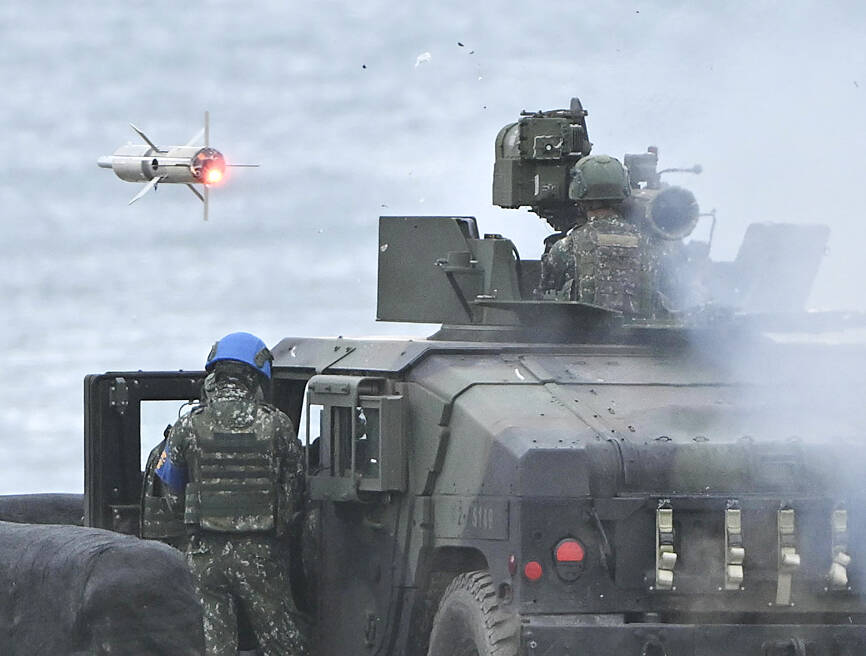
Photo: Tu Chien-jung, Taipei Times
The main focus of the Tianma Exercise would be live-fire training with anti-armor missiles, primarily the new TOW-2B RF systems, the source said.
Similar drills were previously held mainly at training grounds in Pingtung County’s Fangshan (枋山) and Jioupeng (九鵬) townships.
The military broke with tradition in August last year by conducting live-fire drills for the first time as part of a combat-oriented defense exercise at Taichung’s Dajia River (大甲溪), underscoring an increasing emphasis on realistic, location-specific training. The move to Taimali continues that shift.
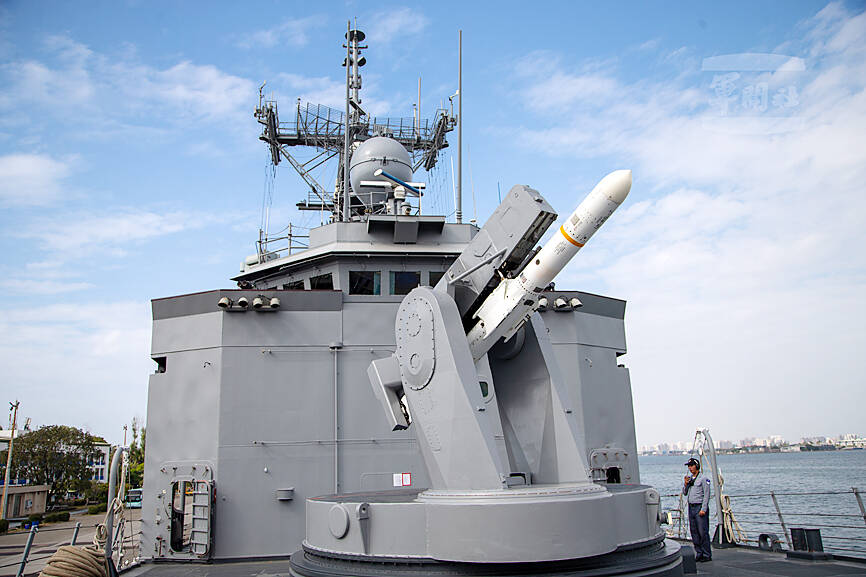
Photo courtesy of Military News Agency
Next month’s exercise would draw on part of a consignment of 1,700 TOW-2B RF missiles purchased from the US, the source said.
The TOW-2B features radio-frequency guidance and a range of up to 4,500m. Using a top-attack “flyover, shoot down” mode with dual explosively formed penetrators, it is designed to strike vulnerable vehicle roofs, fortified bunkers and troop transport vessels, enhancing the army’s anti-armor and counter-landing capabilities along Taiwan’s beaches.
Separately, the Ministry of National Defense on Tuesday released footage of the navy’s Perry-class guided-missile frigate Feng Chia (逢甲), formerly the USS Gary, conducting combat-readiness and realistic training, demonstrating rapid maritime response capabilities.
The ship’s MK-13 missile launcher can be fitted with Standard-1 surface-to-air missiles or Harpoon anti-ship missiles, depending on operational requirements, the ministry said.
The Harpoon missiles carried by the Feng Chia are evidently the RGM-84L Harpoon Block II variant, military analyst Mei Fu-hsing (梅復興) said.
The model features a littoral target-suppression mode, enabling not only anti-ship missions, but also strikes against land, coastal and harbor targets — a capability not available on other ship-launched anti-ship missiles in the navy’s inventory, he said.
While earlier Harpoon variants were designed primarily for open-ocean engagements, the Block II integrates the inertial measurement unit used in the Joint Direct Attack Munition and the software and GPS/INS navigation system of the SLAM-ER missile.
For strikes on enemy land facilities, the missile uses GPS guidance to target coastal defense positions, surface-to-air missile sites, aircraft parked at airfields or port infrastructure, Mei said.
In harbor attack scenarios, earlier anti-ship missiles were more susceptible to land clutter interference, but the Block II can more accurately identify and lock onto enemy vessels moored in port or operating close to shore, he said.
“The RGM-84L Harpoon Block II offers enhanced target discrimination in complex geographic environments,” he said.
In littoral settings, radar seekers can be disrupted by islands, coastlines or heavy neutral vessel traffic, Mei said.
The Block II can be programmed with avoidance areas and use precise GPS coordinates to filter out land returns, improving target identification and strike probability, he added.
Regarding tactical strike modes, the terminal dive “suppression” profile typically includes a pop-up maneuver followed by a steep-angle dive onto the target, a tactic particularly effective against protected land targets and coastal facilities, he said.
The littoral target-suppression capability transforms the missile from a purely anti-ship weapon into a multirole precision land-attack system, enabling the Feng Chia to conduct pre-emptive strikes against enemy coastal radar stations or missile sites, Mei said.
Kenting National Park service technician Yang Jien-fon (楊政峰) won a silver award in World Grand Prix Photography Awards Spring Season for his photograph of two male rat snakes intertwined in combat. Yang’s colleagues at Kenting National Park said he is a master of nature photography who has been held back by his job in civil service. The awards accept entries in all four seasons across six categories: architectural and urban photography, black-and-white and fine art photography, commercial and fashion photography, documentary and people photography, nature and experimental photography, and mobile photography. Awards are ranked according to scores and divided into platinum, gold and
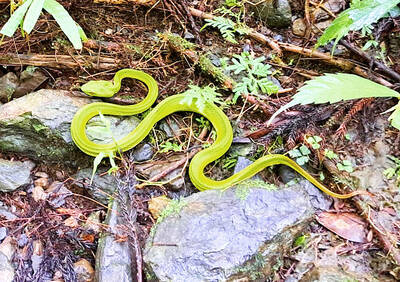
More than half of the bamboo vipers captured in Tainan in the past few years were found in the city’s Sinhua District (新化), while other districts had smaller catches or none at all. Every year, Tainan captures about 6,000 snakes which have made their way into people’s homes. Of the six major venomous snakes in Taiwan, the cobra, the many-banded krait, the brown-spotted pit viper and the bamboo viper are the most frequently captured. The high concentration of bamboo vipers captured in Sinhua District is puzzling. Tainan Agriculture Bureau Forestry and Nature Conservation Division head Chu Chien-ming (朱健明) earlier this week said that the

The Chinese Nationalist Party (KMT) caucus yesterday said it opposes the introduction of migrant workers from India until a mechanism is in place to prevent workers from absconding. Minister of Labor Hung Sun-han (洪申翰) on Thursday told the Legislative Yuan that the first group of migrant workers from India could be introduced as early as this year, as part of a government program. The caucus’ opposition to the policy is based on the assessment that “the risk is too high,” KMT caucus secretary-general Lin Pei-hsiang (林沛祥) said. Taiwan has a serious and long-standing problem of migrant workers absconding from their contracts, indicating that

SPACE VETERAN: Kjell N. Lindgren, who helps lead NASA’s human spaceflight missions, has been on two expeditions on the ISS and has spent 311 days in space Taiwan-born US astronaut Kjell N. Lindgren is to visit Taiwan to promote technological partnerships through one of the programs organized by the US for its 250th national anniversary. Lindgren would be in Taiwan from Tuesday to Saturday next week as part of the US Bureau of Educational and Cultural Affairs’ US Speaker Program, organized to celebrate the 250th anniversary of the signing of the Declaration of Independence, the American Institute in Taiwan (AIT) said in a statement yesterday. Lindgren plans to engage with key leaders across the nation “to advance cutting-edge technological partnerships and inspire the next generation of scientists and engineers,”


 RSS
RSS