


The National Communications Commission (NCC) on Friday said that amendments to the Satellite Broadcasting Act (衛星廣播電視法) passed by the Legislative Yuan earlier that day, which eases license renewal rules for news channels, would not restore the cable news broadcasting rights of Chung Tien Television (CTi TV).
The legislation contains no retroactive provisions and would not affect CTi News, which was offlined in 2020, NCC Secretary-General Huang Wen-che (黃文哲) said.
The amendments, proposed by Chinese Nationalist Party (KMT) and Taiwan People’s Party lawmakers, allow channels to continue broadcasting on their original slots during administrative lawsuits and require authorities to provide remedies if a channel has been reassigned.
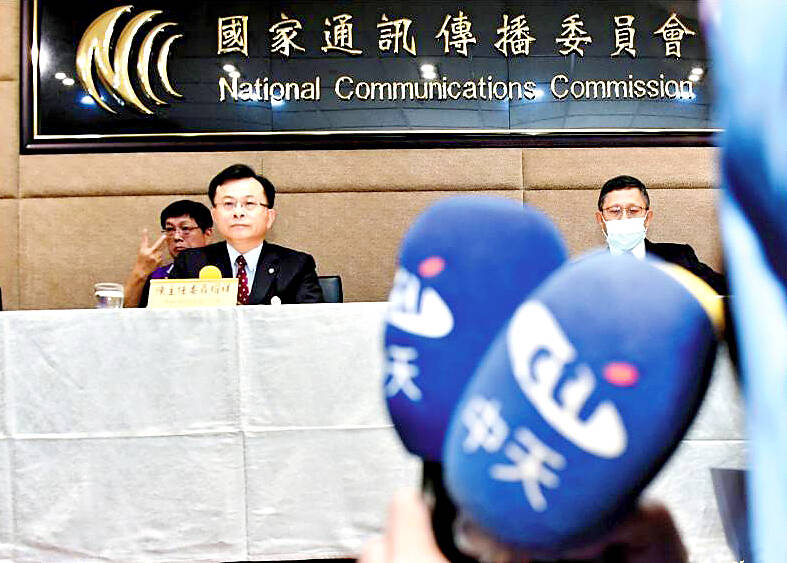
Photo: Taipei Times
The revisions also stipulate that applications for renewal of news channel licenses should be approved in principle and extend satellite broadcasting licenses from six years to nine years.
The bill passed 60-48, with the KMT and TPP outvoting the ruling Democratic Progressive Party, which opposed the amendments.
The changes have been dubbed the “CTi TV clause” by critics who say they could open a path for CTi News to regain its license after it was taken off the air on Dec. 12, 2020, when its license expired and was not renewed by the NCC.
The broadcasting regulator rejected CTi News’ license renewal application on Nov. 18, 2020, citing “repeated rule violations” and “a failure of its internal discipline and control mechanisms.”
CTi TV later entered into an administrative lawsuit with the NCC, which is still ongoing.
In a statement on Friday, CTi TV said the passage of the amendments marked “a major development for news freedom” and called it a step toward “fairness.”
Meanwhile, KMT Legislator Cheng Cheng-chien (鄭正鈐) yesterday refuted the NCC’s statement, saying that under Article 18 of the Central Regulation Standard Act (中央法規標準法), the “principle of applying the more favorable law” generally dictates that new laws should apply if the case is still pending.
Cheng said the case over the license renewal for CTi News is under further review by the High Administrative Court, with the legal proceedings ongoing.
As long as the case is being reviewed in court, it remains very much a “work in progress” from a legal standpoint, he said.
If the NCC continues to try to block the application of the new law by relying on established facts, it would effectively elevate administrative interpretations above legal protections, he said.
KMT Legislator Hsu Chiao-hsin (徐巧芯) said the KMT caucus was never focused on a specific TV station.
Whether CTi News can apply the act would depend on the outcome of the upcoming lawsuit, she said.
If they win, the new law would apply; if they lose, there is nothing more to discuss, she said, adding that this is a matter for the court to decide.
Additional reporting by Liu Wan-lin

Fast food chain McDonald's is to raise prices by up to NT$5 on some products at its restaurants across Taiwan, starting on Wednesday next week, the company announced today. The prices of all extra value meals and sharing boxes are to increase by NT$5, while breakfast combos and creamy corn soup would go up by NT$3, the company said in a statement. The price of the main items of those meals, if ordered individually, would remain the same. Meanwhile, the price of a medium-sized lemon iced tea and hot cappuccino would rise by NT$3, extra dipping sauces for chicken nuggets would go up

Yangmingshan National Park’s Qingtiangang (擎天崗) nature area has gone viral after a park livestream camera observed a couple in the throes of intimate congress, which was broadcast live on YouTube, drawing large late-night crowds and sparking a backlash over noise, bright lights and disruption to wildlife habitat. The area’s livestream footage appeared to show a couple engaging in sexual activity on a picnic table in the park on Friday last week, with the uncensored footage streamed publicly online. The footage quickly spread across social media, prompting a tide of visitors to travel to the site to “check in” and recreate the

Minister of Digital Affairs Lin Yi-ching (林宜敬) yesterday cited regulatory issues and national security concerns as an expert said that Taiwan is among the few Asian regions without Starlink. Lin made the remarks on Facebook after funP Innovation Group chief executive officer Nathan Chiu (邱繼弘) on Friday said Taiwan and four other countries in Asia — China, North Korea, Afghanistan and Syria — have no access to Starlink. Starlink has become available in 166 countries worldwide, including Ukraine, Malaysia, the Philippines and Vietnam, in the six years since it became commercial, he said. While China and North Korea block Starlink, Syria is not

GROUNDED: A KMT lawmaker proposed eliminating drone development programs and freezing funding for counterdrone systems, despite China’s adoption of the technology China has deployed attack drones at air bases near the Taiwan Strait in a strategy aimed at overwhelming Taiwan’s air defense systems through saturation attacks, the Mainland Affairs Council (MAC) said. The council’s latest quarterly report on China said that satellite imagery and open-source intelligence indicate that the Chinese People’s Liberation Army (PLA) had converted retired J-6 fighter jets into J-6W drones, which the PLA has stationed at six air bases near Taiwan, five in China’s Fujian Province and one in Guangdong Province. The report cited J. Michael Dahm, a senior fellow at the US-based Mitchell Institute, as saying that China has


 RSS
RSS