


The US is impressed by the leadership of Ministry of National Defense (MND) and the thoroughness of its assessment of defense needs, American Institute in Taiwan (AIT) Director Raymond Greene said.
Greene made the remarks in an interview with CommonWealth published yesterday when asked about the government’s proposed NT$1.25 trillion (US$39.7 billion) special defense budget.
The opposition blocked the special defense budget for the 10th time during the Procedure Committee’s Tuesday meeting.

Photo: Tien Yu-hua, Taipei Times
Asked how he viewed the defense budget being blocked, Greene said the US is a democracy and appreciates differences in opinion among political parties.
However, there is no strong disagreement between Republicans and Democrats in Washington over US policy on Taiwan, he said.
The US hopes that Taiwanese parties would prioritize the nation’s security and defense over partisan differences, and focus on what their nation needs, Greene said.
The AIT has facilitated numerous visits by congressional delegations that included members of both US parties, all of whom expressed firm support for Taiwan as a matter of US national security interest, he said.
The current National Security Strategy, published last month, clearly affirmed the vital importance of the first island chain to the Indo-Pacific region and US national security, Greene said.
Taiwan is the keystone of the island chain and plays a crucial role in that security vision, he said, referring to the proceedings of the US’ Indo-Pacific Command’s regional ambassadors conference in Hawaii on Jan. 16.
The defense ministry displayed impressive feats of leadership and judgement in assessing the nation’s defensive requirements, including military planning, training and equipment, he said.
Taiwan has made admirable strides to improve its defensive capabilities by embracing an erosion strategy that should prove viable so long as the nation obtains the resources it needs, he said.
A defense industrial base is crucial to provide the Taiwanese armed forces with arms and resilience during a conflict, he said.
An indigenous Taiwanese arms sector would also contribute to meeting a global demand for defense materiel, he added.

A total lunar eclipse coinciding with the Lantern Festival on March 3 would be Taiwan’s most notable celestial event this year, the Taipei Astronomical Museum said, urging skywatchers not to miss it. There would be four eclipses worldwide this year — two solar eclipses and two lunar eclipses — the museum’s Web site says. Taiwan would be able to observe one of the lunar eclipses in its entirety on March 3. The eclipse would be visible as the moon rises at 5:50pm, already partly shaded by the Earth’s shadow, the museum said. It would peak at about 7:30pm, when the moon would

A New York-based NGO has launched a global initiative to rename the nation’s overseas missions, most of which operate under the name "Taipei," to "Taiwan Representative Office (TRO)," according to a news release. Ming Chiang (江明信), CEO of Hello Taiwan, announced the campaign at a news conference in Berlin on Monday, coinciding with the World Forum held from Monday through Wednesday, the institution stated in the release. Speaking at the event, Democratic Progressive Party Legislator Huang Jie (黃捷) said she believed this renaming campaign would enable the international community to see Taiwan

DEFENSE: The US should cancel the US visas or green cards of relatives of KMT and TPP lawmakers who have been blocking the budget, Grant Newsham said A retired US Marine Corps officer has suggested canceling the US green cards and visas of relatives of opposition Taiwanese lawmakers who have been stalling the review of a proposed NT$1.25 trillion (US$39.7 billion) special defense budget. The Executive Yuan has proposed the budget for major weapons purchases over eight years, from this year to 2033. However, opposition lawmakers have refused to review the proposal, demanding that President William Lai (賴清德) first appear before the Legislative Yuan to answer questions about the proposed budget. On Thursday last week, 37 bipartisan US lawmakers sent a letter to Legislative Speaker Han Kuo-yu (韓國瑜), the heads
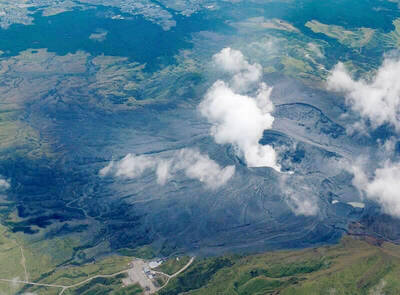
TOO DANGEROUS: The families agreed to suspend crewed recovery efforts that could put rescuers in danger from volcanic gases and unstable terrain The bodies of two Taiwanese tourists and a Japanese pilot have been located inside a volcanic crater, Japanese authorities said yesterday, nearly a month after a sightseeing helicopter crashed during a flight over southwestern Japan. Drone footage taken at the site showed three bodies near the wreckage of the aircraft inside a crater on Mount Aso in Kumamoto Prefecture, police and fire officials said. The helicopter went missing on Jan. 20 and was later found on a steep slope inside the Nakadake No. 1 Crater, about 50m below the rim. Authorities said that conditions at the site made survival highly unlikely, and ruled


 RSS
RSS