


The Legislative Yuan yesterday passed amendments to the Housing Act (住宅法), requiring that at least 20 percent of social housing units be reserved for newlyweds within their first two years of marriage and families with minor children.
Under the amended law, the Ministry of the Interior (MOI) is required to set up a social housing registration platform to track demand and unit types, which will serve as a basis for future social housing development plans.
The MOI platform must be able to connect with local government social housing registration systems, allowing data to be shared for nationwide planning.
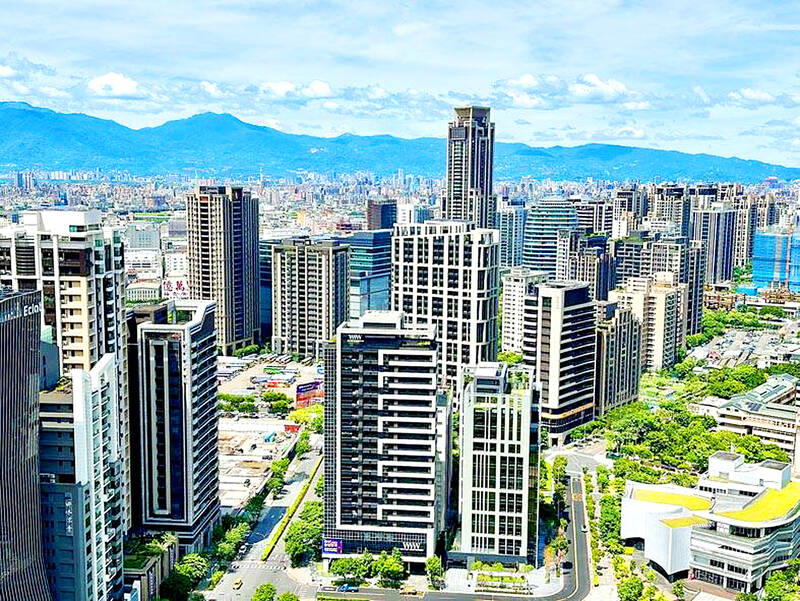
Photo: Hsu Yi-ping, Taipei Times
Before the amendment, the law only required that at least 40 percent of social housing units be allocated to economically or socially disadvantaged groups, without provisions for newlyweds. Also, families were previously required to have two or more minor children to be eligible for priority consideration.
To promote transparency, the amendment also requires the competent authorities to regularly collect, analyze and publish rental market data, including information on rental prices per unit of floor area (measured locally in “ping” = 3.30579 square meters).
Meanwhile, the amended law also added Article 19-1, which establishes the principle that up to 50 percent of social housing units in annual development plans should follow the government lease-and-management model.
The new Article 20-1, requires authorities to consider local population trends and housing conditions when drafting or reviewing urban plans, in order to assess social housing needs and designate land accordingly.
In a news release, Minister of the Interior Liu Shyh-fang (劉世 芳) said the passage of the amendments reflects consensus across party lines on expanding housing support for newlyweds and families with children.
She added that the establishment of a social housing registration platform will allow the public to access nationwide rental information and help authorities continue improving social housing policies.

The Ministry of Finance this afternoon announced the winning numbers for the March-April uniform invoice lottery. The winning number for the NT$10 million (US$318,060) special prize is 19531471, and the winning number for the NT$2 million grand prize is 85941329. Three numbers were drawn for the NT$200,000 first prize: 07225810, 20231230 and 83518781. Those with receipts matching the last seven digits of any of the first-prize numbers will win the NT$40,000 second prize, while those matching the last six digits will win the NT$10,000 third prize. Those whose receipts match the last five digits of the first-prize numbers can claim the NT$4,000 fourth prize,

SIX SUBSIDIES: The monthly allowance for older farmers is to increase to NT$10,000, and NT$5,000 is to be given to homemakers under the national pension system, Lai said The government is to implement major welfare policies for disadvantaged groups, including raising the monthly allowance for older farmers to NT$10,000 and providing homemakers with NT$5,000 per month, President William Lai (賴清德) said yesterday. Lai made the remarks during a visit to Wangling Temple in Chiayi County, saying that the planned increases were being introduced amid economic growth and an increase in tax revenue. Touting a policy, in which the government plans to provide a monthly allowance of NT$5,000 for every child under the age of 18 in a bid to address Taiwan’s low birthrate, Lai said that if received for the
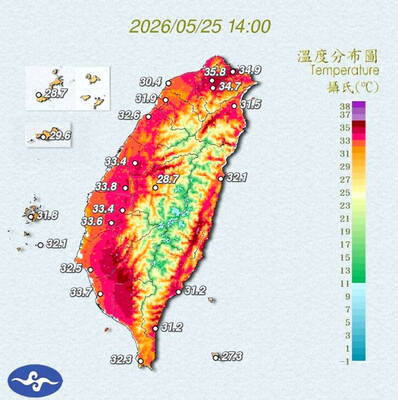
STAY COOL: The HPA recommended that people stay hydrated, use air-conditioning or fans while indoors, wear loose-fitting clothes and walk in the shade while outdoors Employers must implement measures such as installing cooling equipment, and providing drinking water and rest breaks for outdoor workers starting from Monday next week, the Taipei Department of Labor said on Sunday. Employers who fail to comply could face fines of NT$30,000 to NT$300,000 under the Occupational Safety and Health Act (職業安全衛生法), the department said. Businesses in Taipei employing fewer than 100 workers, as well as registered self-employed workers with labor insurance coverage, could receive on-site assessments and guidance from occupational safety consultants to help them apply for central government subsidies to implement or improve heat-protection measures, it said. Under the Ministry of
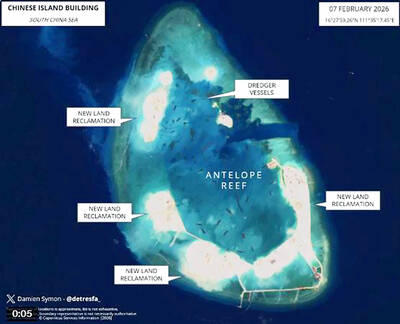
ISOLATION: The outposts would serve as support and backup bases, forcing US forces to either face China head-on or reroute, increasing travel time and operational costs China’s outposts in the South China Sea could be used to delay and constrain foreign forces during a conflict in the Taiwan Strait, giving Beijing a critical window to carry out amphibious landing and blockade operations, a report said. The Chinese Communist Party’s (CCP) forward operating bases on islands and reclaimed features in the South China Sea could delay foreign forces long enough for the Chinese People’s Liberation Army (PLA) to secure a key 48-to-72-hour window in the Taiwan Strait, a report commissioned by the Mainland Affairs Council found. The report, conducted by the Institute for National Defense and Security Research, examined


 RSS
RSS