


The Chinese Nationalist Party (KMT) caucus yesterday demanded that the Executive Yuan submit a comprehensive industry impact assessment regarding a US$500 billion investment plan in the US.
The Cabinet on Friday said the US has agreed to lower tariffs on Taiwanese goods from 20 percent to 15 percent, without stacking them on existing most-favored-nation rates, and to grant the nation’s semiconductors and related products most-favorable treatment under Section 232 of the US Trade Expansion Act.
The deal includes a pledge that Taiwanese semiconductor and technology companies would invest at least US$250 billion in the US, and an additional US$250 billion credit guarantee from the government for other investments.
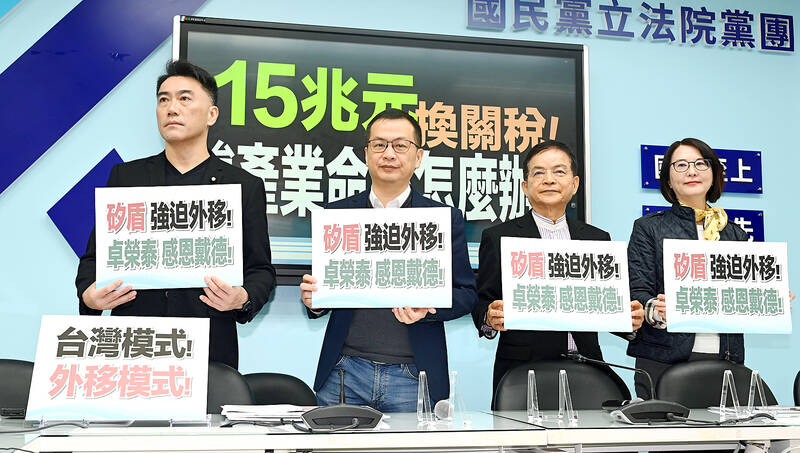
Photo: Liao Chen-huei, Taipei Times
In response to opposition parties’ concerns that Taiwan is trading US$500 billion in investments for a reduced tariff rate, Minister of Economic Affairs Kung Ming-hsin (龔明鑫) said the US$250 billion company-led investments and the credit guarantees are different forms of capital, and that lumping them together was like comparing “apples with oranges.”
Unconvinced, the KMT caucus demanded that the Executive Yuan submit a comprehensive industry impact assessment report.
The report must include the deal’s its impacts on Taiwan’s GDP, the semiconductor supply chain and the labor market; spillover effects on small and medium-sized enterprises (SMEs), and traditional industries; and an assessment of national fiscal and financial risks, the KMT said.
The KMT caucus also demanded that the Executive Yuan answer three questions, and submit the full details of the negotiations to the Legislative Yuan for formal review and oversight.
First is where the funding for the credit guarantees would come from, and how associated risks would be managed and controlled.
Second, the Cabinet must answer how it plans to safeguard the core competitiveness of the semiconductor industry, as the government had promised to keep advanced chip manufacturing processes in Taiwan, but the deal would shift 30 percent to 40 percent of production to the US.
Third is to explain how the deal would impact SMEs, traditional industries and domestic job opportunities, as well as how it plans to deal with the impacts.
KMT caucus secretary-general Lo Chih-chiang (羅智強) said that half a century ago, the KMT-led government had planted the “great tree” of Taiwan’s high-tech industry for the benefit of all citizens, but now the Democratic Progressive Party (DPP) government is not only enjoying the shade under this tree, but has also begun to chop it down.
Now, it is not only Taiwan Semiconductor Manufacturing Co (TSMC) that is moving away, but the entire high-tech supply chain, he said, adding that in five, 10 or 20 years, “the great tree will be gone.”
“What will become of Taiwan’s next generation by then?” he said, adding that he found it difficult to understand how the DPP government could gleefully cheer for the result of the trade negotiations.
KMT Deputy Secretary-General Lin Pei-hsiang (林沛祥) said the US$500 billion investment by Taiwan in the US semiconductor industry is equivalent to more than 60 percent of the nation’s annual GDP.
“Who will shoulder the risk of such a massive guarantee, and who will be held accountable if the investments fail?” he said. “This is not ‘reciprocal cooperation’ [with the US], but a substantial hollowing out of our country.”
That is a national security crisis far more perilous than the declining birthrate, energy shortages or even cross-strait relations, Lin said.
KMT caucus deputy secretary-general Wang Hung-wei (王鴻薇) urged the government to address the impact of the massive investment, as it should not crowd out domestic investment.
With 40 percent of Taiwan’s “silicon shield” — TSMC — about to be relocated to the US, the government must face the issue of securing the future employment of 300,000 semiconductor industry workers, she said.

FUKUOKA SITUATION: Japanese media reported that the pathogen is expected to be identified by the summer, while the CDC downplayed the idea that it was hMPV A “mysterious cold-like illness” reported in Japan’s Fukuoka Prefecture does not seem to be a new disease, but Japanese authorities have been asked about the situation, the Centers for Disease Control (CDC) said yesterday. The Fukuoka Prefectural Medical Association on Wednesday told a news conference that a “mystery cold” that has become a hot topic on social media is “highly likely to be caused by some kind of viral infection,” Japan’s KBC News reported. “Many people are experiencing symptoms starting with a sore throat, followed by a runny nose, phlegm and a severe cough,” KBC News reported, citing association officials. Health authorities are

Nvidia Corp CEO Jensen Huang (黃仁勳) arrived in Taiwan yesterday ahead of upcoming AI and technology events, saying he plans to meet with clients and Taiwan Semiconductor Manufacturing Co Chairman C.C. Wei (魏哲家) during his visit. After landing at Taipei Songshan Airport, Huang posed for photos with fans and handed out Yakult drinks to reporters and supporters waiting at the scene, saying he has “a lot to do” during the trip. Asked about reports that Nvidia’s planned headquarters site in Taipei’s Beitou Shilin Technology Park could break ground on May 27, Huang said that if the company holds an event, he would

The Ministry of Finance this afternoon announced the winning numbers for the March-April uniform invoice lottery. The winning number for the NT$10 million (US$318,060) special prize is 19531471, and the winning number for the NT$2 million grand prize is 85941329. Three numbers were drawn for the NT$200,000 first prize: 07225810, 20231230 and 83518781. Those with receipts matching the last seven digits of any of the first-prize numbers will win the NT$40,000 second prize, while those matching the last six digits will win the NT$10,000 third prize. Those whose receipts match the last five digits of the first-prize numbers can claim the NT$4,000 fourth prize,
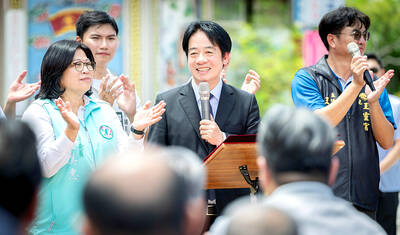
SIX SUBSIDIES: The monthly allowance for older farmers is to increase to NT$10,000, and NT$5,000 is to be given to homemakers under the national pension system, Lai said The government is to implement major welfare policies for disadvantaged groups, including raising the monthly allowance for older farmers to NT$10,000 and providing homemakers with NT$5,000 per month, President William Lai (賴清德) said yesterday. Lai made the remarks during a visit to Wangling Temple in Chiayi County, saying that the planned increases were being introduced amid economic growth and an increase in tax revenue. Touting a policy, in which the government plans to provide a monthly allowance of NT$5,000 for every child under the age of 18 in a bid to address Taiwan’s low birthrate, Lai said that if received for the


 RSS
RSS