


More than 150,000 eggs potentially contaminated with high residues of the pesticide fipronil-sulfone have entered the market in 10 municipalities throughout Taiwan, the Food and Drug Administration (FDA) said last night.
An emergency recall of the eggs has been issued in Taoyuan, Taichung, Tainan, Kaohsiung and Chiayi cities, as well as Hsinchu, Changhua, Yunlin, Nantou and Chiayi counties, the agency said.
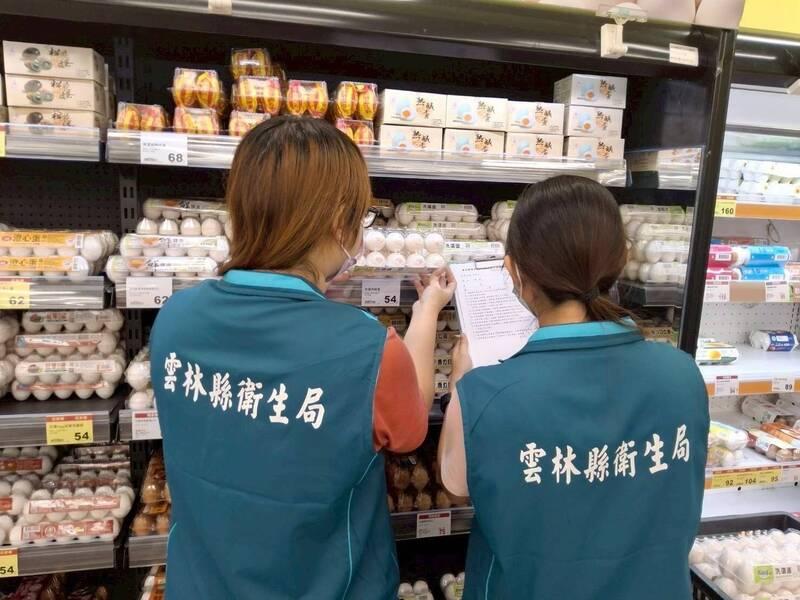
Photo courtesy of the Yunlin County Public Health Bureau
The recall was issued following a finding by Changhua County's Public Health Bureau on Tuesday last week of 0.03 parts per million (ppm) of fipronil-sulfone in a batch of eggs from a local farm, which was in excess of the permissible level of 0.01ppm, the FDA said.
The 626 cartons of eggs were immediately traced and recalled, but 543 cartons had already been sold to consumers, FDA Central Center Director-General Lin Hsu-yang (林旭陽) said last night.
Changhua County carried out subsequent testing on the farm on Wednesday and Thursday last week, and contamination was found again in the eggs, Lin said.
The Changhua agency then notified the other nine municipalities, where about 150,000 eggs with the same lot number had already entered the market, Lin added.
The FDA urged consumers not to buy or eat eggs with the traceability code I47045, and to return them to the retail stores or discard them if they have already been purchased.
While excessive levels of fipronil-sulfone may not directly affect human health, high doses could pose potential health risks, Lin said.
The FDA would provide information to agricultural agencies to investigate the cause of the contamination, he said.
It would also keep working with local health agencies to test eggs on the market to ensure food safety, he added.
Minister of Health and Welfare Shih Chung-liang (石崇良) told reporters today that initial investigations suggest the contamination resulted from environmental pollution, rather than from tainted feed or the use of pesticides on the farm.
Yang Chen-chang (楊振昌), director of occupational medicine and clinical toxicology at Taipei Veterans General Hospital, said that ingesting large amounts of the pesticide could cause symptoms such as cramps, headaches, dizziness, stomach pain and nausea.
While acute poisoning is rare, accumulation over a long period of time may pose more serious health risks such as damage to the liver, kidneys or thyroid gland, he said, citing studies conducted on animals.
Taiwan's standards for fipronil-sulfone residues are stricter than in Japan, South Korea and the US, Yang said.
In a news release yesterday, the Changhua County Public Health Bureau said the fipronil-sulfone contamination was the first food safety case in Taiwan that was handled using traceability codes.
The traceability code system allows for the precise recall of faulty products and provides information to consumers and downstream businesses about a product's quality, the agency said.
Changhua County's Department of Agriculture urged consumers to purchase eggs produced by the county's "Fresh Select" suppliers, which do not include the problematic egg farm.
Meanwhile, Hsinchu County's Public Health Bureau and the Taichung City Government yesterday both said that they have issued recall orders for the contaminated eggs.
Also yesterday, Kaohsiung's Department of Health said a local supermarket would be fined for failing to comply with an order to notify its customers of the egg problem.
The supermarket is subject to a fine of NT$60,000 to NT$200 million (US$1,935 to US$6.45 million), the department said, citing the Act Governing Food Safety and Sanitation (食品安全衛生管理法).

The Ministry of Finance this afternoon announced the winning numbers for the March-April uniform invoice lottery. The winning number for the NT$10 million (US$318,060) special prize is 19531471, and the winning number for the NT$2 million grand prize is 85941329. Three numbers were drawn for the NT$200,000 first prize: 07225810, 20231230 and 83518781. Those with receipts matching the last seven digits of any of the first-prize numbers will win the NT$40,000 second prize, while those matching the last six digits will win the NT$10,000 third prize. Those whose receipts match the last five digits of the first-prize numbers can claim the NT$4,000 fourth prize,

NATIONAL SECURITY: Authorities are working to confirm the identities of the military personnel involved and investigating possible illegal conduct and regulatory violations Authorities are probing possible national security implications after Kinmen police and immigration officers on Sunday found a Chinese woman allegedly posing as a tourist while engaging in prostitution involving more than 10 military personnel. The woman, surnamed Chen (陳), has since been deported, authorities said, adding that investigators are still working to confirm the identities of those implicated, as the records only listed code names and aliases. The case stemmed from a report received by the Kinmen District Prosecutors’ Office on Friday last week from the Jinhu Precinct of the Kinmen County Police Bureau. On Sunday, police, along with the National Immigration

SIX SUBSIDIES: The monthly allowance for older farmers is to increase to NT$10,000, and NT$5,000 is to be given to homemakers under the national pension system, Lai said The government is to implement major welfare policies for disadvantaged groups, including raising the monthly allowance for older farmers to NT$10,000 and providing homemakers with NT$5,000 per month, President William Lai (賴清德) said yesterday. Lai made the remarks during a visit to Wangling Temple in Chiayi County, saying that the planned increases were being introduced amid economic growth and an increase in tax revenue. Touting a policy, in which the government plans to provide a monthly allowance of NT$5,000 for every child under the age of 18 in a bid to address Taiwan’s low birthrate, Lai said that if received for the
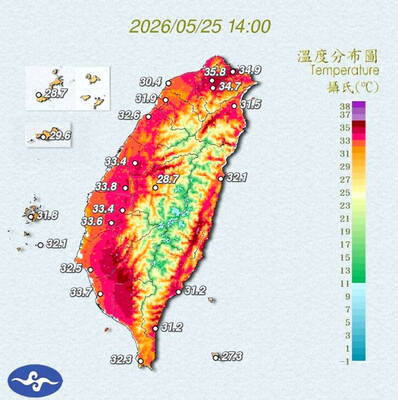
STAY COOL: The HPA recommended that people stay hydrated, use air-conditioning or fans while indoors, wear loose-fitting clothes and walk in the shade while outdoors Employers must implement measures such as installing cooling equipment, and providing drinking water and rest breaks for outdoor workers starting from Monday next week, the Taipei Department of Labor said on Sunday. Employers who fail to comply could face fines of NT$30,000 to NT$300,000 under the Occupational Safety and Health Act (職業安全衛生法), the department said. Businesses in Taipei employing fewer than 100 workers, as well as registered self-employed workers with labor insurance coverage, could receive on-site assessments and guidance from occupational safety consultants to help them apply for central government subsidies to implement or improve heat-protection measures, it said. Under the Ministry of


 RSS
RSS