


Government-funded research has cultivated fungi and bacteria that could help farmers increase vegetable yields amid climate challenges, the Ministry of Agriculture said on Tuesday.
Extreme climate events pose a significant threat to Taiwan’s agriculture sector, which has sustained heavy economic losses from increasingly powerful typhoons, torrential rains, heat waves and dry spells, ministry officials told a news conference.
In 2021, the Taichung District Agricultural Research and Extension Station launched a joint program to enhance the climate resilience of crops and vegetables by developing potentially beneficial microbes, station director Yang Hung-ying (楊宏瑛) said.
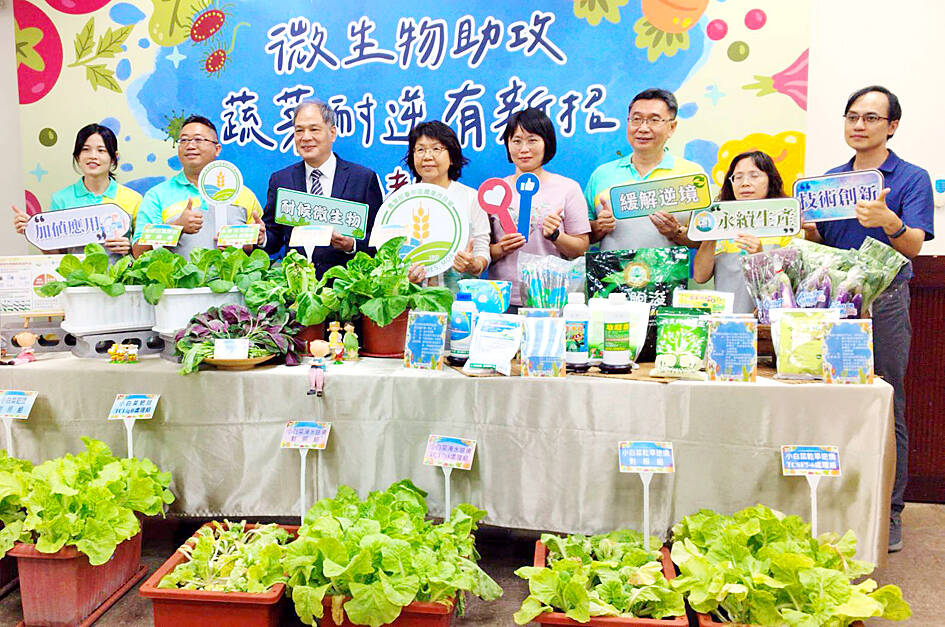
Photo: CNA
The Agricultural Technology Research Institute and National Chung Hsing University collaborated with the station in the endeavor, he said.
The project cultivated fungi in the genus Trichoderma, the bacteria species Bacillus licheniformis, Bacillus amyloliquefaciens, and the bacteria genus Streptomyces, which are capable of bolstering the survival rate and quality of common vegetables, station researcher Ku Chien-chih (郭建志) said.
Through experimentation, researchers found that the fungi and bacteria can improve the survivability of nappa cabbage, common cabbage and types of fast-growing vegetables by 20 to 50 percent, despite a scarcity or overabundance of moisture, he said.
The microbes reduced calcium deficiency-related wilting in nappa cabbages cultivated during summer by 20 percent, he said.
Microbial research is part of the ministry’s drive to improve the agricultural sector’s sustainability and resilience against the effects of global warming, Ku said.
Microbes developed by the program increased the cold-storage shelf life of cucumbers to a month from two weeks, station researcher Chen Chun-wei (陳俊位) said.
Farms that used the program-developed bacteria and fungi increased their yield and maintained stable output, Changhua Fang-yuan He-xiang Fruits and Vegetable Production Co-op manager Chan Ya-ting (詹雅婷) said.
The vegetables produced with the microbes were sweeter and crunchier than those raised without, she added.

Fast food chain McDonald's is to raise prices by up to NT$5 on some products at its restaurants across Taiwan, starting on Wednesday next week, the company announced today. The prices of all extra value meals and sharing boxes are to increase by NT$5, while breakfast combos and creamy corn soup would go up by NT$3, the company said in a statement. The price of the main items of those meals, if ordered individually, would remain the same. Meanwhile, the price of a medium-sized lemon iced tea and hot cappuccino would rise by NT$3, extra dipping sauces for chicken nuggets would go up

Nvidia Corp CEO Jensen Huang (黃仁勳) arrived in Taiwan yesterday ahead of upcoming AI and technology events, saying he plans to meet with clients and Taiwan Semiconductor Manufacturing Co Chairman C.C. Wei (魏哲家) during his visit. After landing at Taipei Songshan Airport, Huang posed for photos with fans and handed out Yakult drinks to reporters and supporters waiting at the scene, saying he has “a lot to do” during the trip. Asked about reports that Nvidia’s planned headquarters site in Taipei’s Beitou Shilin Technology Park could break ground on May 27, Huang said that if the company holds an event, he would

FUKUOKA SITUATION: Japanese media reported that the pathogen is expected to be identified by the summer, while the CDC downplayed the idea that it was hMPV A “mysterious cold-like illness” reported in Japan’s Fukuoka Prefecture does not seem to be a new disease, but Japanese authorities have been asked about the situation, the Centers for Disease Control (CDC) said yesterday. The Fukuoka Prefectural Medical Association on Wednesday told a news conference that a “mystery cold” that has become a hot topic on social media is “highly likely to be caused by some kind of viral infection,” Japan’s KBC News reported. “Many people are experiencing symptoms starting with a sore throat, followed by a runny nose, phlegm and a severe cough,” KBC News reported, citing association officials. Health authorities are

Carrefour Taiwan is to begin using a new name from the start of July, but it cannot divulge the name until then, the chairman of the supermarket chain's parent company said today. President Chain Store Co chairman Lo Chih-hsien (羅智先) was asked by reporters after a shareholders' meeting to confirm whether the company has settled on a new name for the supermarket brand. In March, the government-registered name of two Carrefour Taiwan branches was quietly changed to "Le Chia Kang" (樂家康) in Chinese, raising speculation that has been selected as the name. Lo said that because of local regulations and contractual obligations, the


 RSS
RSS