


Apex Aviation yesterday confirmed reports that Chinese military aircraft flew close to one of its medevac plane near Kinmen County in June.
Confirming the first news report of the incident, which was published by the local RW News on Tuesday, Apex said that the issue occurred on the morning of June 26, when one of its medevac aircraft was flying from Taipei International Airport (Songshan airport) to its base in Kinmen, carrying no patients.
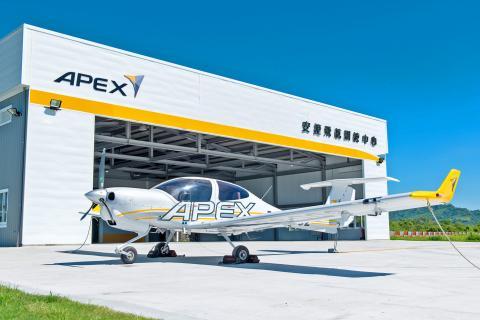
Photo: Lin Chia-chi, Taipei Times
"As the flight neared Kinmen, the pilots heard the Kaohsiung Approach on the public frequency warning off a Chinese People's Liberation Army (PLA) aircraft and ordering it to leave the civilian airway," Apex said, referring to Kaohsiung International Airport's aviation approach procedure.
"The Approach additionally informed our pilots that a fighter jet was flying alongside our plane," the medevac company said.
Apex said it was "difficult to gauge" the distance between its aircraft and the Chinese fighter jet, which was visible to its pilots for about five minutes.
It is unclear how long the fighter jet remained close to the medevac plane, as Apex could not determine precisely when it first approached or departed, the company said.
Apex said its pilots followed air traffic control instructions and encountered "no impediments" during the remainder of the flight to Kinmen Airport.
The plane was not carrying any patients at the time, it said.
On the question of why it did not report the incident at the time, APEX said it believed the encounter was coincidental, as it was aware of the news reports that the PLA was conducting "joint combat readiness patrols" that same day.
The RW News report on Tuesday said that two PLA aircraft — a JH-7 and a J-10 — had closed in on an Apex medical evacuation plane in airspace near Kinmen "several months ago."
Later in the day, the Mainland Affairs Council issued a statement saying it strongly condemned Beijing's actions and called for a cessation of "such irrational actions," which it said undermine "humanitarian relief and jeopardize flight safety."
"China's military threat against Taiwan is growing by the day, amid frequent military intimidation and 'gray zone' incursions in the waters and airspace around the Taiwan Strait," the council said at the time.
"It has even targeted our medevac aircraft," the council said, adding that such actions show "a disregard for human life."
Yesterday, council Deputy Minister and spokesperson Liang Wen-chieh (梁文傑) told a regular news briefing that the incident was the first of its kind, and the council hoped it would not be repeated.
The Kinmen medevac service is a special one designed to address the area's limited medical resources and meet the needs of the county's residents, he said.
However, Liang did not respond to questions about why the incident was not reported at the time, or what measure were being taken to prevent a recurrence.
Given the discrepancy between Apex's and RW News reports on the number of PLA aircaraft, reporters sought clarification from the air force yesterday, but did not obtain a clear answer.
"In the face of PLA incursions, the air force employs a joint intelligence, surveillance and reconnaissance system to maintain full awareness of movements in the waters and airspace around the Taiwan Strait," the air force said.
Asked why Taiwanese authorities regarded the incident as a "gray zone" incursion rather than a chance encounter with PLA aircraft, the air force did not respond directly.
On Wednesday, Chen Binhua (陳斌華), spokesperson for China's Taiwan Affairs Office, commented on the council's response the previous day, saying that the Democratic Progressive Party authorities are "accustomed to making an issue of so-called 'gray zone harassment.'"
The party "deliberately hypes up a 'mainland threat' and incites 'anti-China' sentiment" to distract from Taiwanese residents' dissatisfaction with its incompetent governance," Chen said.

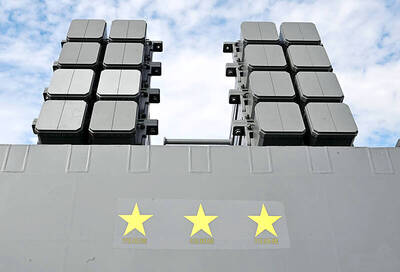
UPGRADE: The Kang Ding-class frigate is replacing its Chaparall missiles with Tien Chien II and Hua Yang VLS, which would provide it with long-range, 360° air defense Taiwan plans to produce 1,200 to 1,376 Hai Chien II missiles (海劍二, Sea Sword II) — also known as TC-2N — to serve as the standard air defense system of the navy’s surface combatant fleet, a source said yesterday. Last week, the Hai Chien II, the naval version of the Tien Kung II missile (天劍二, Sky Sword II), completed a live-fire test in waters off the National Chungshan Institute of Science and Technology’s Jiupeng facility (九鵬) in Pingtung County’s Manjhou Township (滿州). The MIM72 Chaparral and other dated air defense missiles that currently arm Taiwanese ships have inadequate range to combat Chinese

REASONS FOR TRAVEL: An assistant professor said that proposed amendments to penalize drivers if they used drugs overseas would not deter people from traveling People who operate a motor vehicle under the influence of marijuana would have their driver’s license revoked, even if they used the substance while overseas, the Ministry of Transportation and Communications said yesterday, citing proposed amendments to the Road Traffic Management and Penalty Act (道路交通管理處罰條例). The amendments would also authorize the government to revoke the licenses of people determined to have used Category 1 or Category 2 narcotics, even if they were not operating a vehicle while under the influence of drugs, as well as ban them from taking the license test for three years, the ministry said. People aged 18 or
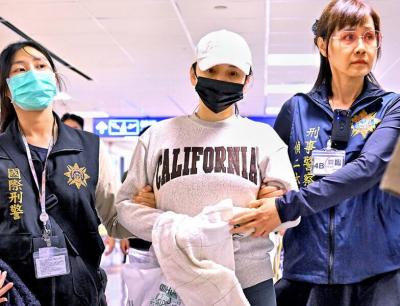
Johanne Liou (劉喬安), a Taiwanese woman who shot to unwanted fame during the Sunflower movement protests in 2014, returned to Taiwan last night after being deported from the US. She is to stand trial in Taiwan for charges involving embezzlement, fraud and drug crimes. The Criminal Investigation Bureau (CIB) said it took her into custody at Taiwan Taoyuan International Airport and would first question her before transferring her to the New Taipei District Prosecutors’ Office. She was arrested upon disembarking a flight from San Francisco that landed shortly before 7pm. Liou absconded to the US in 2019 after jumping bail
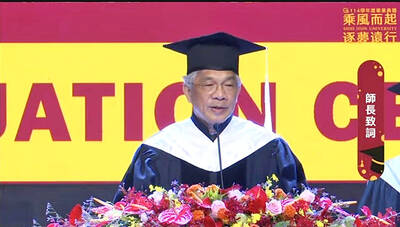
Shih Hsin University President Chen Ching-he (陳清河) yesterday issued a public apology for comments made in his commencement speech last week, stating that he has asked the school to suspend his duties and halt his wages for two months as a show of contrition. At the commencement ceremony on May 30, Chen said, “If you don’t manage your time well, or your own emotions, or your health, then I am telling every one of you — put a quick end to ‘you,’ because the world has no need for ‘you.’” The comments have sparked significant controversy online, and Chen through an open


 RSS
RSS