


National Taiwan Normal University (NTNU) has decided to dismiss Chou Tai-ying (周台英), the university’s long-time women’s varsity soccer coach, over her improper handling of blood sampling for research projects involving student athletes.
The university said in a brief statement yesterday that after completing a three-tier, three-level review, the Faculty Evaluation Committee decided to dismiss Chou and banned her from employment as a teacher for four years.
The decision was made during a university-level meeting earlier in the day, with more than half of the 20 attendees voting anonymously in favor of Chou’s dismissal, NTNU said.
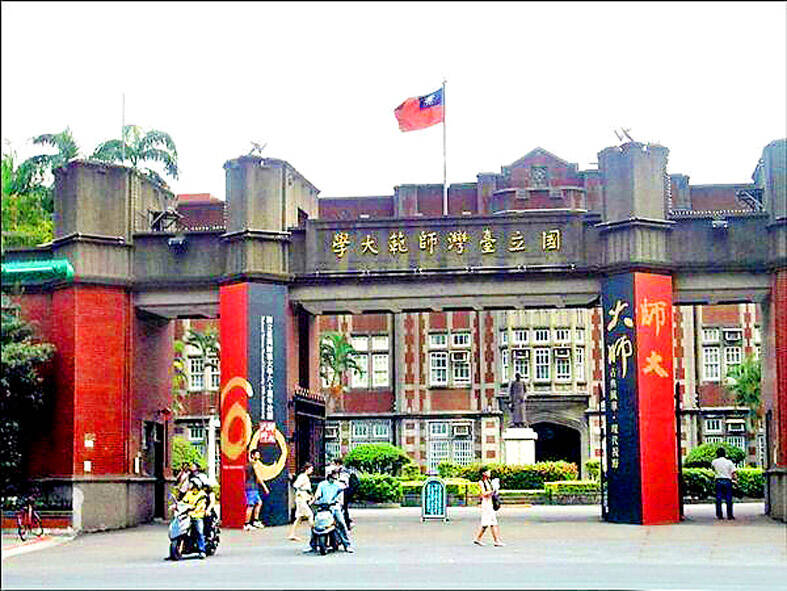
Photo: Taipei Times
A report on the decision would soon be submitted to the Ministry of Education for final approval and execution, the university said.
The vote overturned the university’s earlier decision that Chou, an associate professor at the university’s Department of Sport and Kinesiology, be subjected to five disciplinary measures, including a salary freeze.
That earlier decision came despite a recommendation by a committee on campus bullying prevention that Chou be suspended for two years.
Chou, 61, is a former national team player who led Taiwan to three consecutive Asian Cup titles in 1977, 1979 and 1981. She has served as head coach of the university’s women’s soccer team since 2004.
The case first came to light in November last year, when Democratic Progressive Party Chen Pei-yu (陳培瑜) said that an unnamed educator had forced members of NTNU’s women’s soccer team to participate in studies she designed that were approved by the National Science and Technology Council.
The projects, focused on determining the impact of sports apparel and treatment methods on athletes’ recovery, required each player to give three blood samples per day for 14 consecutive days.
Students were told that refusal to participate could cost them course credits required for graduation, Chen said.
The university’s previous decision sparked public outrage and prompted the education ministry to demand that the university hold another review.
Yesterday’s meeting was the final stage of NTNU’s three-tier faculty evaluation process, following reviews at the department and college levels.
The NTNU statement said the committee’s decision considered the unequal power dynamic between Chou and the students, the number of students affected, the physical and psychological harm caused, and the infringement on students’ educational rights.
Other factors included the duration, number and frequency of the bullying, as well as the level of responsibility Chou should bear, it said.
The university confirmed that Chou repeatedly bullied and demeaned students, conducted blood sampling without clearly informing students of its purpose, and failed to obtain their informed consent.
Citing Chou’s own admission that she had instructed senior students without medical licenses to help carry out the blood sampling, NTNU said she had clearly breached regulations.
The outcome could result in Chou, who is soon to turn 62, losing her pension.
The education ministry has said that dismissed faculty members cannot apply for pension benefits.

The Ministry of Finance this afternoon announced the winning numbers for the March-April uniform invoice lottery. The winning number for the NT$10 million (US$318,060) special prize is 19531471, and the winning number for the NT$2 million grand prize is 85941329. Three numbers were drawn for the NT$200,000 first prize: 07225810, 20231230 and 83518781. Those with receipts matching the last seven digits of any of the first-prize numbers will win the NT$40,000 second prize, while those matching the last six digits will win the NT$10,000 third prize. Those whose receipts match the last five digits of the first-prize numbers can claim the NT$4,000 fourth prize,

SIX SUBSIDIES: The monthly allowance for older farmers is to increase to NT$10,000, and NT$5,000 is to be given to homemakers under the national pension system, Lai said The government is to implement major welfare policies for disadvantaged groups, including raising the monthly allowance for older farmers to NT$10,000 and providing homemakers with NT$5,000 per month, President William Lai (賴清德) said yesterday. Lai made the remarks during a visit to Wangling Temple in Chiayi County, saying that the planned increases were being introduced amid economic growth and an increase in tax revenue. Touting a policy, in which the government plans to provide a monthly allowance of NT$5,000 for every child under the age of 18 in a bid to address Taiwan’s low birthrate, Lai said that if received for the
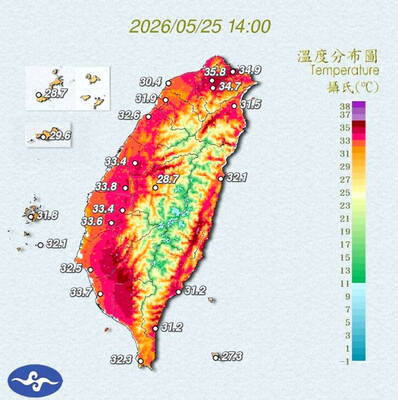
STAY COOL: The HPA recommended that people stay hydrated, use air-conditioning or fans while indoors, wear loose-fitting clothes and walk in the shade while outdoors Employers must implement measures such as installing cooling equipment, and providing drinking water and rest breaks for outdoor workers starting from Monday next week, the Taipei Department of Labor said on Sunday. Employers who fail to comply could face fines of NT$30,000 to NT$300,000 under the Occupational Safety and Health Act (職業安全衛生法), the department said. Businesses in Taipei employing fewer than 100 workers, as well as registered self-employed workers with labor insurance coverage, could receive on-site assessments and guidance from occupational safety consultants to help them apply for central government subsidies to implement or improve heat-protection measures, it said. Under the Ministry of
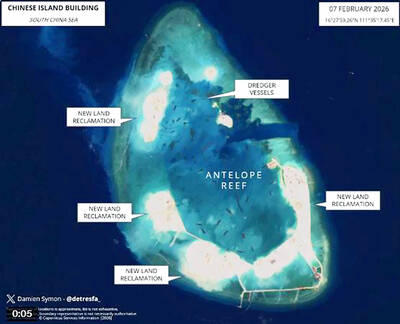
ISOLATION: The outposts would serve as support and backup bases, forcing US forces to either face China head-on or reroute, increasing travel time and operational costs China’s outposts in the South China Sea could be used to delay and constrain foreign forces during a conflict in the Taiwan Strait, giving Beijing a critical window to carry out amphibious landing and blockade operations, a report said. The Chinese Communist Party’s (CCP) forward operating bases on islands and reclaimed features in the South China Sea could delay foreign forces long enough for the Chinese People’s Liberation Army (PLA) to secure a key 48-to-72-hour window in the Taiwan Strait, a report commissioned by the Mainland Affairs Council found. The report, conducted by the Institute for National Defense and Security Research, examined


 RSS
RSS