


Taiwan could start exporting guavas to Australia within a year, the Animal and Plant Health Inspection Agency said yesterday.
The Australian Department of Agriculture, Fisheries and Forestry on Monday last week released a draft risk assessment report for Taiwanese guava exports to the country, the agency said.
After a two-month public notification period, discussions can begin about details and procedures for managing guava exports to Australia, with shipments likely starting within one year, it said.
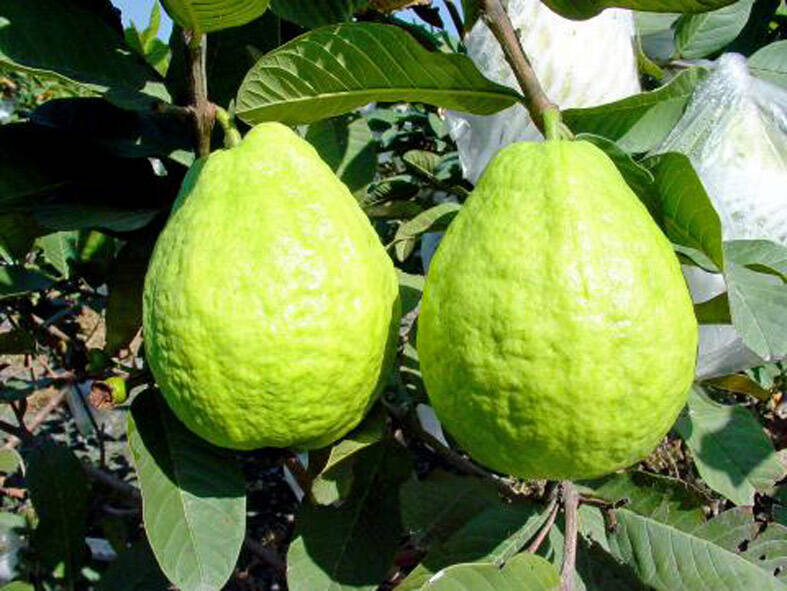
Photo courtesy of the Ministry of Agriculture
Guavas could be vulnerable to the oriental fruit fly, or Bactrocera dorsalis, which is endemic to Taiwan. In December 2009, the agency submitted pest control management information on eradicating oriental fruit flies to the Australian quarantine unit.
After years of communication and Taiwan submitting supplementary documents, Australia in November 2023 sent experts to Taiwan for on-site inspections and verifications of guava orchards, it said.
The specialists inspected production facilities, pest and disease management, and post-harvest processing and packaging, which served as the basis for the draft risk assessment report, the agency said.
The experts affirmed Taiwan’s “high” operating and management standards, it said.
The draft assessment focused on fruit flies and other pests that could enter the country via fruit imports, it said.
Australian experts agreed to a proposed cold treatment disinfection technique for fruit flies, in addition to visual inspections and sorting prior to exports, it said.
After the public notification period is completed, Australian authorities would finalize their assessment, taking into account the public comments gathered, it added.
After that, the two countries could confirm quarantine and production conditions, it said.
The time between the consultation period and final agreement on imports varies by country, but it usually takes a few months to a year, the agency said.
Taiwanese officials will continue negotiations with their Australian counterparts as soon as possible, it said.
Taiwan currently exports guavas to the US, Canada, China, Hong Kong, Malaysia, Macau, Brunei, Indonesia, the Netherlands and the United Arab Emirates.
For exports to the US, guavas have to be stored in an environment below 1°C for 17 consecutive days before arriving in the US to minimize the risk of fruit fly infestation.

The Ministry of Finance this afternoon announced the winning numbers for the March-April uniform invoice lottery. The winning number for the NT$10 million (US$318,060) special prize is 19531471, and the winning number for the NT$2 million grand prize is 85941329. Three numbers were drawn for the NT$200,000 first prize: 07225810, 20231230 and 83518781. Those with receipts matching the last seven digits of any of the first-prize numbers will win the NT$40,000 second prize, while those matching the last six digits will win the NT$10,000 third prize. Those whose receipts match the last five digits of the first-prize numbers can claim the NT$4,000 fourth prize,

SIX SUBSIDIES: The monthly allowance for older farmers is to increase to NT$10,000, and NT$5,000 is to be given to homemakers under the national pension system, Lai said The government is to implement major welfare policies for disadvantaged groups, including raising the monthly allowance for older farmers to NT$10,000 and providing homemakers with NT$5,000 per month, President William Lai (賴清德) said yesterday. Lai made the remarks during a visit to Wangling Temple in Chiayi County, saying that the planned increases were being introduced amid economic growth and an increase in tax revenue. Touting a policy, in which the government plans to provide a monthly allowance of NT$5,000 for every child under the age of 18 in a bid to address Taiwan’s low birthrate, Lai said that if received for the
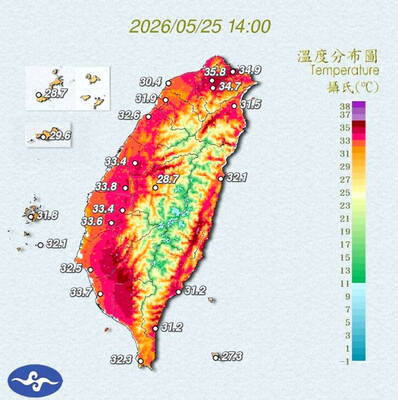
STAY COOL: The HPA recommended that people stay hydrated, use air-conditioning or fans while indoors, wear loose-fitting clothes and walk in the shade while outdoors Employers must implement measures such as installing cooling equipment, and providing drinking water and rest breaks for outdoor workers starting from Monday next week, the Taipei Department of Labor said on Sunday. Employers who fail to comply could face fines of NT$30,000 to NT$300,000 under the Occupational Safety and Health Act (職業安全衛生法), the department said. Businesses in Taipei employing fewer than 100 workers, as well as registered self-employed workers with labor insurance coverage, could receive on-site assessments and guidance from occupational safety consultants to help them apply for central government subsidies to implement or improve heat-protection measures, it said. Under the Ministry of

NATIONAL SECURITY: Authorities are working to confirm the identities of the military personnel involved and investigating possible illegal conduct and regulatory violations Authorities are probing possible national security implications after Kinmen police and immigration officers on Sunday found a Chinese woman allegedly posing as a tourist while engaging in prostitution involving more than 10 military personnel. The woman, surnamed Chen (陳), has since been deported, authorities said, adding that investigators are still working to confirm the identities of those implicated, as the records only listed code names and aliases. The case stemmed from a report received by the Kinmen District Prosecutors’ Office on Friday last week from the Jinhu Precinct of the Kinmen County Police Bureau. On Sunday, police, along with the National Immigration


 RSS
RSS