


Yushan National Park is to upgrade solar power generation facilities at its mountain cabins to provide stable power supply that can last for up to 10 days even in cloudy conditions.
The Yushan National Park Headquarters yesterday signed a memorandum of understanding with Ta Tun Electric Wire and Cable Co (TEWC) on collaborating to upgrade the microgrid for mountain cabins.
National Park Service Director-General Wang Cheng-chi (王成機) at the signing ceremony said that the national park’s mountain cabins have long relied on solar energy for lighting, telecommunications and simple meal preparation.
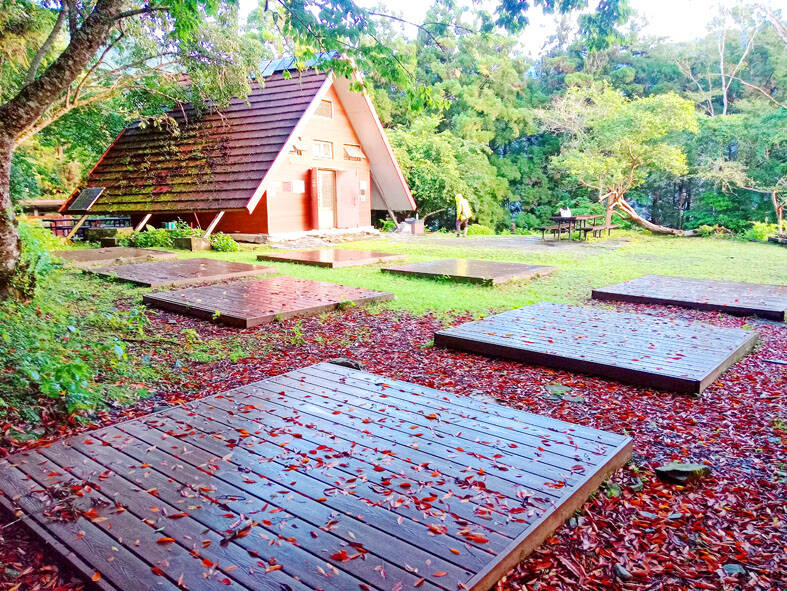
Photo courtesy of the National Park Service
However, they are mostly located in remote areas, making it difficult to maintain or renew their solar equipment, he said.
Nearly 30 of the total 40 cabins at the national park are equipped with solar power systems, but the equipment’s efficiency has decreased with time, Wang said.
With advanced power grid technology, TEWC has become the first corporation to engage in a solar facility upgrade plan for mountain cabins, he said, adding the headquarters’ collaboration with TEWC would start with Walami Cabin (瓦拉米山屋) in Hualien County.
Upgraded solar systems are expected to boost the energy efficiency to at least three times higher than the original equipment, Wang said.
The construction is slated to begin on Aug. 5 and would be completed in five days.
Lin Mei-ling (林美伶), chief executive officer of Tun Green Power Co, an affiliate of TEWC, said the company’s solar energy storage equipment can store 10 kilowatt-hours (kWh) of electricity.
She said that 1kWh is enough to fully charge 60 hikers’ mobile phones, or provide heat for making 60 bowls of instant noodles.
Such amounts of power are unlikely to be used up under regular circumstances, Lin said, adding the power would be enough for 10-day use even on sunshine-free, cloudy days.
The new equipment can be conveniently managed via mobile phones, and its solar panels would adopt an all-black design to blend seamlessly into the environment and minimize ecological impacts, she said.

The military has spotted two Chinese warships operating in waters near Penghu County in the Taiwan Strait and sent its own naval and air forces to monitor the vessels, the Ministry of National Defense (MND) said. Beijing sends warships and warplanes into the waters and skies around Taiwan on an almost daily basis, drawing condemnation from Taipei. While the ministry offers daily updates on the locations of Chinese military aircraft, it only rarely gives details of where Chinese warships are operating, generally only when it detects aircraft carriers, as happened last week. A Chinese destroyer and a frigate entered waters to the southwest
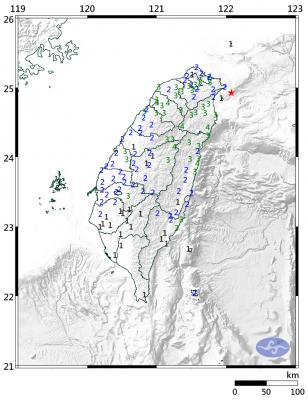
A magnitude 6.1 earthquake struck off the coast of Yilan County at 8:39pm tonight, the Central Weather Administration (CWA) said, with no immediate reports of damage or injuries. The epicenter was 38.7km east-northeast of Yilan County Hall at a focal depth of 98.3km, the CWA’s Seismological Center said. The quake’s maximum intensity, which gauges the actual physical effect of a seismic event, was a level 4 on Taiwan’s 7-tier intensity scale, the center said. That intensity level was recorded in Yilan County’s Nanao Township (南澳), Hsinchu County’s Guansi Township (關西), Nantou County’s Hehuanshan (合歡山) and Hualien County’s Yanliao (鹽寮). An intensity of 3 was

Instead of focusing solely on the threat of a full-scale military invasion, the US and its allies must prepare for a potential Chinese “quarantine” of Taiwan enforced through customs inspections, Stanford University Hoover fellow Eyck Freymann said in a Foreign Affairs article published on Wednesday. China could use various “gray zone” tactics in “reconfiguring the regional and ultimately the global economic order without a war,” said Freymann, who is also a nonresident research fellow at the US Naval War College. China might seize control of Taiwan’s links to the outside world by requiring all flights and ships entering or leaving Taiwan
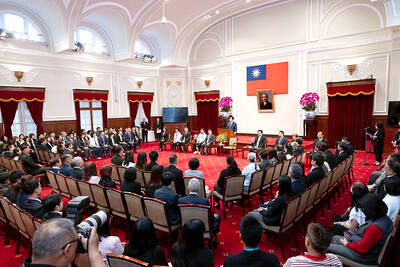
The next minimum wage hike is expected to exceed NT$30,000, President William Lai (賴清德) said yesterday during an award ceremony honoring “model workers,” including migrant workers, at the Presidential Office ahead of Workers’ Day today. Lai said he wished to thank the awardees on behalf of the nation and extend his most sincere respect for their hard work, on which Taiwan’s prosperity has been built. Lai specifically thanked 10 migrant workers selected for the award, saying that although they left their home countries to further their own goals, their efforts have benefited Taiwan as well. The nation’s industrial sector and small businesses lay


 RSS
RSS