


Taiwan and the US are discussing the potential for spaceport cooperation, which could shorten travel time between Taipei and Houston, Texas, to two-and-a-half hours, the American Institute in Taiwan (AIT) said on Monday.
The program would expand space cooperation between Taiwan and the US, the AIT said on Facebook, adding that the matter is “awaiting further evaluation.”
Ellington Airport in Houston already has a spaceport license, it said.

Photo: Screen grab from American Institute in Taiwan’s Facebook page
If suborbital flights are used, it would take only two-and-a-half hours to travel between Taipei and Houston, the AIT said.
The cooperation could initially focus on uncrewed cargo missions before maturing technology enables crewed flights, it added.
“This concept highlights Taiwan’s potential for space innovation and also marks the deep scientific and technological partnership between the United States and Taiwan,” the AIT said.
The National Science and Technology Council (NSTC), which oversees the Taiwan Space Agency (TASA), yesterday welcomed the expansion of bilateral space cooperation, but added that specific plans for space transportation required further evaluation and discussion.
An entirely new form of transportation, the spaceport program could use several different approaches, an unnamed official from Houston First, the tourism bureau of Houston, said late last month.
One would involve a large aircraft carrying a spacecraft into the air and releasing it over open ocean, the official said.
After release, the spacecraft would ignite its engine, ascend vertically through the atmosphere, adjust its orientation, then return to Earth in a free-fall trajectory before making a precision landing at a designated airport, the official added.
The US has 20 spaceports and launch or re-entry sites, including the Houston Spaceport, which is located next to Ellington Airport, US Federal Aviation Administration information says.
That airport focuses on spacecraft development and supports training activities for NASA.
A source familiar with the matter said that relevant US agencies have engaged in informal discussions about the spaceport concept with TASA during international exchange events.
Given the speed of launch and landing, such travel is currently unsuitable for untrained passengers, making cargo transport a more feasible application, the source said.
Taiwan currently does not have a spaceport.
The NSTC announced earlier this year that Jioupeng Village (九棚) in Pingtung County’s Manjhou Township (滿州) was selected as the location for Taiwan’s national launch facility, with current plans focused on launch operations after the site is completed.
However, space has been reserved at the site for potential expansion into a spaceport capable of handling landings, the source said.
Separately, when asked about the potential spaceport cooperation, Ministry of Foreign Affairs North American Affairs Department Director-General Wang Liang-yu (王良玉) yesterday said that the ministry does not have details on the issue, but it would discuss it with relevant government agencies, and that it would be glad to assist where needed.
Additional reporting by Tsai Yun-jung

REASONS FOR TRAVEL: An assistant professor said that proposed amendments to penalize drivers if they used drugs overseas would not deter people from traveling People who operate a motor vehicle under the influence of marijuana would have their driver’s license revoked, even if they used the substance while overseas, the Ministry of Transportation and Communications said yesterday, citing proposed amendments to the Road Traffic Management and Penalty Act (道路交通管理處罰條例). The amendments would also authorize the government to revoke the licenses of people determined to have used Category 1 or Category 2 narcotics, even if they were not operating a vehicle while under the influence of drugs, as well as ban them from taking the license test for three years, the ministry said. People aged 18 or

GLOBALGIVING: ‘ Caving to external pressure is not acceptable for an organization that has cultivated justice reform and human rights for 30 years,’ one NGO said A slew of non-government organizations (NGOs) have withdrawn from the GlobalGiving fundraising platform after it announced it would use “Chinese Taipei” instead of “Taiwan” from next month. The Taiwan Good Rice Association wrote on Facebook on Friday that it was informed on April 28 via a teleconference call of the change, which was made because the platform wanted to operate in China. Taiwan Good Rice is to terminate all cooperative relationships with GlobalGiving in response to the platform’s “unilateral and non-negotiable” decision to remove references to Taiwan, the NGO said. “Taiwan is in the official name of Taiwan Good Rice Association and the

HEAVY WEATHER: Typhoon Jangmi is due to crash straight into the Ryukyus as airlines look to shift flights to larger aircraft or cancel flights to Okinawa entirely Taiwan’s international air carriers announced flight adjustments over the weekend as Typhoon Jangmi is forecast to hit the Ryukyu Islands today and tomorrow. The Central Weather Administration (CWA) upgraded Jangmi from a tropical storm to a typhoon at 8am yesterday, with the eye located 580km south of Naha city. It was moving north at 19kph. Today, China Airlines’ CI-120, CI-121, CI-122 and CI-123 flights between Taoyuan and Naha, Okinawa, have been canceled as well as CI-132 and CI-133 between Kaohsiung and Naha. EVA Air’s BR-112, BR-113, BR-186 and BR-185 flights between Taoyuan and Naha are also canceled. Low-cost carrier Tigerair Taiwan canceled IT-230,
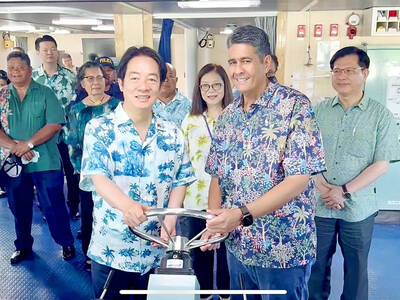
MULTIPRONGED APPROACH: China has sought to pressure Palau across a number of fronts, but the island nation has staunchly resisted overtures to ditch Taiwan Palau has been firm in backing Taiwan despite Chinese pressure that uses tourism economics, cyberattacks and criminal infiltration as tools to threaten the Pacific ally into renouncing its recognition of Taiwan as a sovereign state. The Presidential Office yesterday announced that Vice President Hsiao Bi-khim (蕭美琴) would visit Palau from Saturday to Wednesday next week at the invitation of Palauan President Surangel Whipps Jr. Whipps in April said in an interview that China had outspokenly asked Palau to “denounce Taiwan.” “And we have said: ‘We have no enemies, but nobody tells us who our friends are,’” he said. Whipps has told reporters multiple times


 RSS
RSS