


Taiwan will ask its diplomatic and unofficial allies to raise the issue of China’s decision to unilaterally launch a new flight route in the Taiwan Strait at the International Civil Aviation Organization’s (ICAO) assembly in September, a diplomatic source said yesterday.
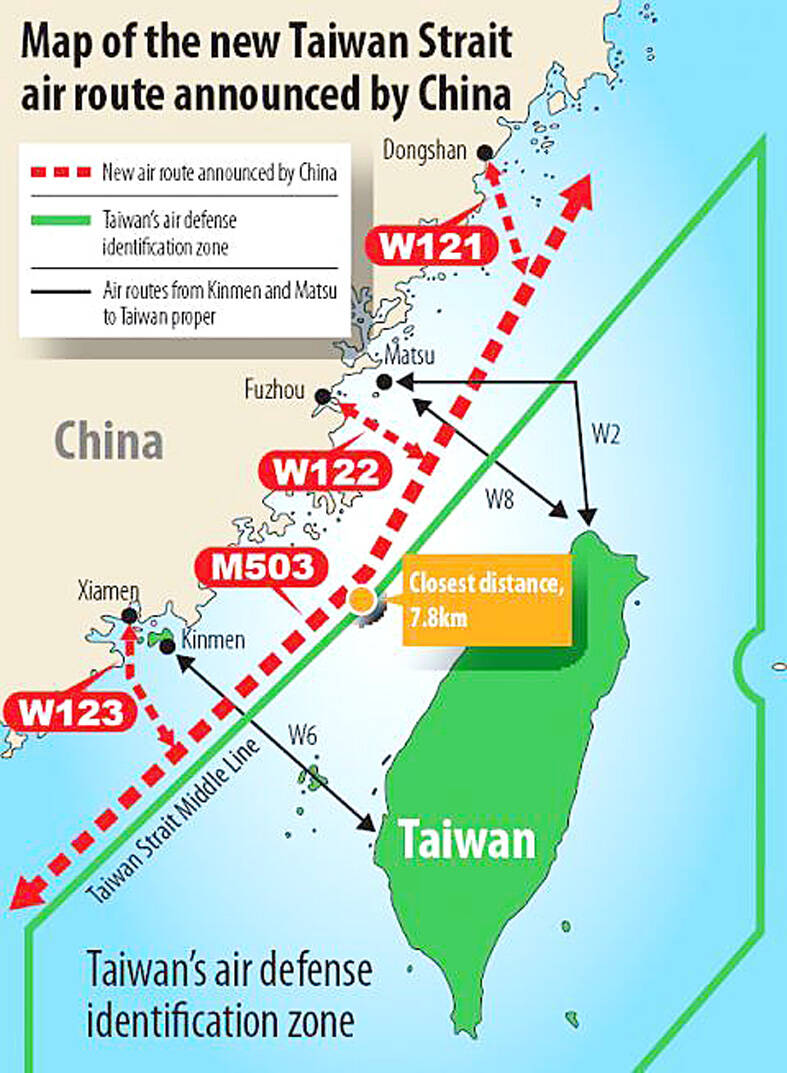
The move comes after China on Sunday unilaterally announced that it would open the northwest-southeast W121 flight route connecting Dongshan in Zhejiang Province to the M503 route along the Taiwan Strait.
The Mainland Affairs Council urged China to promptly begin talks through existing channels on its decision to launch the W121 route.
The Civil Aviation Administration said that China’s decision was “regrettable” and it would closely watch flights that would potentially be affected to ensure flight safety.
It was not the first time China has acted unilaterally in establishing flight routes, the source told reporters in Taipei on Tuesday.
Since China launched the M503 route in 2015, Taiwan has been in close discussions with its diplomatic allies and friendly nations to speak on its behalf, said the source, speaking on condition of anonymity.
“Every time China makes a unilateral decision in launching a flight path, Taiwan’s government will launch a protest and convey its clear stance to the ICAO via the help of allies and friendly countries, given that Taiwan is not a member of the ICAO,” they said.
The W122 and W123 paths, two other west-east paths to the south of W121, were opened at the same time as the M503 route was moved eastward early last year, following which the US, Canada, Japan, Sweden and the Netherlands expressed concern over China’s decision, the source said.
The nations spoke up not solely for Taiwan’s interests, but also for their own interests, because China contravened international rules that could put passenger safety at risk, the source said.
Despite the opposition, the routes remain in use, an indication that diplomatic pressure might be insufficient to sway China, even if ICAO regulations require that the creation, reduction or adjustment of flight routes be coordinated with the regions they pass through and relevant stakeholders, they said.
With the 42nd Session of the ICAO Assembly scheduled for late September at its headquarters in Montreal, Taiwan would again use the decisionmaking meeting as a platform to convey its stance on the flight path issue, the source said.
Taiwan would reiterate its call to be included in the ICAO system to contribute to international aviation safety, they added.
In related news, a US Department of State spokesperson on Sunday told reporters that the US expected cross-Taiwan Strait differences to be resolved “by peaceful means, free from coercion, in a manner acceptable to the people on both sides of the strait.”
The US’ stance related to cross-strait disputes was consistent, the spokesperson said.
“Issues related to civil aviation and safety in the Taiwan Strait should be decided through dialogue between both sides,” they said.
Michael Mazza, senior director for research at the Virginia-based Institute for Indo-Pacific Security, on Monday said that the unilateral opening of the flight routes represented symbolic and substantive actions from China.
In a symbolic way, China wants to use the routes to demonstrate sovereignty over the skies, hoping to make Taiwan feel isolated, as the ICAO will not object, Mazza said.
Substantively, the routes pose a national security concern to Taiwan, as they allow Chinese pilots who might be involved in potential military action against Taiwan to familiarize themselves with the Taiwan Strait, he said.
China might use the routes to approach Taiwanese airspace without raising alarms by disguising military aircraft as civilian carriers, he added.
“Overall, China’s air route machinations are part and parcel of a broader effort to pressure, envelop and complicate the defense of Taiwan,” he said.

FUKUOKA SITUATION: Japanese media reported that the pathogen is expected to be identified by the summer, while the CDC downplayed the idea that it was hMPV A “mysterious cold-like illness” reported in Japan’s Fukuoka Prefecture does not seem to be a new disease, but Japanese authorities have been asked about the situation, the Centers for Disease Control (CDC) said yesterday. The Fukuoka Prefectural Medical Association on Wednesday told a news conference that a “mystery cold” that has become a hot topic on social media is “highly likely to be caused by some kind of viral infection,” Japan’s KBC News reported. “Many people are experiencing symptoms starting with a sore throat, followed by a runny nose, phlegm and a severe cough,” KBC News reported, citing association officials. Health authorities are

Nvidia Corp CEO Jensen Huang (黃仁勳) arrived in Taiwan yesterday ahead of upcoming AI and technology events, saying he plans to meet with clients and Taiwan Semiconductor Manufacturing Co Chairman C.C. Wei (魏哲家) during his visit. After landing at Taipei Songshan Airport, Huang posed for photos with fans and handed out Yakult drinks to reporters and supporters waiting at the scene, saying he has “a lot to do” during the trip. Asked about reports that Nvidia’s planned headquarters site in Taipei’s Beitou Shilin Technology Park could break ground on May 27, Huang said that if the company holds an event, he would

The Ministry of Finance this afternoon announced the winning numbers for the March-April uniform invoice lottery. The winning number for the NT$10 million (US$318,060) special prize is 19531471, and the winning number for the NT$2 million grand prize is 85941329. Three numbers were drawn for the NT$200,000 first prize: 07225810, 20231230 and 83518781. Those with receipts matching the last seven digits of any of the first-prize numbers will win the NT$40,000 second prize, while those matching the last six digits will win the NT$10,000 third prize. Those whose receipts match the last five digits of the first-prize numbers can claim the NT$4,000 fourth prize,

SIX SUBSIDIES: The monthly allowance for older farmers is to increase to NT$10,000, and NT$5,000 is to be given to homemakers under the national pension system, Lai said The government is to implement major welfare policies for disadvantaged groups, including raising the monthly allowance for older farmers to NT$10,000 and providing homemakers with NT$5,000 per month, President William Lai (賴清德) said yesterday. Lai made the remarks during a visit to Wangling Temple in Chiayi County, saying that the planned increases were being introduced amid economic growth and an increase in tax revenue. Touting a policy, in which the government plans to provide a monthly allowance of NT$5,000 for every child under the age of 18 in a bid to address Taiwan’s low birthrate, Lai said that if received for the


 RSS
RSS