


Representatives of A’tolan Village in Taitung County’s Donghe Township (東河), along with environmental groups, yesterday protested in front of the Ministry of Environment in Taipei against a proposed resort construction project near the village, saying the developer failed to conduct sufficient environmental impact assessments (EIA) and communicate with the village.
ATT Group plans to build a resort that would comprise seven large buildings and 18 villas on nearly seven hectares in Kakahalay, an indigenous traditional territory of the village.
ATT initially proposed the project in 2016, which underwent an EIA review by the Taitung County Government in 2018 and was transferred to the central government the following year.
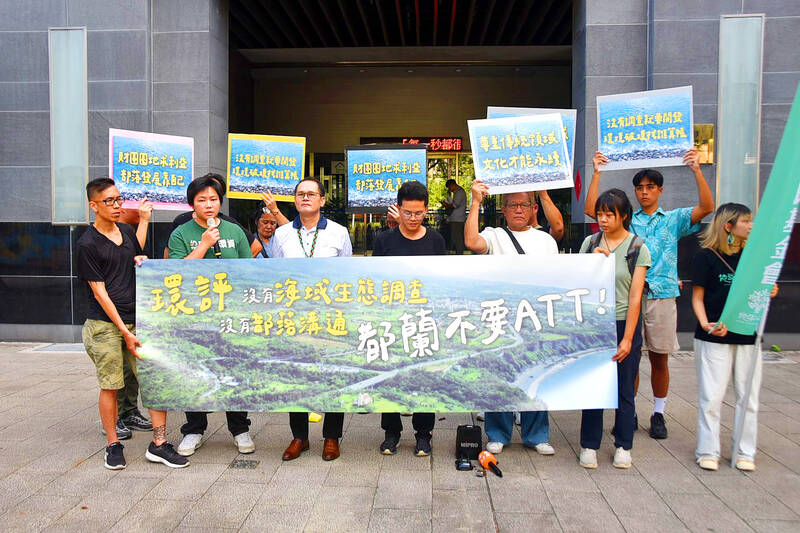
Photo: Wu Po-hsuan, Taipei Times
The project in June and November last year went through the first and second EIA review by the ministry respectively before the third review was completed yesterday.
Village representative Paylang Caya asked the firm to hold public hearings at the community center in the village instead of at the Donghe Township Office 20km away.
The developer violated the Rules Governing Traditional Territories of the A’tolan Village (都蘭部落傳統領域管理原則) by initiating the project without obtaining approval from the village, he said.
Sontok Diway asked ATT to remove the Amis Music Festival from its list of “recreational resources” for the project, as the festival is the indigenous community’s achievement and should not be appropriated without permission.
The village would not reject economic revitalization via land development, but the village’s tourism should not be developed without due respect to the land, environment and local culture, he said.
Papah Tupang said the resort might compete with the village and local communities for water, as the region often has shortages due to low water pressure.
ATT should specify whether it would bear the cost of extending water pipelines, he said.
Trust in Nature Foundation spokeswoman Chen Zih-rong (陳姿蓉) said the resort would generate lots of wastewater, which would affect local natural water systems.
The developer did not conduct an EIA of surrounding maritime areas and the coral reef ecosystem, while data from the foundation showed that living coral reefs in the bay decreased by nearly half to 32.5 percent last year, from 60 percent in 2014, she said.
Massive quantities of water discharge from the resort could cause the bay’s near-shore salinity to plunge to lower than 20 practical salinity units, to the detriment of coral reefs, Chen said.
The Society of Wilderness’ Taitung branch spokeswoman Su Ya-ting (蘇雅婷) said the construction site is near a coastal terrace that has been repeatedly hit by landslides due to typhoons or heavy rainfall, with the affected slope left bare.
The developer judged the slope to be safe simply using images from Google Earth, and ignored the fact that the terrace continues to collapse and recede, she said.
Citizen of the Earth spokesman Liang Sheng-yueh (梁聖岳) said the project is not a dilemma between economic development and environmental protection, but a choice between land speculation, and social and environmental reconciliation.
The EIA committee yesterday said it would continue to review the case and requested that ATT submit additional documents by Sept. 30.
ATT said it would obtain Green Building and Green Mark Hotel certifications, as well as communicate with local residents and visit the village with committee member Chiou Chyi-rong (邱祈榮).


UPGRADE: The Kang Ding-class frigate is replacing its Chaparall missiles with Tien Chien II and Hua Yang VLS, which would provide it with long-range, 360° air defense Taiwan plans to produce 1,200 to 1,376 Hai Chien II missiles (海劍二, Sea Sword II) — also known as TC-2N — to serve as the standard air defense system of the navy’s surface combatant fleet, a source said yesterday. Last week, the Hai Chien II, the naval version of the Tien Kung II missile (天劍二, Sky Sword II), completed a live-fire test in waters off the National Chungshan Institute of Science and Technology’s Jiupeng facility (九鵬) in Pingtung County’s Manjhou Township (滿州). The MIM72 Chaparral and other dated air defense missiles that currently arm Taiwanese ships have inadequate range to combat Chinese

REASONS FOR TRAVEL: An assistant professor said that proposed amendments to penalize drivers if they used drugs overseas would not deter people from traveling People who operate a motor vehicle under the influence of marijuana would have their driver’s license revoked, even if they used the substance while overseas, the Ministry of Transportation and Communications said yesterday, citing proposed amendments to the Road Traffic Management and Penalty Act (道路交通管理處罰條例). The amendments would also authorize the government to revoke the licenses of people determined to have used Category 1 or Category 2 narcotics, even if they were not operating a vehicle while under the influence of drugs, as well as ban them from taking the license test for three years, the ministry said. People aged 18 or

Johanne Liou (劉喬安), a Taiwanese woman who shot to unwanted fame during the Sunflower movement protests in 2014, returned to Taiwan last night after being deported from the US. She is to stand trial in Taiwan for charges involving embezzlement, fraud and drug crimes. The Criminal Investigation Bureau (CIB) said it took her into custody at Taiwan Taoyuan International Airport and would first question her before transferring her to the New Taipei District Prosecutors’ Office. She was arrested upon disembarking a flight from San Francisco that landed shortly before 7pm. Liou absconded to the US in 2019 after jumping bail

Shih Hsin University President Chen Ching-he (陳清河) yesterday issued a public apology for comments made in his commencement speech last week, stating that he has asked the school to suspend his duties and halt his wages for two months as a show of contrition. At the commencement ceremony on May 30, Chen said, “If you don’t manage your time well, or your own emotions, or your health, then I am telling every one of you — put a quick end to ‘you,’ because the world has no need for ‘you.’” The comments have sparked significant controversy online, and Chen through an open


 RSS
RSS