


Air raid drills are to take place across Taiwan from July 15 to 18 alongside the Han Kuang exercises, with drills staggered across cities and counties nationwide, the Ministry of National Defense (MND) said today.
Traditional air raid sirens and mobile phone alerts are set to go off before evacuation and sheltering drills commence, with traffic control implemented, it said.
Taichung, Tainan and Taipei are also set to host one-day urban resilience exercises incorporating emergency relief operations and tabletop simulations, scheduled for July 15, 16 and 17, respectively.
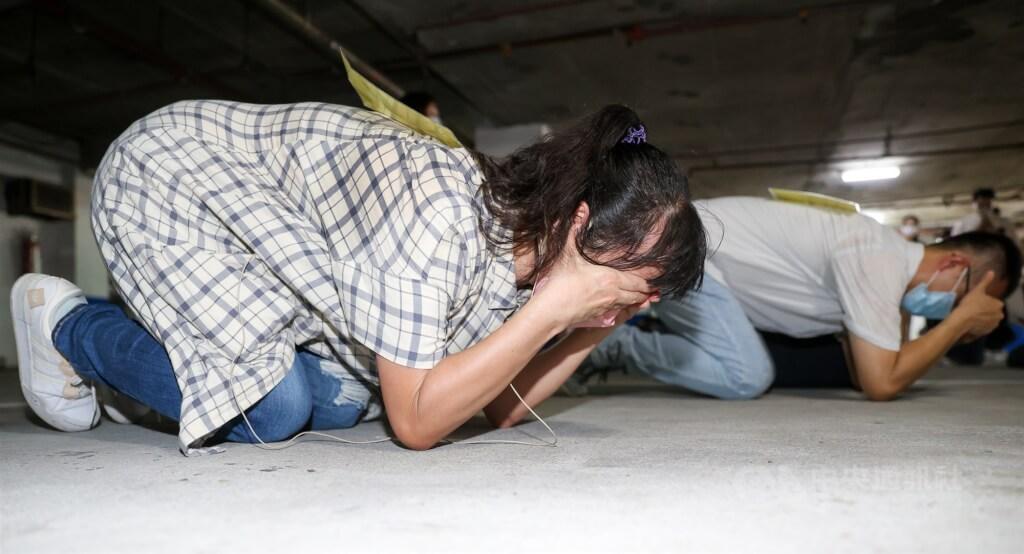
Photo: CNA
The ministry today held a media conference to discuss arrangements for this month’s air raid drills, this year's urban resilience drills and the 41st Han Kuang exercises, Taiwan’s largest annual military drills.
Chu Sen-tsuen (朱森村), director of the All-out Defense Mobilization Office's Manpower Mobilization Division, also introduced a new air defense evacuation feature on the police service app.
The urban resilience drills would be staggered from July 15 to 18, occurring across the country from 1:30pm until 2pm, except the East Coast and outlying islands, where they would be held from 10am until 10:30am, the ministry said.
Once air raid alerts are lifted, local governments and civil defense teams would conduct follow-up drills, including setting up relief stations, first aid stations and practicing disaster rescue operations, it added.
The air raid drills are to start on July 15 in seven regions: Miaoli County, Taichung, Nantou County, Changhua County, Yunlin County, Chiayi County and Chiayi City.
On the 16th, drills would be held in three areas: Tainan, Kaohsiung and Pingtung County.
The 17th would see drills in seven more regions: Yilan County, Keelung, Taipei, New Taipei, Taoyuan, Hsinchu County and Hsinchu City.
Finally, on the 18th, drills are to be held in five regions on the East Coast and outlying islands: Hualien County, Taitung County, Kinmen County, Lienchiang County and Penghu County.
Each local government is to select three townships, cities or districts to verify citizen participation in evacuating to air defense shelters, which would include public transportation hubs, commercial zones and government facilities, the ministry said.
Alerts would be issued by the civil defense centers of local government police departments and would be broadcast widely across television channels, radio stations, neighborhood loudspeakers, schools and announced from police patrol cars, it said.
The mobile phone alerts would also provide a link to a map of nearby air raid shelters, it added.
The public are urged to remain calm once sirens sound, especially drivers, and to cooperate with police, civil defense groups and traffic control, Chu said.
Drivers should not break traffic laws and instead pull over safely, exit their vehicle and proceed to the nearest shelter or follow guidance from police or civil defense groups, he said.
All exercise zones require government organizations, military units, schools, organizations, companies and factories to comply with air-raid drill procedures, he added.
Three cities are to host further urban resilience exercises: Taichung on July 15, Tainan on July 16 and Taipei on July 17, incorporating all-out defense mobilization, air defense drills and critical infrastructure protection, the ministry said.
Elements of the 10-day, nine-night Han Kuang exercises would be condensed into these three one-day urban resilience exercises to strengthen the local governments’ ability to respond to emergencies, it said.
For these one-day exercises, the morning would see war game simulations in a tabletop format that would be scenario-based and unscripted, covering joint blockade, firepower strike and full-scale combat, it said.
The afternoons would focus on practical drills using real-world settings, small-scale zones and realistic wartime conditions, focusing on wartime disaster response and rescue operations, it added.

FUKUOKA SITUATION: Japanese media reported that the pathogen is expected to be identified by the summer, while the CDC downplayed the idea that it was hMPV A “mysterious cold-like illness” reported in Japan’s Fukuoka Prefecture does not seem to be a new disease, but Japanese authorities have been asked about the situation, the Centers for Disease Control (CDC) said yesterday. The Fukuoka Prefectural Medical Association on Wednesday told a news conference that a “mystery cold” that has become a hot topic on social media is “highly likely to be caused by some kind of viral infection,” Japan’s KBC News reported. “Many people are experiencing symptoms starting with a sore throat, followed by a runny nose, phlegm and a severe cough,” KBC News reported, citing association officials. Health authorities are

Nvidia Corp CEO Jensen Huang (黃仁勳) arrived in Taiwan yesterday ahead of upcoming AI and technology events, saying he plans to meet with clients and Taiwan Semiconductor Manufacturing Co Chairman C.C. Wei (魏哲家) during his visit. After landing at Taipei Songshan Airport, Huang posed for photos with fans and handed out Yakult drinks to reporters and supporters waiting at the scene, saying he has “a lot to do” during the trip. Asked about reports that Nvidia’s planned headquarters site in Taipei’s Beitou Shilin Technology Park could break ground on May 27, Huang said that if the company holds an event, he would

The Ministry of Finance this afternoon announced the winning numbers for the March-April uniform invoice lottery. The winning number for the NT$10 million (US$318,060) special prize is 19531471, and the winning number for the NT$2 million grand prize is 85941329. Three numbers were drawn for the NT$200,000 first prize: 07225810, 20231230 and 83518781. Those with receipts matching the last seven digits of any of the first-prize numbers will win the NT$40,000 second prize, while those matching the last six digits will win the NT$10,000 third prize. Those whose receipts match the last five digits of the first-prize numbers can claim the NT$4,000 fourth prize,
Taiwan Travelogue (臺灣漫遊錄), which earlier this week became the first Taiwanese novel to win the International Booker Prize, is to be adapted into a television series through a Taiwan-Japan coproduction, producer Chang Chen-yu (張辰漁) said yesterday. Chang, a producer at World Softest Production Film Co, wrote on Facebook that the company had been searching for projects with international appeal that retain a strong Taiwanese identity after colleagues and Japanese partners strongly recommended the novel. After reading the book, Chang said he immediately decided to pursue the screen rights. “A great story has the power to transcend time and borders, and connect countless people,”


 RSS
RSS