


A coalition of migrant worker rights groups yesterday rallied outside the Ministry of Labor in Taipei on the eve of International Domestic Workers’ Day to urge the government to extend labor insurance coverage to approximately 200,000 migrant domestic workers in Taiwan.
Workers covered by labor insurance are entitled to benefits in cases of occupational injury, disability, death and childbirth. Employers with five or more employees are required to enroll them in the labor insurance program, and coverage is mandatory for migrant fishers.
Although many migrant workers in Taiwan are covered by labor insurance, domestic helpers and live-in caregivers have been excluded from the policy since Taiwan began recruiting such workers in 1992.
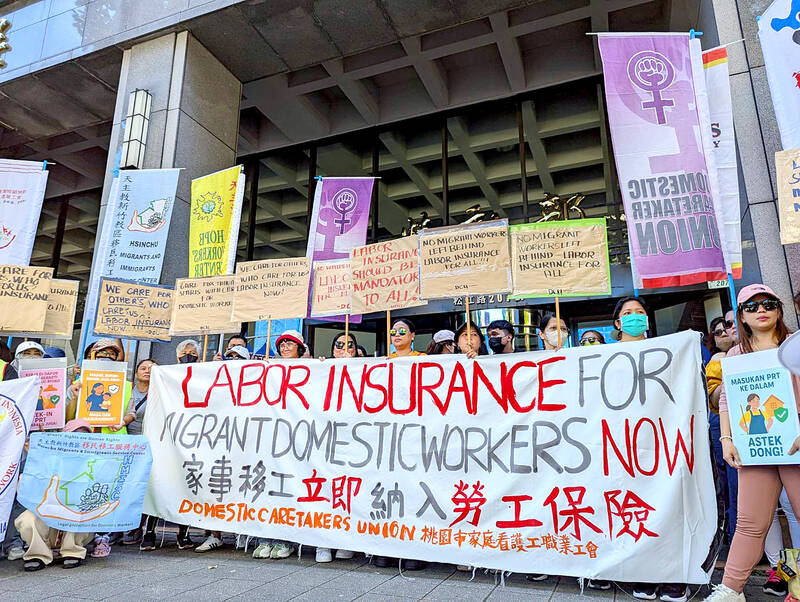
Photo: CNA
“We are workers who clean your homes, cook your meals and care for your children and elderly parents,” a Filipina live-in caregiver who asked to be identified as Carol said at the protest. “But when we get sick or injured, who will take care of us?”
Denying live-in caregivers, who often work long hours and physically assist elderly people, labor insurance protection is “unfair and inhumane,” Carol said.
Marni, an Indonesian worker from the migrant caregiver union Serikat Buruh Industri Perawatan Taiwan, said that live-in caregivers are only covered by Labor Occupational Accident Insurance, which partially reimburses medical expenses incurred from work-related injuries.
However, as domestic workers are not covered by the Labor Standards Act (勞動基準法), they are not entitled to sick leave, she said.
That, combined with a lack of labor insurance, means they receive no income or benefits while recovering from major illnesses, putting their families’ financial well-being at risk, she said.
Other non-governmental organizations that joined the protest organized by the Domestic Caretaker Union included the Migrant Empowerment Network in Taiwan, the Rerum Novarum Center, the Serve the People Association and the Taiwan Association for Human Rights.
In response, Chuang Kuo-liang (莊國良), deputy head of the Workforce Development Agency’s Cross-Border Workforce Management Division, said that employers with fewer than five employees can decide whether to provide insurance.
If the government were to require employers of domestic migrant workers to provide labor insurance, it would need to revise the Labor Insurance Act (勞工保險條例), Chuang said.
In that case, the government must consider the opinions of employers and workers, he said.
For now, the Ministry of Labor would continue to gather and carefully weigh opinions from workers and employers, he added.

A magnitude 6.1 earthquake struck off the coast of Yilan County at 8:39pm tonight, the Central Weather Administration (CWA) said, with no immediate reports of damage or injuries. The epicenter was 38.7km east-northeast of Yilan County Hall at a focal depth of 98.3km, the CWA’s Seismological Center said. The quake’s maximum intensity, which gauges the actual physical effect of a seismic event, was a level 4 on Taiwan’s 7-tier intensity scale, the center said. That intensity level was recorded in Yilan County’s Nanao Township (南澳), Hsinchu County’s Guansi Township (關西), Nantou County’s Hehuanshan (合歡山) and Hualien County’s Yanliao (鹽寮). An intensity of 3 was
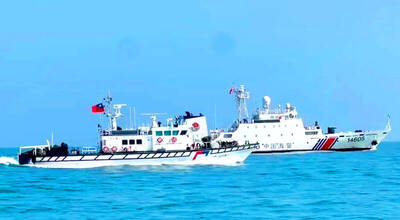
Instead of focusing solely on the threat of a full-scale military invasion, the US and its allies must prepare for a potential Chinese “quarantine” of Taiwan enforced through customs inspections, Stanford University Hoover fellow Eyck Freymann said in a Foreign Affairs article published on Wednesday. China could use various “gray zone” tactics in “reconfiguring the regional and ultimately the global economic order without a war,” said Freymann, who is also a nonresident research fellow at the US Naval War College. China might seize control of Taiwan’s links to the outside world by requiring all flights and ships entering or leaving Taiwan
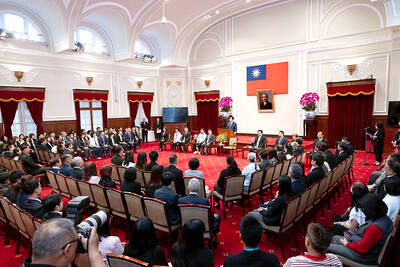
The next minimum wage hike is expected to exceed NT$30,000, President William Lai (賴清德) said yesterday during an award ceremony honoring “model workers,” including migrant workers, at the Presidential Office ahead of Workers’ Day today. Lai said he wished to thank the awardees on behalf of the nation and extend his most sincere respect for their hard work, on which Taiwan’s prosperity has been built. Lai specifically thanked 10 migrant workers selected for the award, saying that although they left their home countries to further their own goals, their efforts have benefited Taiwan as well. The nation’s industrial sector and small businesses lay
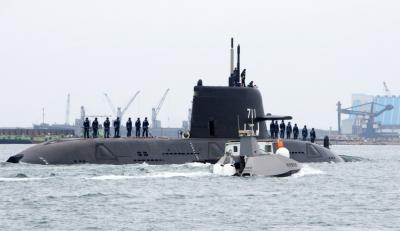
Taiwan's first indigenous defense submarine, the SS-711 Hai Kun (海鯤, or Narwhal), departed for its 13th sea trial at 7am today, marking its seventh submerged test, with delivery to the navy scheduled for July. The outing also marked its first sea deployment since President William Lai (賴清德) boarded the submarine for an inspection on March 19, drawing a crowd of military enthusiasts who gathered to show support. The submarine this morning departed port accompanied by CSBC Corp’s Endeavor Manta (奮進魔鬼魚號) uncrewed surface vessel and a navy M109 assault boat. Amid public interest in key milestones such as torpedo-launching operations and overnight submerged trials,


 RSS
RSS