

Civil groups called on the Executive Yuan to approve the Ministry of the Interior’s social housing development plans, citing a promise by President William Lai (賴清德) to build more social housing units.
Lai outlined the plan to build 130,000 more social housing units between last year and 2032 when he was running for office, The Organization of Urban Re-s secretary-general Peng Yang-kai (彭揚凱) and Tseui Ma Ma Foundation for Housing and Community Services chief executive officer Lu Ping-yi (呂秉怡) told a news conference at the Legislative Yuan in Taipei.
Democratic Progressive Party Legislator Chang Hung-lu (張宏陸), Chinese Nationalist Party (KMT) Legislator Niu Hsu-ting (牛煦庭) and Taiwan People’s Party Legislator Vivian Huang (黃珊珊) also attended the news conference.
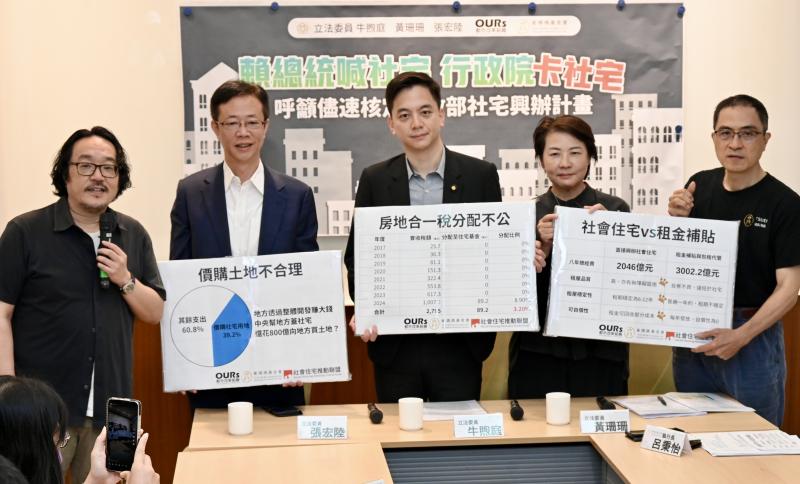
Photo: George Tsorng, Taipei Times
Lai's plan would build on the 120,000 units built during former president Tsai Ing-wen’s (蔡英文) time in office, reaching a total of 250,000 units, Peng and Lu said.
The ministry proposed the next phase of the social housing plan in August last year, but the Executive Yuan has yet to approve it, they said.
The Executive Yuan should approve the ministry’s plan as soon as possible so that Lai’s plan can be put into action and 15,000 units can be contracted for development this year as planned, Peng said.
Chang, who is convener of the Internal Administration Committee, said that the Executive Yuan has yet to approve the plan for two reasons: cuts to the central government's budget and land issues.
The Executive Yuan needs to reallocate the budget, and then it should be able to approve the plan quickly, Chang said.
The Executive Yuan should do more to help the ministry resolve its financial issues, Peng and Lu said.
On the revenue side, the proportion of integrated housing and land tax allocated to the housing fund could be reasonably increased to ensure stable funding, they said.
On the expenditure side, long-term affordable rentals could be used to develop land comprehensively, and legislative amendments could systematically resolve financial issues related to acquiring land for social housing, they added.
Last year, the Lai administration launched an eight-year plan to support 1 million rental households, focusing on three main approaches to social housing: direct construction, subleasing and management, and rental subsidies.
The goal is to subsidize 500,000 rented units, sublease and manage 250,000 units, and build 250,000 units by 2032.
As of last month, 120,000 units had been built, 90,000 units were being subleased and managed, and 750,000 households were receiving rental subsidies.
Additional reporting by Lee Wen-hsin

A total of 400 foreign “high- level” professionals have been naturalized as Republic of China (Taiwan) citizens over the past decade as the government has eased nationality rules to attract talent from a wider range of fields, the Ministry of the Interior said yesterday. The 400th high-level professional, who works in the electronics industry, was approved for ROC citizenship on Aug. 26, the MOI said. The MOI quoted the newly naturalized citizen as saying that Taiwan is a leader in fields such as semiconductors, electronics manufacturing, artificial intelligence development and energy technology. He also said

OCT. 31: The antiviral drugs Tamiflu and Eraflu have been distributed to about 4,000 medical facilities nationwide for people in seven groups who develop flu-like symptoms As the domestic influenza epidemic enters its peak season and continues to escalate, the Centers for Disease Control (CDC) yesterday announced that publicly funded influenza antiviral drugs for seven eligible groups have been extended to Oct. 31, allowing those who develop flu-like symptoms to receive the medication without undergoing a rapid influenza test. The CDC has extended the expanded use of flu antiviral drugs to seven groups: healthcare and influenza-prevention personnel; residents and staff at nursing homes, long-term care facilities and similar institutions; kindergarten and daycare workers and home-based caregivers; students from kindergarten through high school, vocational high school and the
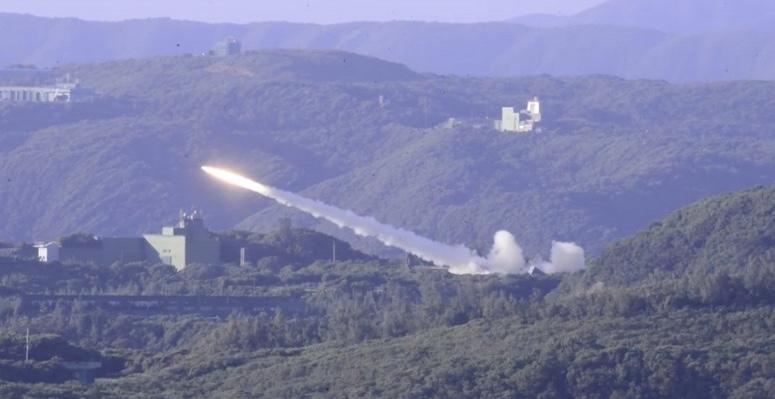
A Chinese military drone was spotted conducting reconnaissance off Taitung County as President William Lai (賴清德) visited Pingtung County this morning to inspect a drill of the armed forces’ precision-strike capabilities, prompting the military to closely monitor its actions. Today was the final day of a three-day military exercise at Jioupeng Base (九鵬基地) to test the joint combat capabilities of the armed forces and coast guard. The exercise began on Wednesday simulating air defense interception and yesterday tested long-range strike capabilities and new air defense weapons. This morning, the military conducted a final exercise involving air defense, anti-ship and drone operations. Military sources said
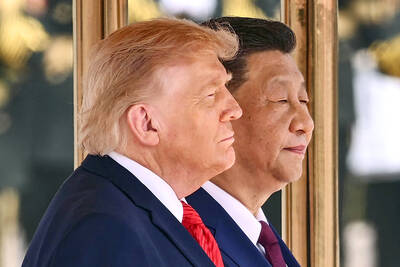
China has warned that it could cancel a planned US-China leaders’ summit if Washington approves new arms sales to Taiwan, a Japanese media outlet quoted sources as saying yesterday. US President Donald Trump, “apparently eager to showcase some diplomatic achievements ahead of November’s midterm congressional elections, places great importance on holding the summit with Chinese President Xi Jinping (習近平),” Japan’s Kyodo News reported. “While preparing for Xi’s upcoming trip, China has restated its position that the Taiwan issue is a ‘red line’ in bilateral relations,” the report said. The report said that when Xi met with Trump in Beijing in May, Xi said


 RSS
RSS