


Greenpeace today said it is to file an appeal after the Taipei High Administrative Court last month dismissed its 2021 lawsuit against the Ministry of Economic Affairs for “loose” regulations governing major corporate electricity consumers.
The climate-related lawsuit — the first of its kind in Taiwan — seeks to require the government to enforce higher green energy thresholds on major corporations to reduce emissions in light of climate change and an uptick in extreme weather phenomena.
The suit, filed by Greenpeace East Asia, the Environmental Jurists Association and four individual plaintiffs, was overturned on May 8 following four years of litigation.
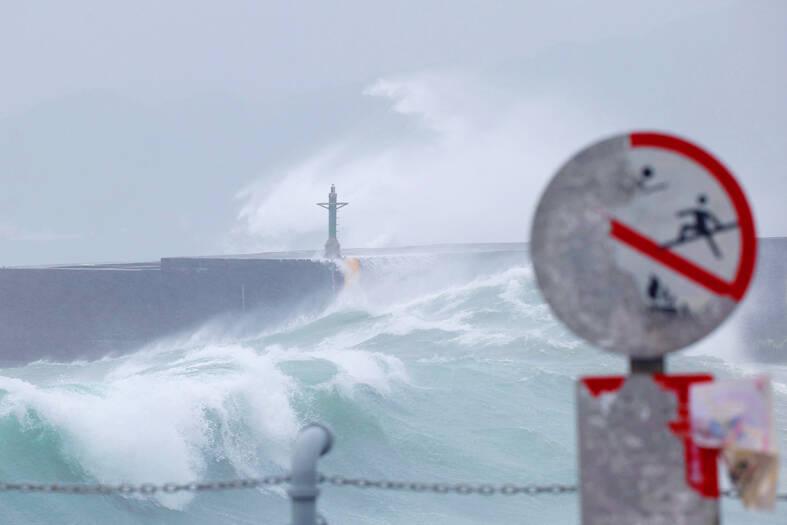
Photo: Carlos Garcia Rawlins, Reuters
The groups said that the Regulations for the Management of Setting up Renewable Energy Power Generation Equipment of Power Users above a Certain Contract Capacity (一定契約容量以上之電力用戶應設置再生能源發電設備管理辦法), promulgated by the ministry in 2021, were ineffective in incentivizing corporations to reduce emissions.
Greenpeace said it would continue to challenge the court ruling on legal and factual grounds, adding that all voices must be heard and respected equally when it comes to climate justice.
The judge said that people or civic groups only have the right of initiation in legislation, but have no right to demand that administrative agencies amend laws, Greenpeace East Asia climate and energy director Hsin I (忻儀) said.
The court also found that Taiwan experiences typhoons, floods and natural disasters due to its geographical location, and it is difficult to determine whether extreme weather events are related to climate change, she said.
However, it is already internationally recognized and scientifically proven that Taiwan’s extreme weather phenomena are related to climate change, she said.
Research by World Weather Attribution found that climate change increased Typhoon Gaemi’s wind speeds by about 7 percent and rainfall by 14 percent last year, Greenpeace said.
Moreover, residential and commuter areas are already under tangible threat from extreme flooding due to climate change, it added.
It referenced a 2023 report by National Taiwan University’s Center for Weather, Climate and Disaster Research and cases of flooding around New Taipei City’s Fuzhou, Banqiao and Sanchong railway stations in recent years.
The government must address the long-term consequences of climate change on natural disasters and the environment, and protect citizens’ rights in cases of natural disasters, Hsin said.
Citizens have the right to demand that the government and corporations uphold their carbon reduction commitments, she added.
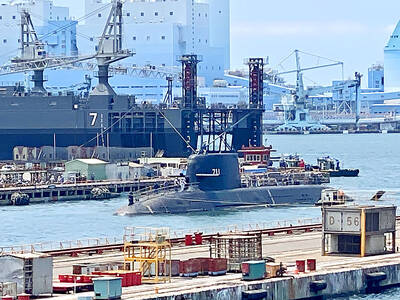
AGING: While Japan has 22 submarines, Taiwan only operates four, two of which were commissioned by the US in 1945 and 1946, and transferred to Taiwan in 1973 Taiwan would need at least 12 submarines to reach modern fleet capabilities, CSBC Corp, Taiwan chairman Chen Cheng-hung (陳政宏) said in an interview broadcast on Friday, citing a US assessment. CSBC is testing the nation’s first indigenous defense submarine, the Hai Kun (海鯤, Narwhal), which is scheduled to be delivered to the navy next month or in July. The Hai Kun has completed torpedo-firing tests and is scheduled to undergo overnight sea trials, Chen said on an SET TV military affairs program. Taiwan would require at least 12 submarines to establish a modern submarine force after assessing the nation’s operational environment and defense

A white king snake that frightened passengers and caused a stir on a Taipei MRT train on Friday evening has been claimed by its owner, who would be fined, Taipei Rapid Transit Corp (TRTC) said yesterday. A person on Threads posted that he thought he was lucky to find an empty row of seats on Friday after boarding a train on the Bannan (Blue) Line, only to spot a white snake with black stripes after sitting down. Startled, he jumped up, he wrote, describing the encounter as “terrifying.” “Taipei’s rat control plan: Release snakes on the metro,” one person wrote in reply, referring
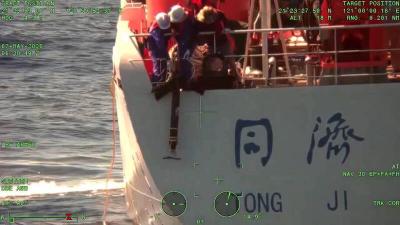
The coast guard today said that it had disrupted "illegal" operations by a Chinese research ship in waters close to the nation and driven it away, part of what Taipei sees a provocative pattern of China's stepped up maritime activities. The coast guard said that it on Thursday last week detected the Chinese ship Tongji (同濟號), which was commissioned only last year, 29 nautical miles (54km) southeast of the southern tip of Taiwan, although just outside restricted waters. The ship was observed lowering ropes into the water, suspected to be the deployment of scientific instruments for "illegal" survey operations, and the coast
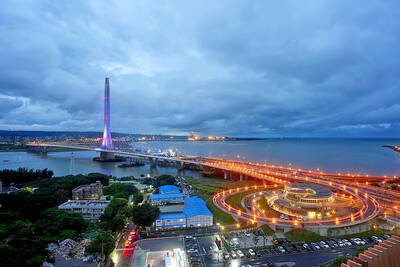
An inauguration ceremony was held yesterday for the Danjiang Bridge, the world’s longest single-mast asymmetric cable-stayed bridge, ahead of its official opening to traffic on Tuesday, marking a major milestone after nearly three decades of planning and construction. At the ceremony in New Taipei City attended by President William Lai (賴清德), Premier Cho Jung-tai (卓榮泰), Minister of Transportation and Communications Chen Shih-kai (陳世凱) and New Taipei City Mayor Hou Yu-ih (侯友宜), the bridge was hailed as both an engineering landmark and a long-awaited regional transport link connecting Tamsui (淡水) and Bali (八里)


 RSS
RSS