


Setting a national precedent, the Kaohsiung City Council yesterday passed a carbon budget that is expected to reduce carbon emissions by 3.83 million tonnes over the next two years.
The budget includes 16 quantifiable and 57 supporting carbon reduction measures covering six major sectors.
The budget is the first of its kind, setting a precedent for local governments nationwide.
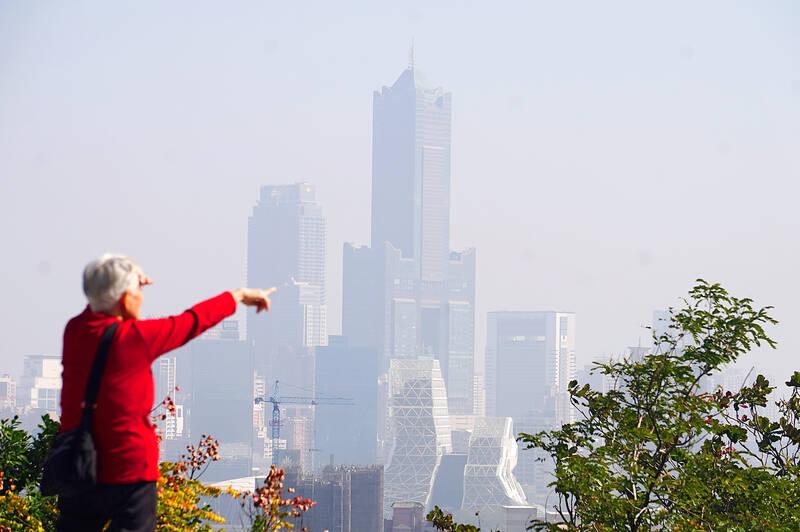
Photo: CNA
The Kaohsiung City Government thanked the council for its support, saying that through the two-year plan — which sets an upper limit on greenhouse gas emissions — the city is moving toward its net-zero emissions goal.
Kaohsiung announced regulations for the development of a net-zero city in June last year, requiring the city government to set carbon reduction actions plans, including a carbon budget, on a two-year basis, the Kaohsiung Environmental Protection Bureau said.
Accordingly, the bureau conducted an environmental impact assessment for this year and next, which estimated that that city’s greenhouse gas emissions would increase by 2.42 million tonnes over those two years, it said.
The budget incorporates industry-led carbon reduction targets, reducing carbon emissions through energy transition, recycling waste, public sector energy-saving programs and using electric power for transportation equipment.
The budget is based on the city’s 2022 emissions of 52.35 million tonnes, bureau Chief Secretary Chang Jui-hun (張瑞琿) said.
Accounting for projected increases and reductions, the carbon budget for this year and next is set at 50.93 million tonnes, a reduction of about 23 percent from 2005 emissions, Chang said.
To formulate the budget, more than 10 meetings were held with academics, industry experts and civil society groups.
It was also reviewed by the Kaohsiung Sustainable Development and Climate Change Response Committee before being submitted to the city council.
Councilors raised a wide range of suggestions, including oversight methods, carbon credit programs and industry support measures, which would serve as references for the next carbon budget cycle.
Chang emphasized that the budget does not involve actual funds, but rather sets a limit on the city’s greenhouse gas emissions, acting as a policy tool to help the city achieve its carbon reduction goals.
He thanked the city council, industries and civil society groups for their support in establishing a practical and science-based carbon reduction strategy for Kaohsiung.

Considering that most countries issue more than five denominations of banknotes, the central bank has decided to redesign all five denominations, the bank said as it prepares for the first major overhaul of the banknotes in more than 24 years. Central bank Governor Yang Chin-lung (楊金龍) is expected to report to the Legislative Yuan today on the bank’s operations and the redesign’s progress. The bank in a report sent to the legislature ahead of today’s meeting said it had commissioned a survey on the public’s preferences. Survey results showed that NT$100 and NT$1,000 banknotes are the most commonly used, while NT$200 and NT$2,000

The Centers for Disease Control (CDC) yesterday reported the first case of a new COVID-19 subvariant — BA.3.2 — in a 10-year-old Singaporean girl who had a fever upon arrival in Taiwan and tested positive for the disease. The girl left Taiwan on March 20 and the case did not have a direct impact on the local community, it said. The WHO added the BA.3.2 strain to its list of Variants Under Monitoring in December last year, but this was the first imported case of the COVID-19 variant in Taiwan, CDC Deputy Director-General Lin Ming-cheng (林明誠) said. The girl arrived in Taiwan on

South Korea is planning to revise its controversial electronic arrival card, a step Taiwanese officials said prompted them to hold off on planned retaliatory measures, a South Korean media report said yesterday. A Yonhap News Agency report said that the South Korean Ministry of Foreign Affairs is planning to remove the “previous departure place” and “next destination” fields from its e-arrival card system. The plan, reached after interagency consultations, is under review and aims to simplify entry procedures and align the electronic form with the paper version, a South Korean ministry official said. The fields — which appeared only on the electronic form

The Ministry of Foreign Affairs (MOFA) is suspending retaliation measures against South Korea that were set to take effect tomorrow, after Seoul said it is updating its e-arrival system, MOFA said today. The measures were to be a new round of retaliation after Taiwan on March 1 changed South Korea's designation on government-issued alien resident certificates held by South Korean nationals to "South Korea” from the "Republic of Korea," the country’s official name. The move came after months of protests to Seoul over its listing of Taiwan as "China (Taiwan)" in dropdown menus on its new online immigration entry system. MOFA last week


 RSS
RSS