


Applications to enter Taiwan for the World Masters Games in Taipei and New Taipei City next month are still being processed, with about half having been approved, Games organizers said on Thursday amid reports that some of the 500 Chinese athletes seeking to take part might withdraw due to difficulties entering the nation.
Some athletes from China have complained that they have seen no progress on their applications to enter Taiwan for the Games, which are to start on May 17, Chinese-language media reported earlier on Thursday.
Chinese athletes are facing difficulties leaving China, as Chinese authorities — who have claimed to be unaware of the event in Taiwan — are obstructing participation, the reports said, adding that some athletes might have to reroute through Hong Kong or Macau to enter Taiwan, a complication that would inconvenience them and might lead to withdrawals.

Photo: Tien Yu-hua, Taipei Times
World Masters Games spokeswoman Kuo Yin-lan (郭音蘭) said that about 25,000 athletes had registered, with athletes from China accounting for about 2 percent.
Entry applications from Chinese athletes must be submitted to the central government for approval and the authorities are processing them, Kuo said.
Chinese seeking to visit Taiwan for tourism purposes are only allowed in if they are studying or residing in a third country, while Chinese authorities have banned individual and group travel from China to Taiwan since the middle of 2019 and early 2020 respectively, she said.
The Mainland Affairs Council (MAC) late on Thursday confirmed its role in reviewing whether registered athletes from China would be allowed to enter Taiwan.
MAC Deputy Minister Liang Wen-chieh (梁文傑) said that 555 Chinese had registered for the Games, with about 230 having been issued entry permits to enter Taiwan as of Thursday.
“We have adopted a supportive approach to help individuals from China, who are not part of an official delegation, enter Taiwan,” Liang said, adding that the World Masters Games is not a competition based on national representation, with athletes registering individually.
It is not like other major international events such as the Asian Games or the Universiade, at which participants compete as part of national teams, he added.
However, while the MAC can issue entry permits for Chinese nationals seeking to enter Taiwan, they still need approval from Chinese authorities to leave China, he said.
“This has happened before in other cases — we often approve people [to enter Taiwan], but they end up unable to travel here because the Chinese side does not grant them permission” to leave China, he said.
The MAC has not heard of any specific policies from the Chinese authorities targeting Chinese planning to participate in the Games or suggesting that such participation is considered illegal, he said.
First held in 1985, the World Masters Games is an international multisports event held every four years for athletes aged 30 or above from around the world, with this year’s edition marking the first time the event is to be hosted in Taiwan, the International Masters Games Association said.
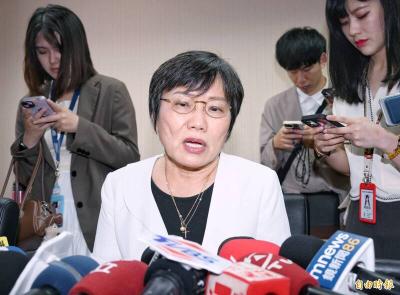
Chinese Nationalist Party (KMT) Chairman Eric Chu (朱立倫), spokeswoman Yang Chih-yu (楊智伃) and Legislator Hsieh Lung-chieh (謝龍介) would be summoned by police for questioning for leading an illegal assembly on Thursday evening last week, Minister of the Interior Liu Shyh-fang (劉世芳) said today. The three KMT officials led an assembly outside the Taipei City Prosecutors’ Office, a restricted area where public assembly is not allowed, protesting the questioning of several KMT staff and searches of KMT headquarters and offices in a recall petition forgery case. Chu, Yang and Hsieh are all suspected of contravening the Assembly and Parade Act (集會遊行法) by holding

PRAISE: Japanese visitor Takashi Kubota said the Taiwanese temple architecture images showcased in the AI Art Gallery were the most impressive displays he saw Taiwan does not have an official pavilion at the World Expo in Osaka, Japan, because of its diplomatic predicament, but the government-backed Tech World pavilion is drawing interest with its unique recreations of works by Taiwanese artists. The pavilion features an artificial intelligence (AI)-based art gallery showcasing works of famous Taiwanese artists from the Japanese colonial period using innovative technologies. Among its main simulated displays are Eastern gouache paintings by Chen Chin (陳進), Lin Yu-shan (林玉山) and Kuo Hsueh-hu (郭雪湖), who were the three young Taiwanese painters selected for the East Asian Painting exhibition in 1927. Gouache is a water-based
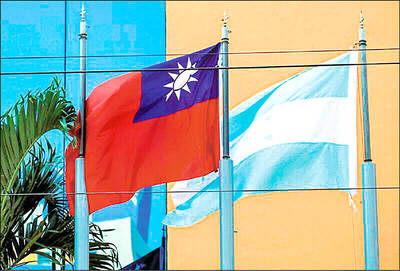
Taiwan would welcome the return of Honduras as a diplomatic ally if its next president decides to make such a move, Minister of Foreign Affairs Lin Chia-lung (林佳龍) said yesterday. “Of course, we would welcome Honduras if they want to restore diplomatic ties with Taiwan after their elections,” Lin said at a meeting of the legislature’s Foreign Affairs and National Defense Committee, when asked to comment on statements made by two of the three Honduran presidential candidates during the presidential campaign in the Central American country. Taiwan is paying close attention to the region as a whole in the wake of a

OFF-TARGET: More than 30,000 participants were expected to take part in the Games next month, but only 6,550 foreign and 19,400 Taiwanese athletes have registered Taipei city councilors yesterday blasted the organizers of next month’s World Masters Games over sudden timetable and venue changes, which they said have caused thousands of participants to back out of the international sporting event, among other organizational issues. They also cited visa delays and political interference by China as reasons many foreign athletes are requesting refunds for the event, to be held from May 17 to 30. Jointly organized by the Taipei and New Taipei City governments, the games have been rocked by numerous controversies since preparations began in 2020. Taipei City Councilor Lin Yen-feng (林延鳳) said yesterday that new measures by


 RSS
RSS