


Taiwan’s tariff negotiations with the US would not sacrifice the interests of the nation’s agricultural and fishery industries, President William Lai (賴清德) said on Friday as he met with fish farming industry owners in Chiayi County.
US President Donald Trump on April 2 announced “reciprocal” tariffs on countries with large trade surpluses with the US, including Taiwan, which was facing an across-the-board 32 percent import duty.
The White House announced a 90-day pause on the new measures last week, with only a 10 percent duty to be applied instead to all countries except China.
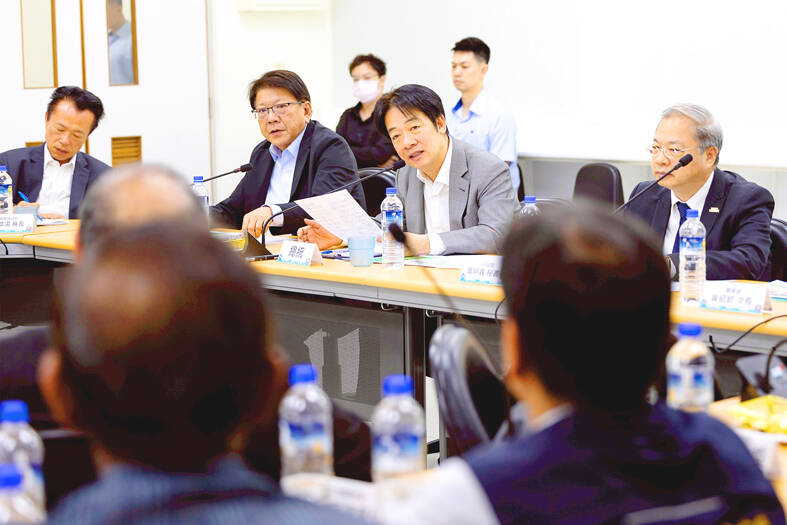
Photo: Screen grab from the Presidential Office’s Flickr page
An Executive Yuan official on Wednesday said that Taiwan and the US expect to hold a second round of tariff negotiations soon following a first discussion on April 11.
During the meeting with Lai, Taiwan Aquaculture Development Association chief executive officer Hou Yen-lung (侯彥隆) cited the example of how Taiwanese tilapia, which previously held only 50 to 60 percent of the US market, now has 80 percent of the post-COVID-19 pandemic US market, highlighting the government’s support for the aquaculture industry.
Such support, alongside excellent technique and technology, ensures that Taiwanese tilapia shines among the hundred countries that are raising tilapia for exports, he said, adding that industry members hope the industry continues to garner such support during the tariff negotiations.
A primary focus is how to reduce disease among the fish population, and if fish illness can be reduced or eradicated, it would provide greater export opportunities, he said.
Aquaculture industry owners and farmers are especially nervous, as it is currently the season for planting and fish stocking, Hou said.
Not everyone can work at Taiwan Semiconductor Manufacturing Co (TSMC), and each person has their own strengths, Lai said.
Farming and fisheries industries are fundamental industries that buttress the nation, and their interests would not be forfeited, he said.
Lai cited the Fisheries Research Institute producing the first batch of artificially grown narrow-barred mackerel which helped diversify fish species grown by Taiwanese fish farmers, which would greatly aid the nation’s fish exports.
The Executive Yuan is putting together a NT$88 billion (US$2.7 billion) package to support industries affected by Trump’s “reciprocal” tariffs, among which NT$10 billion to NT$20 billion would be used to support the agriculture and fisheries industries, he said.
The Executive Yuan would ensure that its support programs are implemented and that the government is committed to encouraging mid to long-term economic development, he said.
It is crucial that Taiwan increases its investment in the US to ensure that its products have a global market, he added.
Lai urged national solidarity to help grow and support local agriculture and aquaculture industries.
Additional reporting by CNA
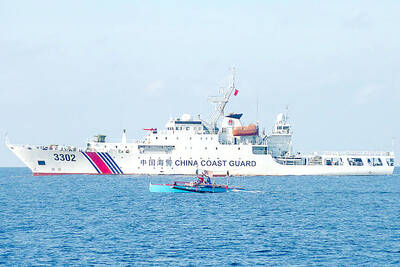
EXPANSIONIST: China deploys an average of 40 to 50 warships and coast guard vessels daily in the South China Sea, despite pledges not to militarize the region, an official said China is attempting to expand its influence across the First Island Chain and increase pressure on Japan by sending coast guard vessels into waters off of Taiwan under the pretext of maritime negotiations with Japan and the Philippines, a national security official said yesterday. China’s recent actions in the waters east of Taiwan and Japan and the Philippines’ exclusive economic zones (EEZ) are attempts to establish dominance in First Island Chain waters, said the official who declined to be named, adding that this is “expansion disguised as law enforcement.” Framing China’s actions solely as a cross-strait issue is a serious misjudgment that
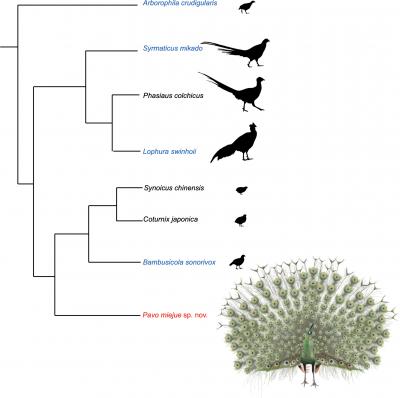
Through analyzing fossil evidence, a research team at National Taiwan University (NTU) discovered the largest endemic bird to have lived in Taiwan, naming it Pavo miejue, or extinct peafowl (滅絕孔雀). The Mikado pheasant, which is printed on the back of the NT$1,000 bank note, was previously believed to be the biggest endemic bird to Taiwan. The research team’s findings suggest that Pavo miejue lived during the Pleistocene epoch tens of thousands of years ago. It is the first endemic extinct bird species discovered and formally named in Taiwan. The study was coauthored by NTU Institute of Ecology and Evolutionary Biology professor Tsai Cheng-hsiu (蔡政修),
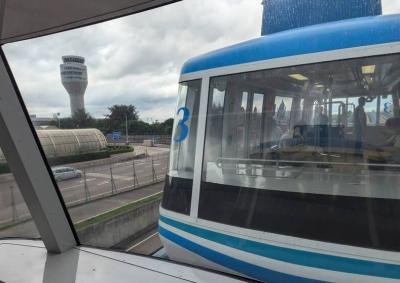
Taiwan Taoyuan International Airport is to suspend its automated Skytrain service connecting Terminal 1 and Terminal 2 starting on July 1 to facilitate connection works for the upcoming Terminal 3, the airport operator said today. Passengers and staff who need to travel between the two terminals after the suspension can instead use the Taoyuan MRT or the airport's 24-hour shuttle bus service, Taoyuan International Airport Corp said. The Taoyuan MRT Airport Line directly links the two terminals, while the shuttle buses are to operate around the clock, the company added. The Skytrain provides free transportation between the airport’s two terminals for travelers and
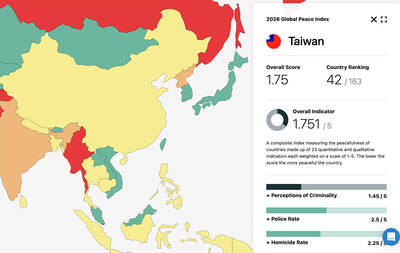
Taiwan ranked 42nd in terms of peacefulness among 163 countries, down five places from last year, according to this year’s Global Peace Index. With an overall score of 1.751, Taiwan dropped from 37th last year, the report published by the global Institute for Economics and Peace showed. The overall score measures a country’s level of peacefulness using 23 quantitative and qualitative indicators across three domains — ongoing domestic and international conflict, societal safety and security, and militarization. While Taiwan ranked 42nd worldwide, it was listed in ninth place among the 19 Asian-Pacific countries in the report, after New Zealand, Singapore, Japan, Malaysia,


 RSS
RSS