


Taiwan’s economic challenges are not limited to the imposition of higher US tariffs, it also includes US pressure to increase defense spending, currency valuation and risks from holding too much US debt, Chinese Nationalist Party (KMT) Chairman Eric Chu (朱立倫) said on Wednesday.
Speaking at a meeting of the KMT’s Central Committee, Chu said that Wednesday last week — when the US placed steep tariffs on its trading partners — represented “the death knell of global free trade.”
“The era of globalization is over. It is being replaced by the rise of protectionism,” he said.
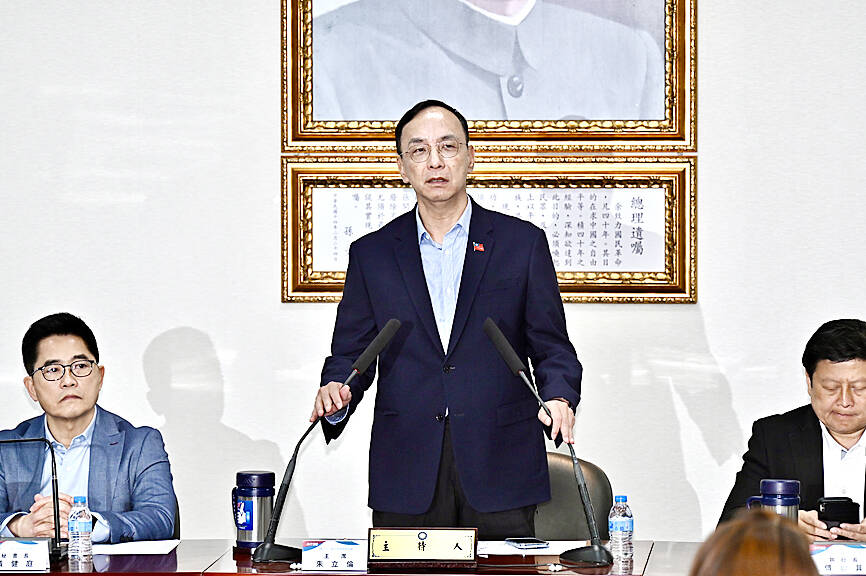
Photo: Tu Chien-jung, Taipei Times
US President Donald Trump has since his campaign frequently spoken of his plans to impose tariffs and demanded other countries increase their defense spending, Chu said.
Taiwan was slapped with a 32 percent tariff, despite major investments in the US by Taiwan Semiconductor Manufacturing Co, and moves to increase national defense spending and purchases of US goods, he said.
Trump has promised US$1 trillion in defense spending this year, equivalent to 3.5 percent of the US’ GDP, and Taiwan might be pressured to reach a similar spending ratio, Chu said.
There is also the issue of currency valuation, he said.
“Taiwan will face strong demands [from the US] to allow the New Taiwan dollar to rise, which will deal a heavy blow to export-oriented industries,” Chu said, adding that the government must be prepared to respond.
Chu also pointed out risks connected to Taiwan’s holdings of US debt, which comprise 92 percent of the nation’s US$577 billion of foreign exchange reserves.
“How much of this will Taiwan be able to redeem?” he asked.
Chu said the NT$88 billion (US$2.68 billion) special budget proposed by the government to mitigate the impact of US tariffs and broader financial uncertainty was “only a drop in the bucket” of what is needed.
The impact on labor and the consumer market also needs to be addressed by the special budget, he said, adding that the KMT would propose spending at least NT$200 billion.
As an export-oriented country, Taiwan cannot be completely reliant on the US and should instead learn from the example of Singapore, Chu said.
Only by not neglecting any markets can Taiwan get itself on a new road to prosperity, he said.

Taiwan's Vice President Hsiao Bi-khim (蕭美琴) said Saturday that she would not be intimidated by the Chinese Communist Party (CCP), following reports that Chinese agents planned to ram her car during a visit to the Czech Republic last year. "I had a great visit to Prague & thank the Czech authorities for their hospitality & ensuring my safety," Hsiao said on social media platform X. "The CCP's unlawful activities will NOT intimidate me from voicing Taiwan's interests in the international community," she wrote. Hsiao visited the Czech Republic on March 18 last year as vice president-elect and met with Czech Senate leadership, including

There have been clear signs of Chinese Communist Party (CCP) attempts to interfere in the nationwide recall vote on July 26 in support of Chinese Nationalist Party (KMT) legislators facing recall, an unnamed government official said, warning about possible further actions. The CCP is actively involved in Taiwanese politics, and interference in the recall vote is to be expected, with multiple Chinese state media and TAO attempts to discredit the Democratic Progressive Party (DPP) and undermine public support of their recall movement, the official said. This interference includes a smear campaign initiated this month by a pro-Beijing Hong Kong news outlet against

A week-long exhibition on modern Tibetan history and the Dalai Lama’s global advocacy opened yesterday in Taipei, featuring quotes and artworks highlighting human rights and China’s ongoing repression of Tibetans, Hong Kongers and Uighurs. The exhibition, the first organized by the Human Rights Network for Tibet and Taiwan (HRNTT), is titled “From the Snowy Ridges to the Ocean of Wisdom.” “It would be impossible for Tibetans inside Tibet to hold an exhibition like this — we can do it. because we live in a free and democratic country,” HRNTT secretary-general Tashi Tsering said. Tashi Tsering, a Taiwan-based Tibetan who has never
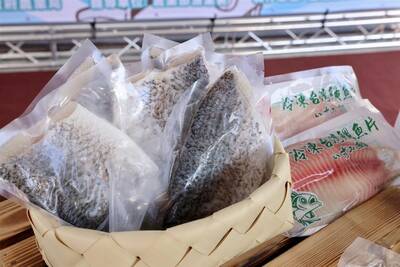
A first shipment of five tons of Taiwan tilapia was sent from Tainan to Singapore on Wednesday, following an order valued at NT$600,000 (US$20,500) placed with a company in the city. The products, including frozen whole fish and pre- cooked fish belly, were dispatched from Jiangjun Fishing Harbor, where a new aquatic processing and logistics center is under construction. At the launch, Tainan Mayor Huang Wei-che (黃偉哲) called the move a “breakthrough,” marking Taiwan’s expansion into the Singaporean tilapia market. Taiwan’s tilapia exports have traditionally focused on the United States, Canada, and the Middle East, Huang said, adding that the new foothold in


 RSS
RSS