


The Executive Yuan today approved a NT$88 billion (US$2.68 billion) support package for Taiwan’s export supply chains in response to the new US tariffs, Premier Cho Jung-tai (卓榮泰) said.
Details on how to apply for the funding would be released on Monday, he said.
US President Donald Trump on Wednesday last week announced a 32-percent tariff on Taiwan goods to be implemented this week.
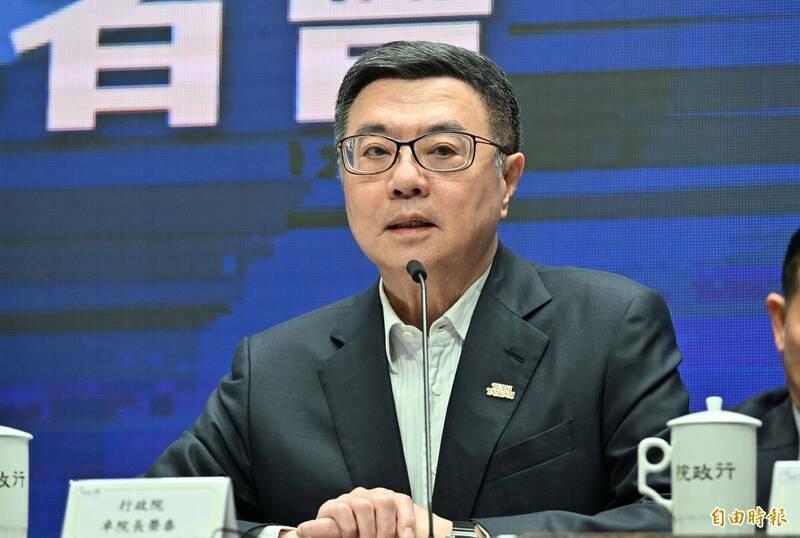
Photo: Taipei Times
However, he yesterday announced a 90-day pause on the new agreement, reverting to the baseline 10 percent tax and halting the additional 22 percent.
Cabinet spokeswoman Michelle Lee (李慧芝) today held a media conference following a cabinet meeting to report Cho’s remarks.
The new stimulus package includes 20 core measures, including export loan guarantees and loans for small and medium-sized businesses, Cho said.
The measures would help counter the tariff’s impact on domestic industries, including manufacturing and agriculture, he said.
The government would take advantage of the 90-day pause to try to enter into direct negotiations with the US, Cho said.
The Ministry of Finance has also been requested to assess the possibility of extending the tax filing deadline, similar to measures taken during the COVID-19 pandemic, he added.
In the face of sudden global shifts, Cho said that the Executive Yuan’s US-Taiwan economic and trade task force would continue to enhance industrial resilience, he said.
The task force would work in line with President William Lai’s (賴清德) five key strategies announced on Sunday, he said.
Economic security is tied to national security, and maintaining balanced trade partnerships is essential to stabilizing Taiwan’s international position, he added.
Relevant ministries have been instructed to quickly develop legal frameworks and set out specific operational plans, using emergency relief measures such as the second reserve fund, the credit guarantee fund, the employment stabilization fund and the agricultural development fund, he said.
The Executive Yuan would also continue to adjust the special statute, reviewing the draft as negotiations proceed, he added.
Furthermore, support would be offered to Taiwanese businesses located in China when necessary, Cho said.
Trump hiked tariffs on Chinese goods up to 125 percent yesterday, which may prompt Taiwanese businesses to return from China, a possibility the Ministry of Economic Affairs (MOEA) has already considered, Minister of Economic Affairs J.W. Kuo (郭智輝) said.
If Taiwanese businesses remain in China over the next 90 days, with a customer base in China, or countries with strong relations with China, the MOEA would continue to assist them in the long run to maintain the competitiveness of Taiwanese businesses, he said.
The MOEA would also assist in shifting production bases outside of China so that products can be prioritized for export to the US, he added.
The mayors of the six special municipalities attended today’s cabinet meeting to speak on behalf of local industries affected by the tariff policies.
Tainan Mayor Huang Wei-che (黃偉哲) said the government must use the delay to better understand US policy and urged financial institutions to help local industries at this critical time.
Meanwhile, Deputy Mayor of Taichung City Cheng Chao-hsin (鄭照新) urged public banks not to restrict lending and avoid sacrificing or harming weaker industries such as agriculture.
He called for the expansion of markets outside the US to diversify the risk for industries and markets.
He further called on the Legislative Yuan to quickly approve the cabinet’s NT$88 billion support package.

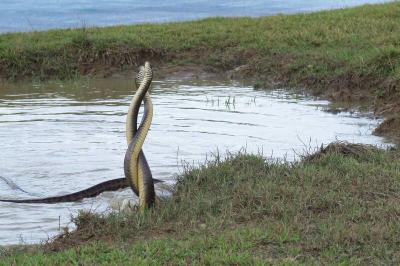
Kenting National Park service technician Yang Jien-fon (楊政峰) won a silver award in World Grand Prix Photography Awards Spring Season for his photograph of two male rat snakes intertwined in combat. Yang’s colleagues at Kenting National Park said he is a master of nature photography who has been held back by his job in civil service. The awards accept entries in all four seasons across six categories: architectural and urban photography, black-and-white and fine art photography, commercial and fashion photography, documentary and people photography, nature and experimental photography, and mobile photography. Awards are ranked according to scores and divided into platinum, gold and
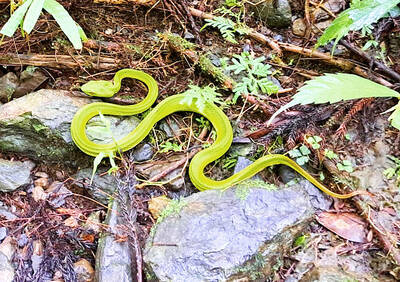
More than half of the bamboo vipers captured in Tainan in the past few years were found in the city’s Sinhua District (新化), while other districts had smaller catches or none at all. Every year, Tainan captures about 6,000 snakes which have made their way into people’s homes. Of the six major venomous snakes in Taiwan, the cobra, the many-banded krait, the brown-spotted pit viper and the bamboo viper are the most frequently captured. The high concentration of bamboo vipers captured in Sinhua District is puzzling. Tainan Agriculture Bureau Forestry and Nature Conservation Division head Chu Chien-ming (朱健明) earlier this week said that the
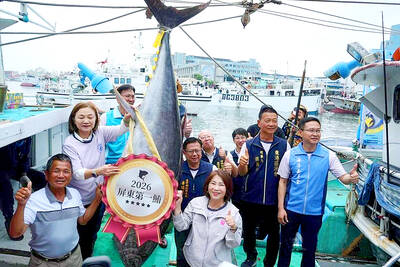
The first bluefin tuna of the season, brought to shore in Pingtung County and weighing 190kg, was yesterday auctioned for NT$10,600 (US$333.5) per kilogram, setting a record high for the local market. The auction was held at the fish market in Donggang Fishing Harbor, where the Siaoliouciou Island-registered fishing vessel Fu Yu Ching No. 2 delivered the “Pingtung First Tuna” it had caught for bidding. Bidding was intense, and the tuna was ultimately jointly purchased by a local restaurant and a local company for NT$10,600 per kilogram — NT$300 ,more than last year — for a total of NT$2.014 million. The 67-year-old skipper
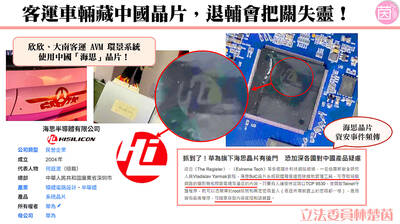
BREACH OF CONTRACT: The bus operators would seek compensation and have demanded that the manufacturer replace the chips with ones that meet regulations Two bus operators found to be using buses with China-made chips are to demand that the original manufacturers replace the systems and provide compensation for breach of contract, the Veterans Affairs Council said yesterday. Democratic Progressive Party Legislator Michelle Lin (林楚茵) yesterday said that Da Nan Bus Co and Shin-Shin Bus Co Ltd have fielded a total of 82 buses that are using Chinese chips. The bus models were made by Tron-E, while the systems provider was CYE Electronics, Lin said. Lin alleged that the buses were using chips manufactured by Huawei subsidiary HiSilicon Co, which presents a national security risk if the


 RSS
RSS