


Pedestrian scramble crossings and widened sidewalks helped reduce pedestrians’ exposure to PM2.5 by up to 94 and carbon monoxide by up to 11 percent, a report of the Ministry of Transportation and Communications’ Institute of Transportation said.
The institute conducted a study on the influence of vehicle exhaust on pedestrians in relation to different traffic environment characteristics at multiple intersections in Taipei, New Taipei City and Kaohsiung.
The study showed that “pedestrian scrambles,” or exclusive pedestrian intervals, significantly reduced pedestrians’ exposure to air pollutants, especially at intersections with a relatively complex traffic environment, the report said.
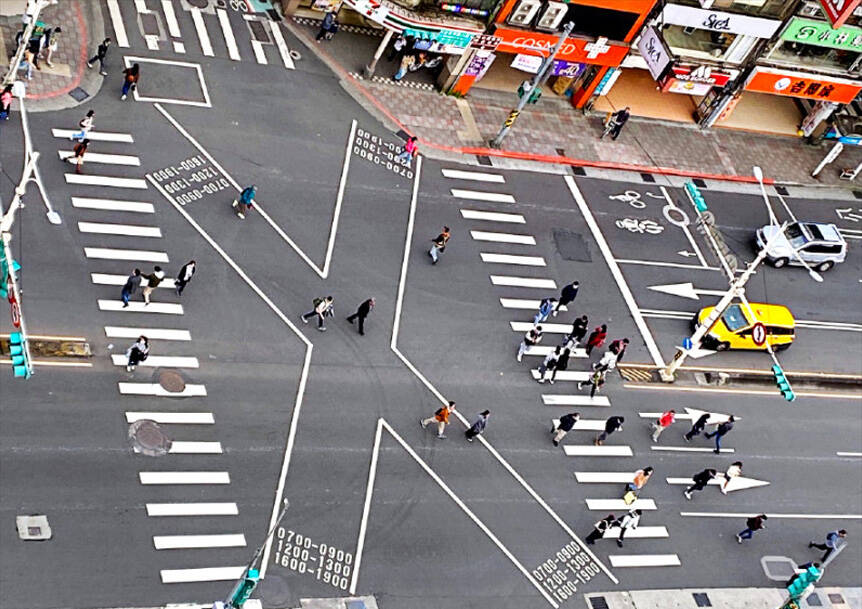
Photo: Wu Liang-yi, Taipei Times
As pedestrian scrambles enable people to cross intersections while keeping their distance from vehicles, their exposure to PM2.5 decreased by 94 percent, it said.
At intersections with more large vehicles, carbon monoxide exposure declined by about 11 percent, it said.
To reduce the likelihood of collisions between pedestrians and vehicles, pedestrian scrambles had been set up at 1,316 intersections nationwide as of the end of last year, covering almost all administrative areas, it said.
Similarly, sidewalks that had been widened by 0.5m could reduce pedestrians’ exposure to PM2.5 by nearly 2 percent and carbon monoxide by about 3 percent, the report said.
Other traffic environment characteristics, such as traffic light timing optimization and crosswalk setbacks, were also found helpful in reducing air pollution exposure, although not as significantly as pedestrian scrambles and sidewalk widening, it said.
Data from the Ministry of Environment showed that transportation made up 16 percent of PM2.5 emissions in Taiwan, less only than construction or road dust and industrial exhaust.
The institute’s Transportation Energy and Environment Division chief Chu Pei-yun (朱珮芸) said the study aimed to aid local government policymaking, with more comprehensive guidelines to be handed to local transportation departments after compilation.
Linkou Chang-Gung Memorial Hospital’s Department of Pediatric Allergy, Asthma and Rheumatology doctor Yeh Kuo-wei (葉國偉) said that although vehicle exhaust has various components, PM2.5 has been foregrounded, as it is most harmful to human health.
PM2.5 is made up of tiny particles that can travel into the lower respiratory tract and be deposited in the lungs, so long-term exposure could cause not only bronchitis and allergies, but also serious lung diseases, he said.
Research shows that PM2.5 and carbon monoxide — the main components of fossil fuel vehicle emissions — tends to aggravate asthma in children and chronic obstructive pulmonary disease, cardiovascular diseases and respiratory syndrome in adults, Yeh said.
Other research over the past few years showed that air pollution is one of the causes of many cancers commonly found in Taiwanese, he added.
Multiple studies looking into the correlation between asthma and the environment ministry’s air quality index found that PM2.5 significantly affected adults and children, Yeh said.
PM2.5 is harmful “particularly for children, as they have diminutive figures, breathe faster, and therefore could easily inhale car exhaust emitted underneath,” he added.
Taipei Medical University’s Department of Respiratory Therapy professor Chuang Hsiao-chi (莊校奇) said that aside from PM2.5, sulfides and nitrogen oxides are also air contaminants harmful to humans.
As for carbon monoxide, its concentration is unlikely to be high enough to cause acute physical injuries, given that intersections are open spaces, he said.
However, residents or shop workers on lower floors must be aware of traffic air pollution’s impact on indoor air quality, Chuang said.
People with respiratory tract diseases or allergies can protect themselves by wearing a mask or keeping their distance from cars or motorbikes while walking outside, he said.
Those who exercise are advised to stay away from places with heavy traffic emissions to avoid breathing in too much exhaust while exercising, Chuang added.
Pedestrian scrambles refer to the time interval when vehicle traffic is stopped by a red light and all pedestrians can cross the intersection simultaneously.
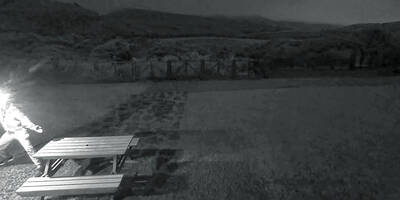
Yangmingshan National Park authorities yesterday urged visitors to respect public spaces and obey the law after a couple was caught on a camera livestream having sex at the park’s Qingtiangang (擎天崗) earlier in the day. The Shilin Police Precinct in Taipei said it has identified a suspect and his vehicle registration number, and would summon him for questioning. The case would be handled in accordance with public indecency charges, it added. The couple entered the park at about 11pm on Thursday and began fooling around by 1am yesterday, the police said, adding that the two were unaware of the park’s all-day live
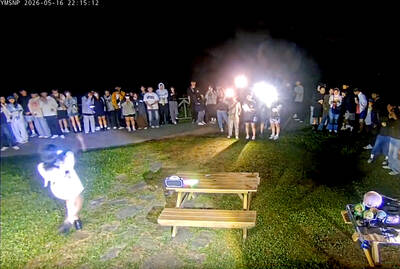
Yangmingshan National Park’s Qingtiangang (擎天崗) nature area has gone viral after a park livestream camera observed a couple in the throes of intimate congress, which was broadcast live on YouTube, drawing large late-night crowds and sparking a backlash over noise, bright lights and disruption to wildlife habitat. The area’s livestream footage appeared to show a couple engaging in sexual activity on a picnic table in the park on Friday last week, with the uncensored footage streamed publicly online. The footage quickly spread across social media, prompting a tide of visitors to travel to the site to “check in” and recreate the
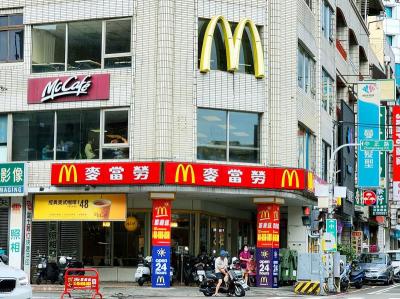
Fast food chain McDonald's is to raise prices by up to NT$5 on some products at its restaurants across Taiwan, starting on Wednesday next week, the company announced today. The prices of all extra value meals and sharing boxes are to increase by NT$5, while breakfast combos and creamy corn soup would go up by NT$3, the company said in a statement. The price of the main items of those meals, if ordered individually, would remain the same. Meanwhile, the price of a medium-sized lemon iced tea and hot cappuccino would rise by NT$3, extra dipping sauces for chicken nuggets would go up

Minister of Digital Affairs Lin Yi-ching (林宜敬) yesterday cited regulatory issues and national security concerns as an expert said that Taiwan is among the few Asian regions without Starlink. Lin made the remarks on Facebook after funP Innovation Group chief executive officer Nathan Chiu (邱繼弘) on Friday said Taiwan and four other countries in Asia — China, North Korea, Afghanistan and Syria — have no access to Starlink. Starlink has become available in 166 countries worldwide, including Ukraine, Malaysia, the Philippines and Vietnam, in the six years since it became commercial, he said. While China and North Korea block Starlink, Syria is not


 RSS
RSS