


Japan, the UK, Canada, Australia and New Zealand have joined the US and EU in expressing concern over China’s two days of military drills around Taiwan that ended late on Wednesday.
Japanese Chief Cabinet Secretary Yoshimasa Hayashi said Tokyo had conveyed its concern to Beijing over the latest Chinese People’s Liberation Army (PLA) exercises around Taiwan.
“We are watching it [the drill] with serious interest,” Hayashi told a news conference in Tokyo on Wednesday as the drills entered their second day. “Peace and stability in the Taiwan Strait are extremely important to the entire international community, including our country.”
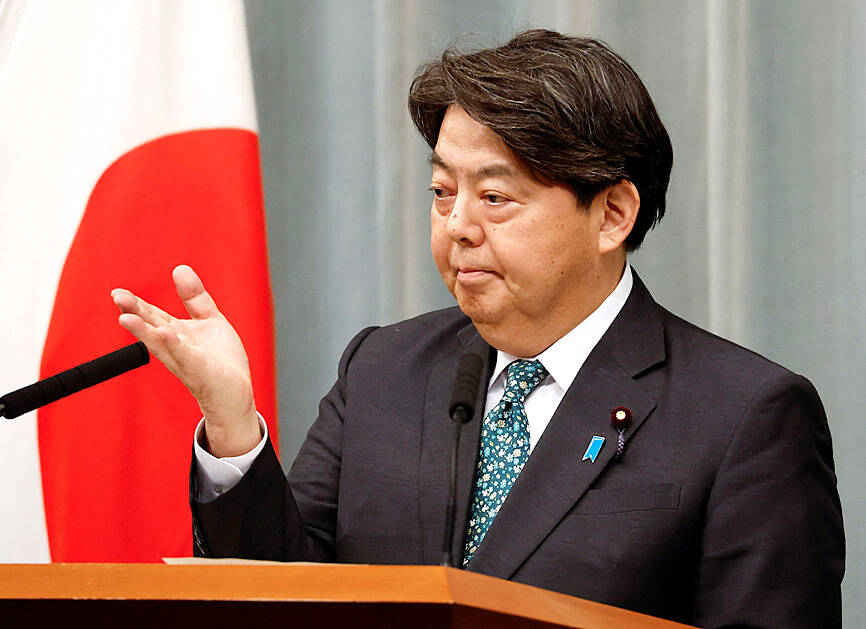
Photo: Reuters
Tokyo would “take all possible measures for vigilance and surveillance activities” in light of China’s increased military activity near Taiwan in the past few years, he said.
Meanwhile, a spokesperson for the UK Foreign, Commonwealth and Development Office expressed the British government’s concern over China’s latest round of military exercises.
The exercises are “part of a pattern of activity which is increasing tensions and risking dangerous escalation in the Taiwan Strait,” the unnamed spokesperson was quoted as saying in a statement issued on Wednesday.
The UK has a “clear interest in peace and stability in the Taiwan Strait, which is of critical importance to global prosperity and our support for a free and open Indo-Pacific,” the spokesperson said.
The UK thinks the Taiwan issue should be settled peacefully by the people on both sides of the Taiwan Strait through constructive dialogue, without the threat or use of force or coercion, they said.
“Military drills or threats to Taiwan are not conducive to such dialogue,” the office said. “We do not support any unilateral attempts to change the status quo.”
Any actions that could undermine peace should be avoided, it added.
In a similar vein, the Canadian Global Affairs Department called for a peaceful resolution of cross-strait differences and condemned China’s drills.
“These threatening actions are increasing tensions and destabilizing the region, impacting global security and prosperity,” the department wrote on Facebook. “Canada calls on China to resolve cross-strait differences by peaceful means.”
Australia in a statement yesterday described China’s military exercises as deeply concerning, disproportionate and destabilizing.
The Australian Department of Foreign Affairs and Trade said it strongly opposes actions that increase the risk of accidents, miscalculations and escalation.
“Differences should be resolved through dialogue, not with the threat or use of force or coercion,” it said.
Australia does not want to see any unilateral change to the “status quo” across the Taiwan Strait, it said, adding that peace and stability across the strait are in Australia’s interests.
Australian officials have raised concerns with Chinese officials, it added.
New Zealand’s government wrote on social media yesterday that it is concerned by the large-scale military exercises around Taiwan.
It called for restraint and the avoidance of actions that might undermine peace and stability.
New Zealand encourages resolution of cross-strait issues through dialogue, it added.
Minister of Foreign Affairs Lin Chia-lung (林佳龍) thanked the governments for supporting peace and stability in the Taiwan Strait.
Facing Chinese intrusion, Taiwan would continue to bolster its self-defense capability and work closely with like-minded allies to safeguard the rules-based world order, Lin said.
He condemned China for unilaterally raising regional tensions and called for the global community to address China’s military threats, legal warfare and “gray zone” tactics employed to coerce Taiwan.
The statements followed similar expressions of concern by the US and the EU on Tuesday, when the PLA’s Eastern Theater Command started its latest exercises in waters around Taiwan.

Yangmingshan National Park authorities yesterday urged visitors to respect public spaces and obey the law after a couple was caught on a camera livestream having sex at the park’s Qingtiangang (擎天崗) earlier in the day. The Shilin Police Precinct in Taipei said it has identified a suspect and his vehicle registration number, and would summon him for questioning. The case would be handled in accordance with public indecency charges, it added. The couple entered the park at about 11pm on Thursday and began fooling around by 1am yesterday, the police said, adding that the two were unaware of the park’s all-day live

Fast food chain McDonald's is to raise prices by up to NT$5 on some products at its restaurants across Taiwan, starting on Wednesday next week, the company announced today. The prices of all extra value meals and sharing boxes are to increase by NT$5, while breakfast combos and creamy corn soup would go up by NT$3, the company said in a statement. The price of the main items of those meals, if ordered individually, would remain the same. Meanwhile, the price of a medium-sized lemon iced tea and hot cappuccino would rise by NT$3, extra dipping sauces for chicken nuggets would go up

Yangmingshan National Park’s Qingtiangang (擎天崗) nature area has gone viral after a park livestream camera observed a couple in the throes of intimate congress, which was broadcast live on YouTube, drawing large late-night crowds and sparking a backlash over noise, bright lights and disruption to wildlife habitat. The area’s livestream footage appeared to show a couple engaging in sexual activity on a picnic table in the park on Friday last week, with the uncensored footage streamed publicly online. The footage quickly spread across social media, prompting a tide of visitors to travel to the site to “check in” and recreate the

Minister of Digital Affairs Lin Yi-ching (林宜敬) yesterday cited regulatory issues and national security concerns as an expert said that Taiwan is among the few Asian regions without Starlink. Lin made the remarks on Facebook after funP Innovation Group chief executive officer Nathan Chiu (邱繼弘) on Friday said Taiwan and four other countries in Asia — China, North Korea, Afghanistan and Syria — have no access to Starlink. Starlink has become available in 166 countries worldwide, including Ukraine, Malaysia, the Philippines and Vietnam, in the six years since it became commercial, he said. While China and North Korea block Starlink, Syria is not


 RSS
RSS