


On average, young Taiwanese children need to engage in more physical activity to promote healthy development, according to a government-funded survey released today.
A research team focusing on early childhood development and funded by the National Science and Technology Council released its latest survey at a news conference.
The team, led by professor Chang Chien-ju (張鑑如) of National Taiwan Normal University’s Department of Family and Child Science, has been conducting a long-term study on children aged three to eight, analyzing the development of their physical mobility and motor skills.
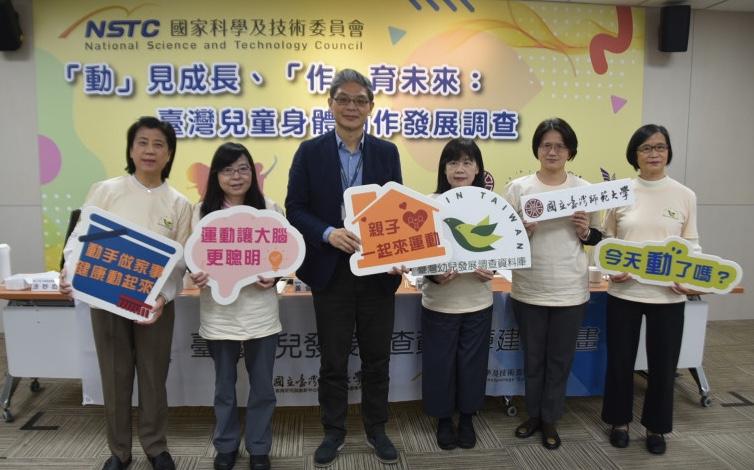
Photo: Wu Po-hsuan, Taipei Times
The WHO and Ministry of Health and Welfare recognize that regular exercise promotes children’s growth, benefiting their muscular and skeletal systems and motor development, Chang said.
Insufficient physical activity can lead to delays in development, affecting motor skills, attention span and even cognitive development, she said.
The team tracked 1,175 children aged three to six and 2,365 children aged seven to eight.
They found that on average, boys were better than girls in terms of gross motor skills, while girls outperformed boys in fine motor skills, Chang said.
While children have physical education (PE) classes after entering elementary school at ages seven to eight, they amount to only 80 minutes per week, Chang said.
The survey found that 20 percent of children aged seven to eight do not exercise regularly, she said.
In addition, less than 20 percent of children meet the standard seven hours of weekly exercise recommended by the WHO, compared with 42 percent in the US, she said.
Only about 30 percent of children participate in moderate to high-intensity exercise, such as swimming, basketball or running, compared with 63 percent in Japan, she added.
In addition to regular exercise, doing household chores can help children with their physical development, Chang said.
Mopping the floor or taking out the trash can help with gross motor skills, while wiping the table or folding clothes can help with fine motor skills, she said.
Frequently taking children to the park, visiting markets or doing puzzles can also help with their development, she added.
If parents exercise, children usually follow suit, Chang said.
Chang stressed the importance of gender-equal development and providing diverse learning environments.
Schools can increase the time of PE classes and encourage students to participate in clubs and after-school activities, she said.
Chang advised the government to raise awareness of children’s physical development and provide more training for teachers and parents.
The government could also introduce vouchers for family sporting activities and expand urban parks and green spaces to promote children’s healthy development, she added.

Alain Robert, known as the "French Spider-Man," praised Alex Honnold as exceptionally well-prepared after the US climber completed a free solo ascent of Taipei 101 yesterday. Robert said Honnold's ascent of the 508m-tall skyscraper in just more than one-and-a-half hours without using safety ropes or equipment was a remarkable achievement. "This is my life," he said in an interview conducted in French, adding that he liked the feeling of being "on the edge of danger." The 63-year-old Frenchman climbed Taipei 101 using ropes in December 2004, taking about four hours to reach the top. On a one-to-10 scale of difficulty, Robert said Taipei 101

Nipah virus infection is to be officially listed as a category 5 notifiable infectious disease in Taiwan in March, while clinical treatment guidelines are being formulated, the Centers for Disease Control (CDC) said yesterday. With Nipah infections being reported in other countries and considering its relatively high fatality rate, the centers on Jan. 16 announced that it would be listed as a notifiable infectious disease to bolster the nation’s systematic early warning system and increase public awareness, the CDC said. Bangladesh reported four fatal cases last year in separate districts, with three linked to raw date palm sap consumption, CDC Epidemic Intelligence

Taiwanese and US defense groups are collaborating to introduce deployable, semi-autonomous manufacturing systems for drones and components in a boost to the nation’s supply chain resilience. Taiwan’s G-Tech Optroelectronics Corp subsidiary GTOC and the US’ Aerkomm Inc on Friday announced an agreement with fellow US-based Firestorm Lab to adopt the latter’s xCell, a technology featuring 3D printers fitted in 6.1m container units. The systems enable aerial platforms and parts to be produced in high volumes from dispersed nodes capable of rapid redeployment, to minimize the risk of enemy strikes and to meet field requirements, they said. Firestorm chief technology officer Ian Muceus said

MORE FALL: An investigation into one of Xi’s key cronies, part of a broader ‘anti-corruption’ drive, indicates that he might have a deep distrust in the military, an expert said China’s latest military purge underscores systemic risks in its shift from collective leadership to sole rule under Chinese President Xi Jinping (習近平), and could disrupt its chain of command and military capabilities, a national security official said yesterday. If decisionmaking within the Chinese Communist Party has become “irrational” under one-man rule, the Taiwan Strait and the regional situation must be approached with extreme caution, given unforeseen risks, they added. The anonymous official made the remarks as China’s Central Military Commission Vice Chairman Zhang Youxia (張又俠) and Joint Staff Department Chief of Staff Liu Zhenli (劉振立) were reportedly being investigated for suspected “serious


 RSS
RSS